Umair Zobia, Kumar Santosh, Rafiq Khezina, Kumar Vijay, Reman Zia Ur, Lee Seung-Hwan, Kim SungChan, Lee Jae-Yong, Lee Unjoo, Kim Jaebong
Department of Biochemistry, Institute of Cell Differentiation and Aging, College of Medicine, Hallym University, Chuncheon, Gangwon-Do, Republic of Korea.
Department of Electrical Engineering, Hallym University, Chuncheon, Gangwon-Do, Republic of Korea.
Anim Cells Syst (Seoul). 2020 Nov 27;24(6):359-370. doi: 10.1080/19768354.2020.1847732.
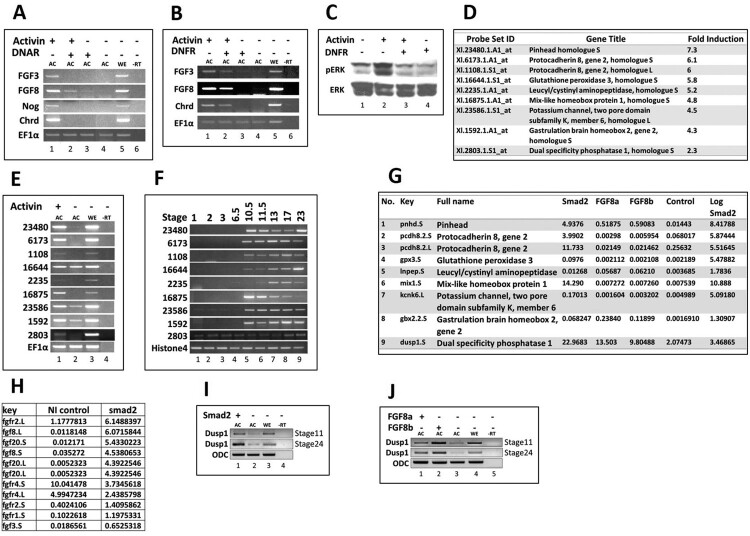
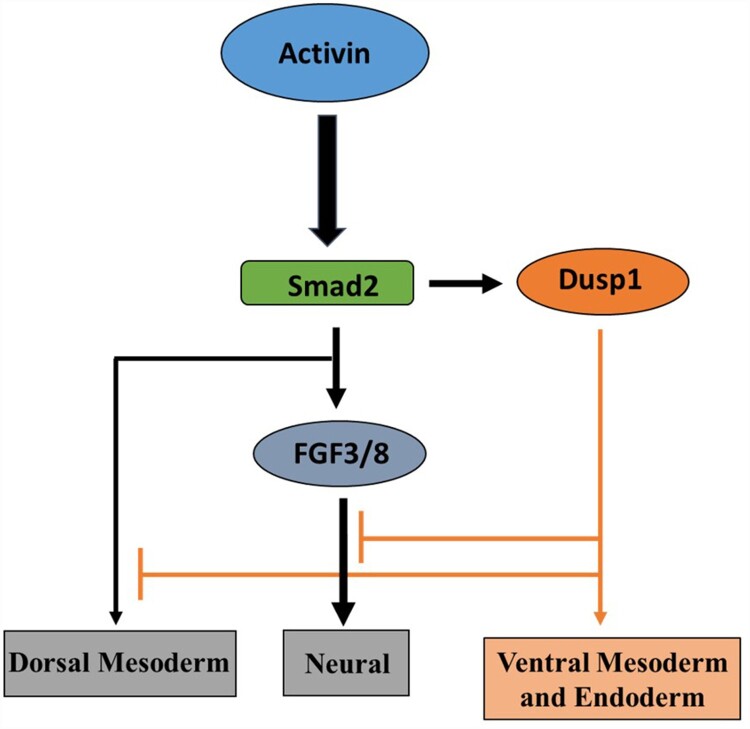
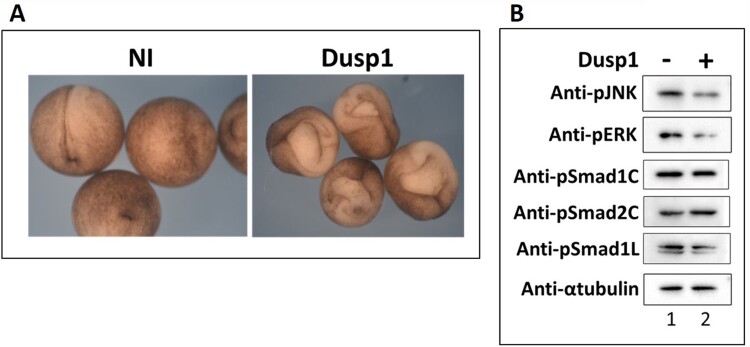
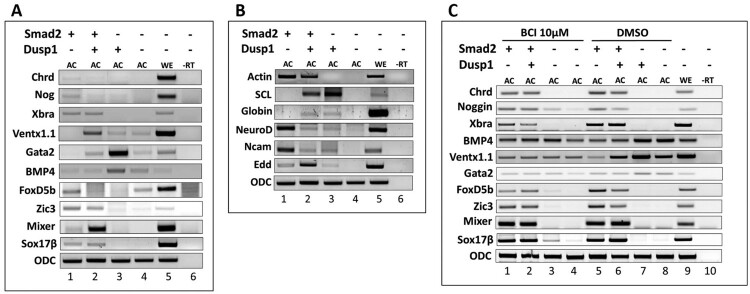
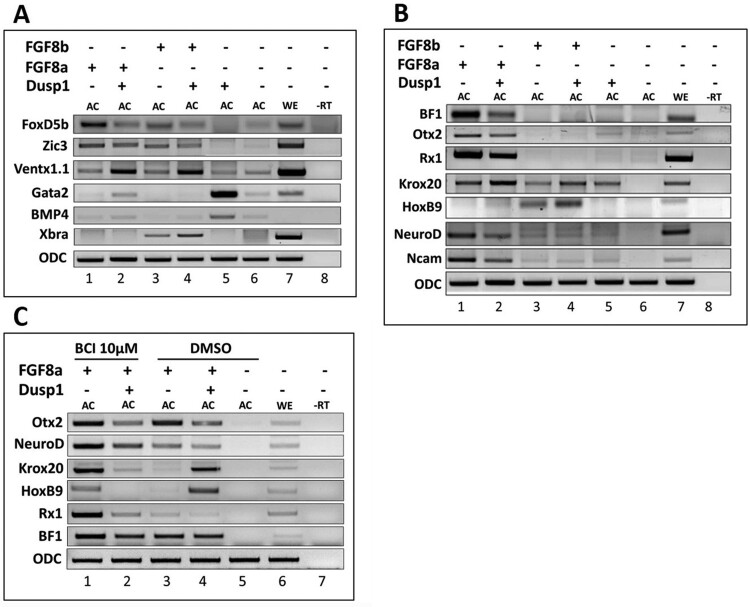
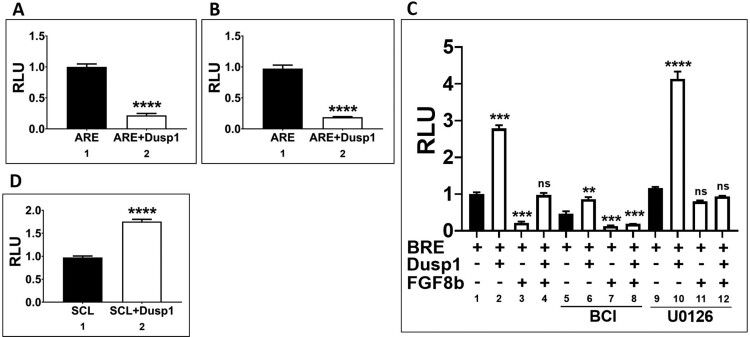
Activin, a member of the transforming growth factor (TGF-β) superfamily, induces mesoderm, endoderm and neuro-ectoderm formation in embryos. Despite several previous studies, the complicated gene regulatory network and genes involved in this induction await more elaboration. We identified expression of various fibroblast growth factor (FGF) genes in activin/ treated animal cap explants (AC) of embryos. Activin/ increased / expression, which was reduced by co-injection of dominant negative activin receptor (DNAR) and dominant negative Fgf receptor (DNFR). Interestingly, activin/ also increased expression of () which has been known to inhibit Fgf signaling. overexpression in dorsal marginal zone caused gastrulation defect and decreased Jnk/Erk phosphorylation as well as Smad1 linker region phosphorylation. decreased neural and organizer gene expression with increasing of endodermal and ventral gene expression in treated AC, indicating that modulates germ layer specification. decreased neural gene expression in treated AC, suggesting that Erk and/or Jnk phosphorylation may be involved in induced neural induction. In addition, decreased the reporter gene activities of activin response element (ARE) and increased it for bmp response element (BRE), indicating that modulates two opposite morphogen signaling of dorsal (activin/Smad2) and ventral (bmp/Smad1) tracks, acting to fine tune the Fgf/Erk pathway.
激活素是转化生长因子(TGF-β)超家族的成员之一,可诱导胚胎中胚层、内胚层和神经外胚层的形成。尽管之前有多项研究,但参与这种诱导的复杂基因调控网络和基因仍有待进一步阐述。我们在激活素处理的胚胎动物帽外植体(AC)中鉴定了各种成纤维细胞生长因子(FGF)基因的表达。激活素增加了基因表达,而共注射显性负性激活素受体(DNAR)和显性负性Fgf受体(DNFR)可降低这种表达。有趣的是,激活素还增加了已知可抑制Fgf信号传导的基因的表达。该基因在背侧边缘区的过表达导致原肠胚形成缺陷,并降低了Jnk/Erk磷酸化以及Smad1连接区磷酸化。在激活素处理的AC中,该基因随着内胚层和腹侧基因表达的增加而降低神经和组织者基因表达,表明该基因调节胚层特化。在激活素处理的AC中该基因降低神经基因表达,提示Erk和/或Jnk磷酸化可能参与激活素诱导的神经诱导。此外,该基因降低了激活素反应元件(ARE)的报告基因活性,并增加了骨形态发生蛋白反应元件(BRE)的报告基因活性,表明该基因调节背侧(激活素/Smad2)和腹侧(骨形态发生蛋白/Smad1)两条相反形态发生素信号通路,作用是微调Fgf/Erk途径。