
使用同一组预定义治疗计划审核放射治疗质量保证的本地方法。
Auditing local methods for quality assurance in radiotherapy using the same set of predefined treatment plans.
作者信息
Seravalli Enrica, Houweling Antonetta C, Van Battum Leo, Raaben Thom A, Kuik Marc, de Pooter Jacco A, Van Gellekom Marion P R, Kaas Jochem, de Vries Wilfred, Loeff Erik A, Van de Kamer Jeroen B
机构信息
Department of Radiation Oncology, University Medical Center Utrecht, Utrecht, The Netherlands.
Department of Radiation Oncology, VU University Medical Center, Amsterdam, The Netherlands.
出版信息
Phys Imaging Radiat Oncol. 2018 Feb 2;5:19-25. doi: 10.1016/j.phro.2018.01.002. eCollection 2018 Jan.
BACKGROUND AND PURPOSE
Local implementation of plan-specific quality assurance (QA) methods for intensity-modulated radiotherapy (IMRT) and volumetric modulated arc therapy (VMAT) treatment plans may vary because of dissimilarities in procedures, equipment and software. The purpose of this work is detecting possible differences between local QA findings and those of an audit, using the same set of treatment plans.
METHODS
A pre-defined set of clinical plans was devised and imported in the participating institute's treatment planning system for dose computation. The dose distribution was measured using an ionisation chamber, radiochromic film and an ionisation chamber array. The centres performed their own QA, which was compared to the audit findings. The agreement/disagreement between the audit and the institute QA results were assessed along with the differences between the dose distributions measured by the audit team and computed by the institute.
RESULTS
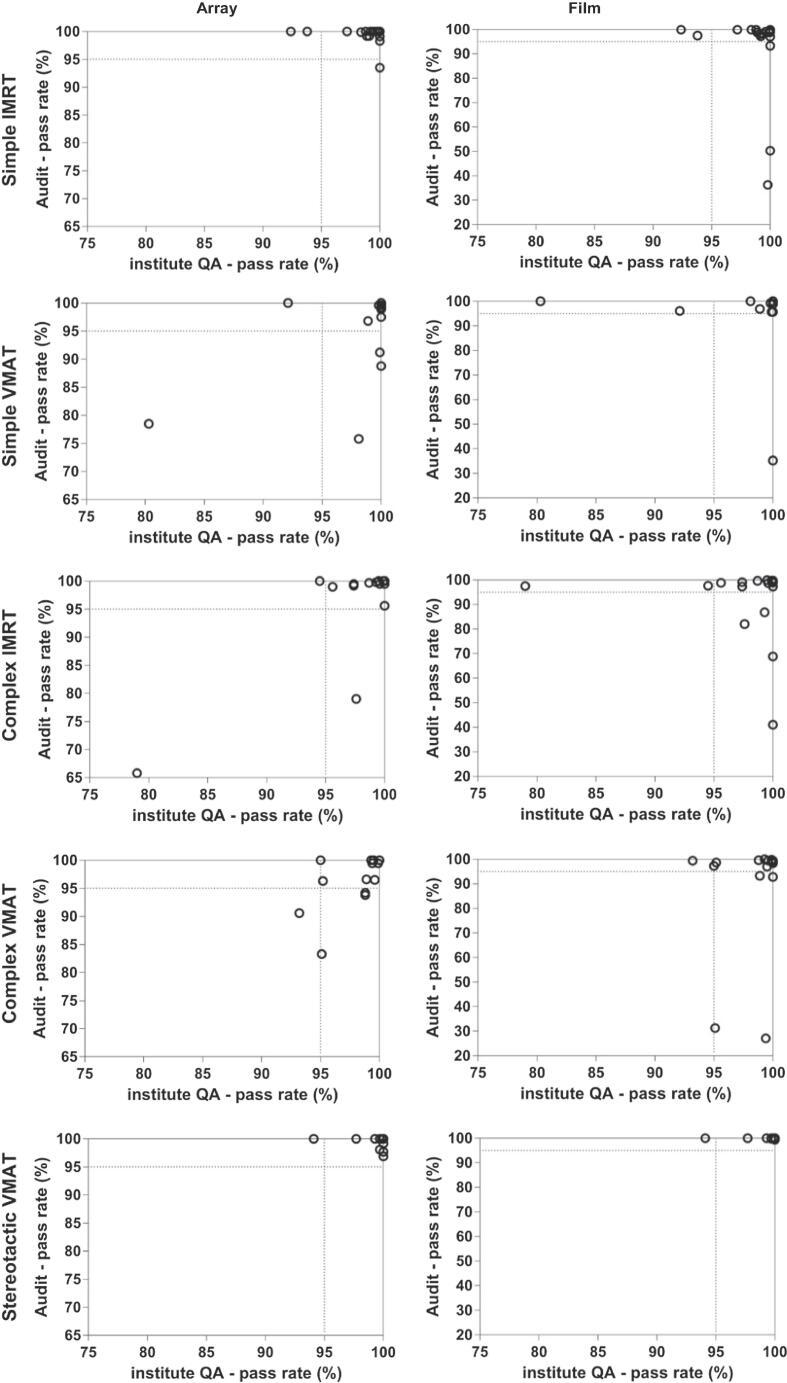
For the majority of the cases the results of the audit were in agreement with the institute QA findings: ionisation chamber: 92%, array: 88%, film: 76% of the total measurements. In only a few of these cases the evaluated measurements failed for both: ionisation chamber: 2%, array: 4%, film: 0% of the total measurements.
CONCLUSION
Using predefined treatment plans, we found that in approximately 80% of the evaluated measurements the results of local QA of IMRT and VMAT plans were in line with the findings of the audit. However, the percentage of agreement/disagreement depended on the characteristics of the measurement equipment used and on the analysis metric.
背景与目的
由于程序、设备和软件的差异,调强放射治疗(IMRT)和容积调强弧形治疗(VMAT)治疗计划的特定计划质量保证(QA)方法在本地的实施可能会有所不同。本研究的目的是使用同一组治疗计划,检测本地QA结果与审核结果之间可能存在的差异。
方法
设计了一组预定义的临床计划,并导入参与机构的治疗计划系统进行剂量计算。使用电离室、放射变色胶片和电离室阵列测量剂量分布。各中心进行自己的QA,并与审核结果进行比较。评估审核结果与机构QA结果之间的一致性/不一致性,以及审核团队测量的剂量分布与机构计算的剂量分布之间的差异。
结果
在大多数情况下,审核结果与机构QA结果一致:电离室:占总测量值的92%,阵列:88%,胶片:76%。在这些情况中,只有少数情况下评估测量对两者均不通过:电离室:占总测量值的2%,阵列:4%,胶片:0%。
结论
使用预定义的治疗计划,我们发现,在大约80%的评估测量中,IMRT和VMAT计划的本地QA结果与审核结果一致。然而,一致/不一致的百分比取决于所使用测量设备的特性和分析指标。

 Zotero 插件