Schrenk Oliver, Spindeldreier Claudia Katharina, Schmitt Daniela, Roeder Falk, Bangert Mark, Burigo Lucas Norberto, Pfaffenberger Asja
Division of Medical Physics in Radiation Oncology, German Cancer Research Center (DKFZ), Heidelberg, Germany.
Heidelberg Institute for Radiation Oncology (HIRO), National Center for Radiation Research in Oncology (NCRO), Heidelberg, Germany.
Phys Imaging Radiat Oncol. 2018 Nov 22;8:23-27. doi: 10.1016/j.phro.2018.11.003. eCollection 2018 Oct.
Inverse treatment planning for lung cancer can be challenging since density heterogeneities may appear inside the planning target volume (PTV). One method to improve the quality of intensity modulation is the override of low density tissues inside the PTV during plan optimization. For magnetic resonance-guided radiation therapy (MRgRT), where the influence of the magnetic field on secondary electrons is sensitive to the tissue density, the reliability of density overrides has not yet been proven. This work, therefore, gains a first insight into density override strategies for MRgRT.
Monte Carlo-based treatment plans for five lung cancer patients were generated based on free-breathing CTs and two density override strategies. Different magnetic field configurations were considered with their effect being accounted for during optimization. Optimized plans were forward calculated to 4D-CTs and accumulated for the comparison of planned and expected delivered dose.
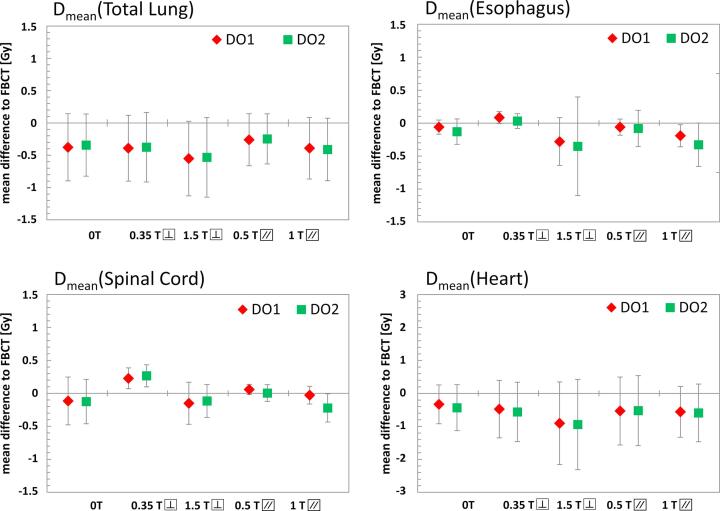
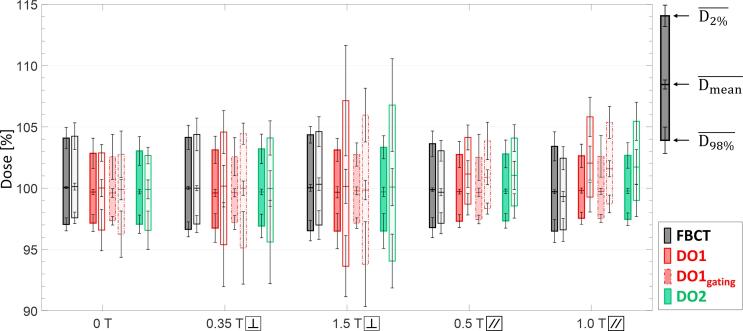
For MRgRT, density overrides led to a discrepancy between the delivered and planned dose. The tumor volume coverage deteriorated for perpendicular magnetic fields of 1.5 T to 93.6% (D). For inline fields a maximal increase of 2.2% was found for the mean dose. In terms of organs at risk, a maximal sparing of 0.6 Gy and 0.9 Gy was observed for lung and heart, respectively.
In this work, first results on the effect of density overrides on treatment planning for MRgRT are presented. It was observed that the underestimation of magnetic field effects in overridden densities during treatment planning resulted in an altered delivered dose, depending on the field strength and orientation.
肺癌的逆向治疗计划颇具挑战性,因为在计划靶区(PTV)内可能会出现密度不均匀性。提高调强质量的一种方法是在计划优化过程中忽略PTV内的低密度组织。对于磁共振引导放射治疗(MRgRT),磁场对次级电子的影响对组织密度敏感,密度忽略的可靠性尚未得到证实。因此,本研究首次深入探讨了MRgRT的密度忽略策略。
基于自由呼吸CT和两种密度忽略策略,为五名肺癌患者生成了基于蒙特卡洛的治疗计划。考虑了不同的磁场配置,并在优化过程中考虑了其影响。将优化后的计划向前计算到4D-CT,并进行累积,以比较计划剂量和预期交付剂量。
对于MRgRT,密度忽略导致交付剂量与计划剂量之间存在差异。对于1.5 T的垂直磁场,肿瘤体积覆盖率降至93.6%(D)。对于同向磁场,平均剂量最大增加2.2%。在危及器官方面,肺和心脏的最大 sparing 分别为0.6 Gy和0.9 Gy。
在本研究中,首次展示了密度忽略对MRgRT治疗计划影响的结果。据观察,治疗计划期间对忽略密度中磁场效应的低估导致交付剂量发生变化,这取决于场强和方向。