Yoshimura Naoto, Morimoto Koichi, Murai Mariko, Kihara Yusaku, Marmolejo-Ramos Fernando, Kubik Veit, Yamada Yuki
Graduate School of Human-Environment Studies, Kyushu University, 744 Motooka, Nishi ku, Fukuoka, 819-0395 Japan.
Japan Society for the Promotion of Science, Tokyo, Japan.
J Cult Cogn Sci. 2021;5(1):1-15. doi: 10.1007/s41809-020-00072-3. Epub 2021 Jan 10.
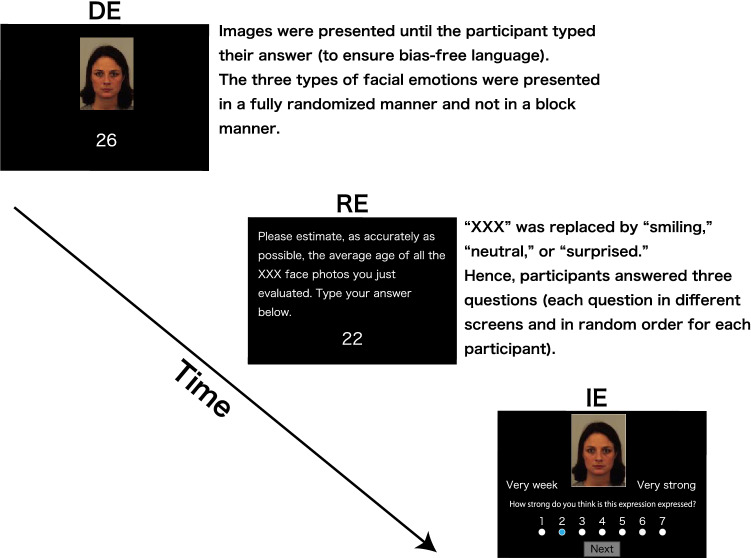
Smiling is believed to make people look younger. Ganel and Goodale (Psychon Bull Rev 25(6):612-616, 10.3758/s13423-017-1306-8, 2018) proposed that this belief is a misconception rooted in popular media, based on their findings that people actually perceive smiling faces as older. However, they did not clarify whether this misconception can be generalized across cultures. We tested the cross-cultural validity of Ganel and Goodale's findings by collecting data from Japanese and Swedish participants. Specifically, we aimed to replicate Ganel and Goodale's study using segregated sets of Japanese and Swedish facial stimuli, and including Japanese and Swedish participants in groups asked to estimate the age of either Japanese or Swedish faces (two groups of participants × two groups of stimuli; four groups total). Our multiverse analytical approach consistently showed that the participants evaluated smiling faces as older in direct evaluations, regardless of the facial stimuli culture or their nationality, although they believed that smiling makes people look younger. Further, we hypothesized that the effect of wrinkles around the eyes on the estimation of age would vary with the stimulus culture, based on previous studies. However, we found no differences in age estimates by stimulus culture in the present study. Our results showed that we successfully replicated Ganel and Goodale (2018) in a cross-cultural context. Our study thus clarified that the belief that smiling makes people look younger is a common cultural misconception.
人们认为微笑会让人看起来更年轻。加内尔和古德尔(《心理通报与评论》25(6):612 - 616,10.3758/s13423 - 017 - 1306 - 8,2018年)基于他们的研究结果提出,这种观点是一种源于大众媒体的误解,他们的研究发现人们实际上会觉得笑脸看起来更老。然而,他们没有阐明这种误解是否能在不同文化中普遍存在。我们通过收集日本和瑞典参与者的数据来测试加内尔和古德尔研究结果的跨文化有效性。具体来说,我们旨在使用分开的日本和瑞典面部刺激集来重复加内尔和古德尔的研究,并让日本和瑞典参与者分组估计日本或瑞典面孔的年龄(两组参与者×两组刺激;共四组)。我们的多宇宙分析方法始终表明,尽管参与者认为微笑会让人看起来更年轻,但在直接评估中,无论面部刺激的文化背景或他们的国籍如何,他们都将笑脸评估为更老。此外,基于之前的研究,我们假设眼睛周围皱纹对年龄估计的影响会因刺激文化的不同而有所变化。然而,在本研究中,我们没有发现不同刺激文化在年龄估计上存在差异。我们的结果表明,我们在跨文化背景下成功重复了加内尔和古德尔(2018年)的研究。因此,我们的研究阐明了微笑会让人看起来更年轻这一观点是一种常见的文化误解。