Neurology Resident at king Fahad General, Hospital Ministry of Health Jeddah, Saudi Arabia. E-mail:
Neurosciences (Riyadh). 2020 Oct;25(5):362-368. doi: 10.17712/nsj.2020.5.20200088.
To determine the prevalence and pattern of complementary and alternative medicine (CAM) use and the CAM types used by stroke patients in Jeddah, Kingdom of Saudi Arabia.
This cross-sectional study included 152 ischemic stroke survivors who visited King Fahad Hospital, Jeddah, Kingdom of Saudi Arabia, between January 2018 and December 2019. Phone-based and face-to-face surveys were conducted. Data on the patients` demographic characteristics, their use of CAM, and their pattern of CAM use were gathered.
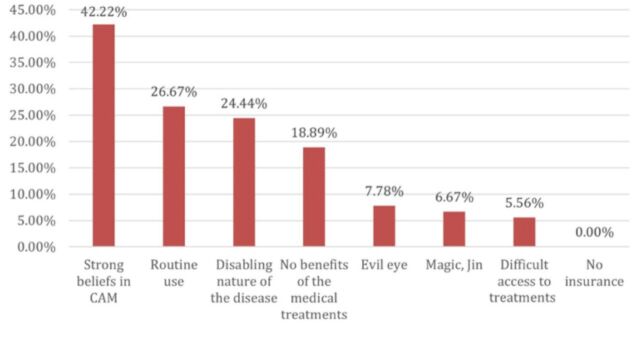
Ninety (59.2%) stroke patients used CAM, mainly cauterization (29.61%) and Quran recitation by a religious sheik (28.95%). Most of the patients (72.22%) used CAM post-hospitalization and within less than one month from stroke onset (62.22%). A minority (6.67%) of the patients stopped their medication while on CAM. Some patients (25.56% to 31.11%) discussed with their physician their use of CAM. The CAM users reported a subjective improvement in their physical weakness (45.6%) and psychological wellbeing (62.2%). The patients learned about CAM mainly from their relatives and friends (96.7%), and the most common reason for their CAM use was their belief in this intervention (42.22%).
The CAM use was prevalent among our cohort of Saudi ischemic stroke patients, and cauterization and Quran recitation were the most commonly used CAM interventions. An effective communication was lacking between the medical professionals and the stroke patients as regards CAM use despite the interest of the patients in this intervention.
确定沙特阿拉伯吉达市中风患者使用补充和替代医学(CAM)的流行率和模式,以及他们使用的 CAM 类型。
本横断面研究纳入了 2018 年 1 月至 2019 年 12 月期间在沙特阿拉伯吉达国王法赫德医院就诊的 152 例缺血性中风幸存者。采用电话和面对面的方式进行调查。收集患者的人口统计学特征、CAM 使用情况及其使用模式的数据。
90 名(59.2%)中风患者使用了 CAM,主要是烧灼(29.61%)和宗教谢赫诵读古兰经(28.95%)。大多数患者(72.22%)在出院后和中风发作后不到一个月(62.22%)使用 CAM。少数患者(6.67%)在使用 CAM 时停止了药物治疗。一些患者(25.56%至 31.11%)与医生讨论了他们使用 CAM 的情况。CAM 用户报告他们的身体虚弱(45.6%)和心理幸福感(62.2%)有主观改善。患者主要从亲戚和朋友那里了解到 CAM(96.7%),他们使用 CAM 的最常见原因是他们相信这种干预(42.22%)。
在我们的沙特缺血性中风患者队列中,CAM 的使用很普遍,烧灼和古兰经诵读是最常用的 CAM 干预措施。尽管患者对这种干预措施感兴趣,但医疗专业人员和中风患者之间缺乏有效的沟通。