Department of Prevention of Diabetes and Lifestyle-Related Diseases, Graduate School of Medicine, The University of Tokyo, Tokyo, Japan.
Department of Eat-loss Medicine, Graduate School of Medicine, The University of Tokyo, Tokyo, Japan.
J Diabetes Investig. 2021 Sep;12(9):1619-1631. doi: 10.1111/jdi.13510. Epub 2021 Feb 28.
AIMS/INTRODUCTION: Discontinuation of diabetes care has been studied mostly in patients with prevalent diabetes and not in patients with newly diagnosed diabetes, whose dropout risk is highest. Because enrolling patients in a prospective study will influence adherence, we retrospectively examined whether guideline-recommended practices, defined as nutritional guidance or ophthalmological examination, can prevent patient discontinuation of diabetes care after its initiation.
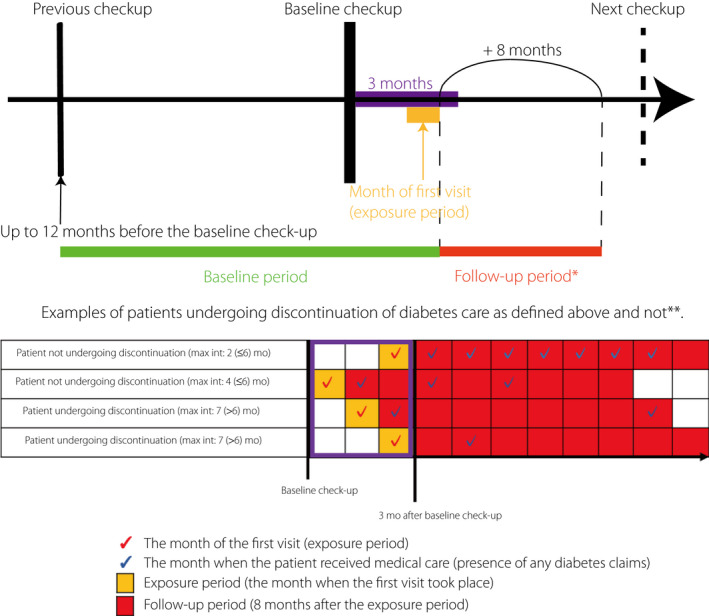
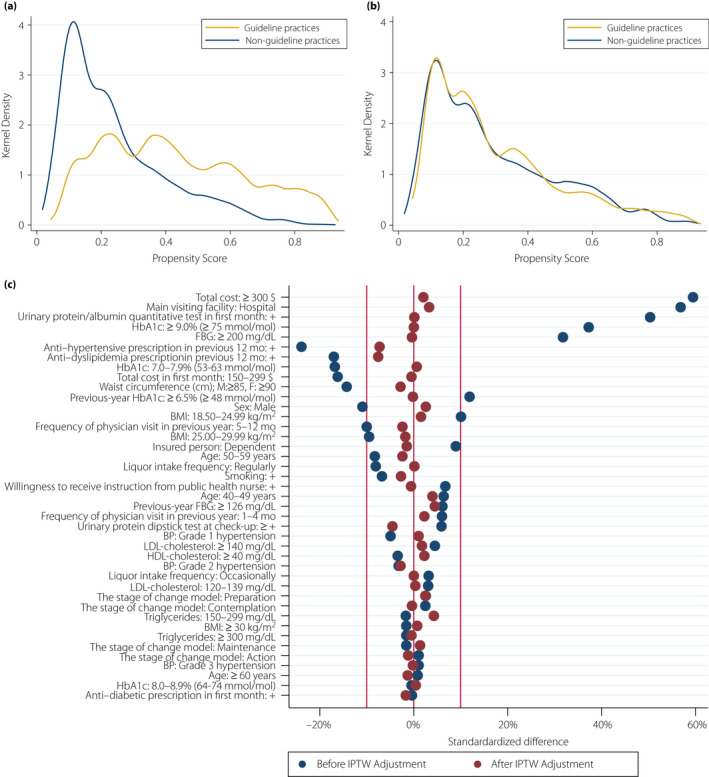
We retrospectively identified adults with newly screened diabetes during checkups using a large Japanese administrative claims database (JMDC, Tokyo, Japan) that contains laboratory data and lifestyle questionnaires. We defined discontinuation of physician visits as a follow-up interval exceeding 6 months. We divided the patients into those who received guideline-recommended practices (nutritional guidance or ophthalmology consultation) within the same month as the first visit and those who did not. We calculated propensity scores and carried out inverse probability of treatment weighting analyses to compare discontinuation between the two groups.
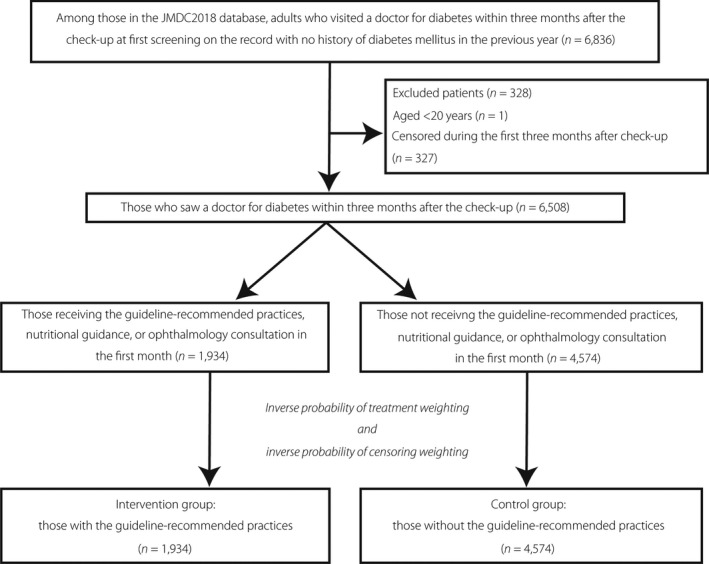
We identified 6,508 patients with at least one physician consultation for diabetes care within 3 months after their checkup, including 4,574 patients without and 1,934 with guideline-recommended practices. After inverse probability of treatment weighting, patients with guideline-recommended practices had a significantly lower proportion of discontinuation than those without (17.2% vs 21.8%; relative risk 0.79, 95% confidence interval 0.69-0.91).
This study is the first to show that after adjustment for both patient and healthcare provider factors, guideline-recommended practices within the first month of physician consultation for diabetes care can decrease subsequent discontinuation of physician visits in patients with newly diagnosed diabetes.
目的/引言:糖尿病管理的中断主要在已确诊的糖尿病患者中进行了研究,而不是在新诊断的糖尿病患者中进行,因为后者的退出风险最高。由于将患者纳入前瞻性研究将影响依从性,我们回顾性地检查了指南推荐的实践(定义为营养指导或眼科检查)是否可以预防新诊断的糖尿病患者在开始治疗后退出糖尿病管理。
我们使用日本大型行政索赔数据库(JMDC,东京,日本)回顾性地确定了在体检期间新筛查出的成年糖尿病患者,该数据库包含实验室数据和生活方式问卷。我们将医生就诊的中断定义为随访间隔超过 6 个月。我们将患者分为在首次就诊的同月接受指南推荐实践(营养指导或眼科咨询)的患者和未接受指南推荐实践的患者。我们计算了倾向评分,并进行了逆概率治疗加权分析,以比较两组之间的停药情况。
我们确定了 6508 例在体检后 3 个月内至少有一次糖尿病护理就诊的患者,其中 4574 例没有,1934 例有指南推荐的实践。在进行逆概率治疗加权后,接受指南推荐实践的患者停药比例明显低于未接受的患者(17.2%比 21.8%;相对风险 0.79,95%置信区间 0.69-0.91)。
这项研究首次表明,在调整患者和医疗服务提供者因素后,在首次就诊后一个月内进行糖尿病管理的指南推荐实践可以降低新诊断的糖尿病患者随后医生就诊的中断率。