CHU de Lyon, Centre Mémoire Ressource et Recherche (CMRR), Departement de Neurologie cognitive et Service de Neuropsychologie, Université Lyon 1, and Hospices civils de Lyon, Hôpital Neurologique Pierre Wertheimer, Bron, France.
CHU de Dijon, Centre Mémoire Ressource et Recherche (CMRR), CHU de Dijon, Dijon, France.
J Alzheimers Dis. 2021;79(4):1735-1745. doi: 10.3233/JAD-201088.
The frontal variant of Alzheimer's disease (fAD) is poorly understood and poorly defined. The diagnosis remains challenging. The main differential diagnosis is the behavioral variant of frontotemporal degeneration (bvFTD). For fAD, there is some dissociation between the clinical frontal presentation and imaging and neuropathological studies, which do not always find a specific involvement of the frontal lobes. DAPHNE is a behavioral scale, which demonstrated excellent performance to distinguish between bvFTD and AD.
The aim of the present study was to assess the reliability of this new tool to improve the clinical diagnosis of fAD.
Twenty fAD patients and their caregivers were prospectively included and were compared with 36 bvFTD and 22 AD patients.
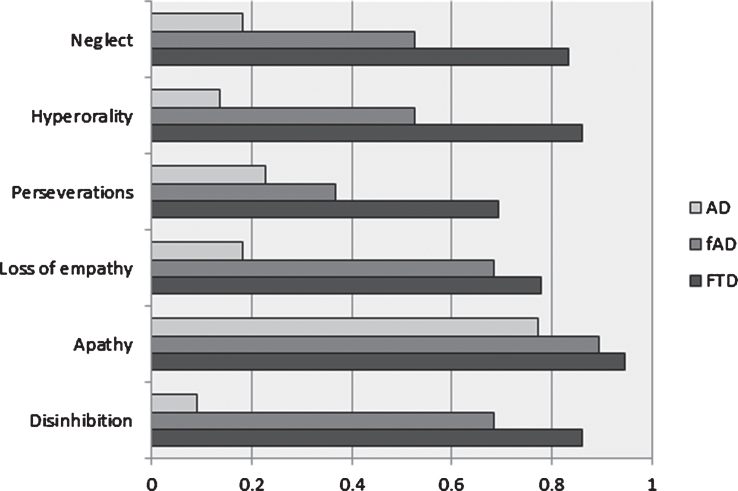
The three main behavioral disorders in the fAD patients were apathy, loss of empathy, and disinhibition. Three disorders were discriminant because they were less frequent and less severe in the fAD patients than in the bvFTD patients, namely hyperorality, neglect, and perseverations. This specific pattern of behavioral disorders was corroborated by SPECT or 18FDG PET-CT scan that showed that patients with fAD could have a medial frontal hypoperfusion, whereas in bvFTD patients the orbitofrontal cortex was the main involved region, with more diffuse hypoperfusion.
We demonstrated that DAPHNE had good sensitivity and good specificity to discriminate between the three groups and in particular between fAD and bvFTD patients. DAPHNE is a quick tool that could help clinicians in memory clinics not only to differentiate bvFTD from typical AD but also from fAD.
额颞叶痴呆(fAD)的额侧变体理解不足且定义欠佳。诊断仍具挑战性。主要鉴别诊断为额颞叶变性的行为变异型(bvFTD)。对于 fAD,临床额侧表现与影像学和神经病理学研究之间存在一定程度的分离,并不总能发现额叶特定区域的受累。DAPHNE 是一种行为量表,它在区分 bvFTD 和 AD 方面表现出了出色的性能。
本研究旨在评估该新工具的可靠性,以改善 fAD 的临床诊断。
前瞻性纳入 20 名 fAD 患者及其照护者,并与 36 名 bvFTD 患者和 22 名 AD 患者进行比较。
fAD 患者的三种主要行为障碍为冷漠、同理心丧失和抑制障碍。三种障碍存在差异,因为它们在 fAD 患者中比 bvFTD 患者中出现的频率较低且程度较轻,即口欲亢进、忽视和持续。这些特定行为障碍模式得到 SPECT 或 18FDG PET-CT 扫描的证实,表明 fAD 患者可能存在内侧额叶灌注不足,而 bvFTD 患者则以眶额皮层为主要受累区域,存在更广泛的灌注不足。
我们证明 DAPHNE 具有良好的敏感性和特异性,可以区分这三组,特别是区分 fAD 和 bvFTD 患者。DAPHNE 是一种快速工具,可帮助记忆门诊的临床医生不仅区分 bvFTD 与典型 AD,还可区分 fAD。