Department of Orthopedic Surgery, Xpert Clinics/SCORE (Specialized Center of Orthopedic Research and Education), Laarderhoogtweg 12, 1101EA, Amsterdam, The Netherlands.
Department of Orthopaedic Surgery, Amsterdam University Medical Centers, location Academic Medical Center, Meibergdreef 15, 1105, AZ, Amsterdam, The Netherlands.
Int Orthop. 2021 Jun;45(6):1447-1454. doi: 10.1007/s00264-020-04895-1. Epub 2021 Jan 18.
In press-fit total hip arthroplasty (THA), primary stability is needed to avoid micromotion and hereby aseptic loosening, the main reason for early revision. High aseptic loosening revision rates of the seleXys TH+ cup (Mathys Medical) with Ceramys ceramic-on-ceramic (CoC) bearing are seen in literature. Since CoC is presumed to overcome long-term wear-related revisions, the reason for early failure of this cup is important to clarify. The aim is to investigate its ten year outcomes and differentiate between potential causes and identify risk factors for aseptic loosening.
Retrospective screening of a prospectively documented series of 315 THAs was performed. Primary outcome was cumulative incidence of cup revision due to aseptic loosening. Secondary outcomes were component revision and reoperation. Additionally, potential predictive factors for aseptic loosening were evaluated.
At the median follow-up of 9.7 years [IQR 4.4; 10.3], 48 TH+ (15.2%) were revised due to aseptic loosening. Competing risk analysis showed a ten year cumulative incidence of cup revision due to aseptic loosening of 15.6% (95% CI 12.0-20.2). Stabilization of early revision rates was observed, following a high rate of respectively 81.3% (n = 39) and 95.8% (n = 46) within the first two and three years. No significant predictive factors for aseptic loosening were found.
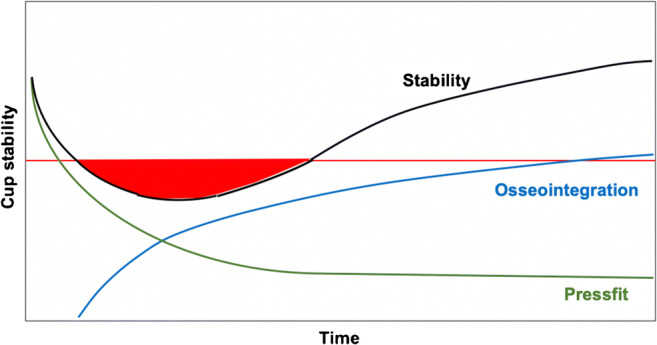
The ten year results of seleXys TH+ cup with Ceramys CoC bearing showed an unacceptable high aseptic loosening rate, which stabilized over time after a high early failure incidence. This could be attributed to a problem with osseointegration during the transition of primary to definitive stability.
在压配式全髋关节置换术(THA)中,需要初始稳定性以避免微动,从而避免无菌性松动,这是早期翻修的主要原因。在文献中,SeleXys TH+ 杯(Mathys Medical)与 Ceramys 陶瓷对陶瓷(CoC)轴承的高无菌性松动翻修率。由于 CoC 被认为可以克服与长期磨损相关的翻修,因此明确这种杯子早期失效的原因很重要。目的是调查其十年结果,并区分潜在原因,确定无菌性松动的危险因素。
对前瞻性记录的 315 例 THA 进行回顾性筛选。主要结果是因无菌性松动而导致的杯子翻修的累积发生率。次要结果是部件翻修和再次手术。此外,还评估了潜在的无菌性松动预测因素。
在中位数随访 9.7 年[IQR 4.4; 10.3]时,有 48 例 TH+(15.2%)因无菌性松动而翻修。竞争风险分析显示,十年累积无菌性松动杯翻修发生率为 15.6%(95%CI 12.0-20.2)。在最初的两年和三年内,分别有 81.3%(n=39)和 95.8%(n=46)的早期翻修率很高,观察到早期翻修率稳定。未发现无菌性松动的显著预测因素。
SeleXys TH+ 杯与 Ceramys CoC 轴承的十年结果显示出不可接受的高无菌性松动率,在早期高失败发生率后,随着时间的推移逐渐稳定。这可能归因于在从初始稳定性到最终稳定性的过渡过程中出现了骨整合问题。