Department of Orthopaedic Surgery, Eulji University Hospital, Eulji University School of Medicine, Daejeon, Korea.
Clin Orthop Surg. 2013 Sep;5(3):174-9. doi: 10.4055/cios.2013.5.3.174. Epub 2013 Aug 20.
This study examines the clinical and radiologic results of ceramic-on-ceramic total hip arthroplasties with regard to wear, osteolysis, and fracture of the ceramic after a minimum follow-up of six years.
We evaluated the results of a consecutive series of 148 primary ceramic-on-ceramic total hip arthroplasties that had been performed between May 2001 and October 2005 in 142 patients. The mean age was 57.2 years (range, 23 to 81 years). The mean follow-up period was 7.8 years (range, 6.1 to 10.1 years). Preoperative diagnosis was avascular necrosis in 77 hips (52%), degenerative arthritis in 36 hips (24.3%), femur neck fracture in 18 hips (12.2%), rheumatoid arthritis in 15 hips (10.1%), and septic hip sequelae in 2 hips (1.4%). Clinical results were evaluated with the Harris hip score, and the presence of postoperative groin or thigh pain. Radiologic analysis was done with special attention in terms of wear, periprosthetic osteolysis, and ceramic failures.
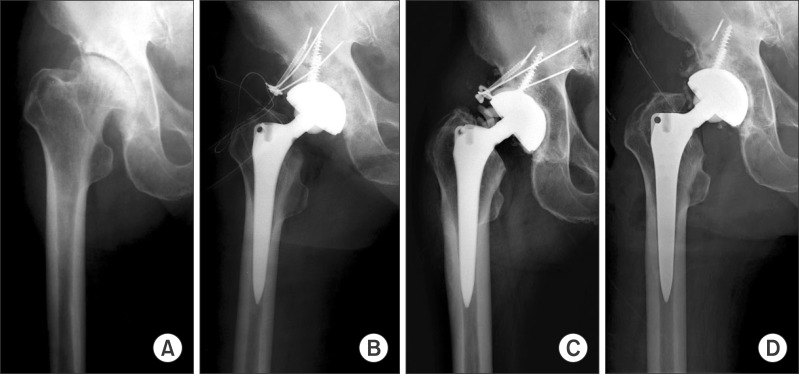
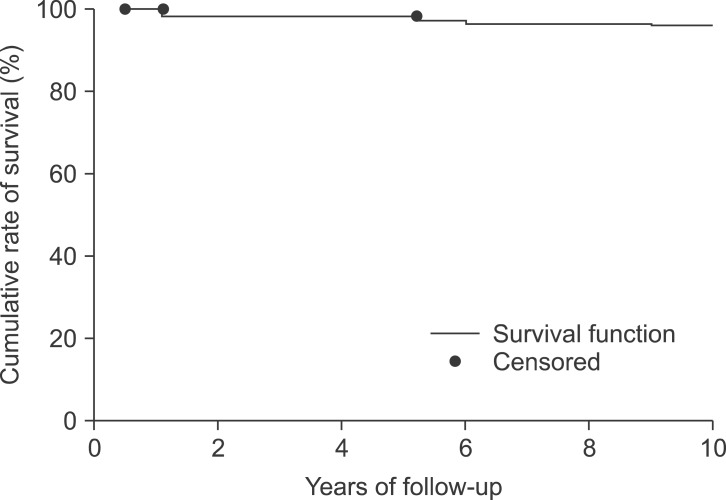
The mean Harris hip score improved from 58.3 (range, 10 to 73) to 92.5 (range, 79 to 100) on the latest follow-up evaluation. At final follow-up, groin pain was found in 4 hips (2.7%), and thigh pain was found in 6 hips (4.1%). Radiologically, all femoral stems demonstrated stable fixations without loosening. Radiolucent lines were observed around the stem in 25 hips (16.9%), and around the cup in 4 hips (2.7%). Endosteal new bone formation was observed around the stem in 95 hips (64.2%) and around the cup in 88 hips (59.5%). No osteolysis was observed around the stem and cup. There were 2 hips (1.4%) of inclination changes of acetabular cup, 2 hips (1.4%) of hip dislocation, 1 hip (0.7%) of ceramic head fracture, and 1 hip (0.7%) of squeaking. The Kaplan-Meier survival rate of the prostheses was 98.1% at postoperative 7.8 years.
The ceramic-on-ceramic total hip arthroplasty produced excellent clinical results and implant survival rates with no detectable osteolysis on a minimum six-year follow-up study. The ceramic-on-ceramic couplings could be a reasonable option of primary total hip arthroplasty for variable indications.
本研究旨在探讨陶瓷-陶瓷全髋关节置换术后 6 年以上的陶瓷磨损、假体周围骨溶解和陶瓷断裂的临床和影像学结果。
我们评估了 2001 年 5 月至 2005 年 10 月期间连续进行的 148 例陶瓷-陶瓷全髋关节置换术的结果,共涉及 142 例患者。患者平均年龄 57.2 岁(范围:23-81 岁)。平均随访时间为 7.8 年(范围:6.1-10.1 年)。术前诊断为:缺血性坏死 77 髋(52%)、退行性关节炎 36 髋(24.3%)、股骨颈骨折 18 髋(12.2%)、类风湿关节炎 15 髋(10.1%)、髋关节感染后遗症 2 髋(1.4%)。临床结果采用 Harris 髋关节评分进行评估,并评估术后腹股沟或大腿疼痛的发生情况。影像学分析特别关注磨损、假体周围骨溶解和陶瓷失败的情况。
在最近的随访评估中,平均 Harris 髋关节评分为 58.3(范围:10-73)分提高至 92.5(范围:79-100)分。在最终随访时,4 髋(2.7%)出现腹股沟疼痛,6 髋(4.1%)出现大腿疼痛。影像学检查显示所有股骨柄均无松动,固定稳定。25 髋(16.9%)可见股骨柄周围出现透亮线,4 髋(2.7%)可见髋臼杯周围出现透亮线。95 髋(64.2%)可见股骨柄周围和 88 髋(59.5%)可见髋臼杯周围有新骨形成。未发现股骨柄和髋臼杯周围有骨溶解。髋臼杯倾斜改变 2 髋(1.4%),髋关节脱位 2 髋(1.4%),陶瓷头骨折 1 髋(0.7%),弹响 1 髋(0.7%)。术后 7.8 年,假体的 Kaplan-Meier 生存率为 98.1%。
在至少 6 年的随访研究中,陶瓷-陶瓷全髋关节置换术具有优异的临床效果和假体生存率,未发现可检测到的骨溶解。陶瓷-陶瓷结合可能是各种适应证的初次全髋关节置换术的合理选择。