Department of Biology, University of Naples Federico II, via Cinthia, 80126, Naples, Italy.
Department of Environmental, Biological and Pharmaceutical Sciences and Technologies, University of Campania "Luigi Vanvitelli", Caserta, Italy.
Anim Cogn. 2021 Mar;24(2):299-309. doi: 10.1007/s10071-021-01473-9. Epub 2021 Jan 18.
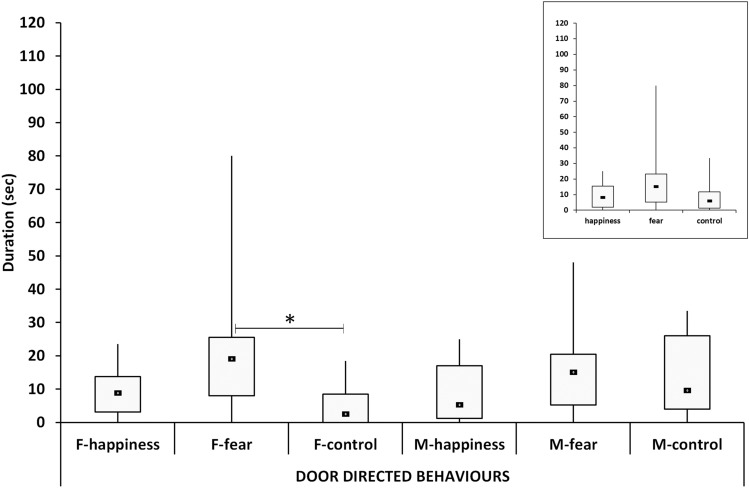
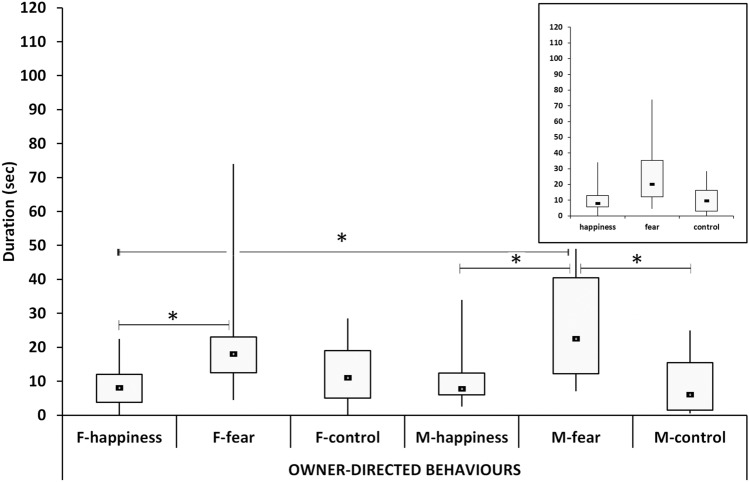
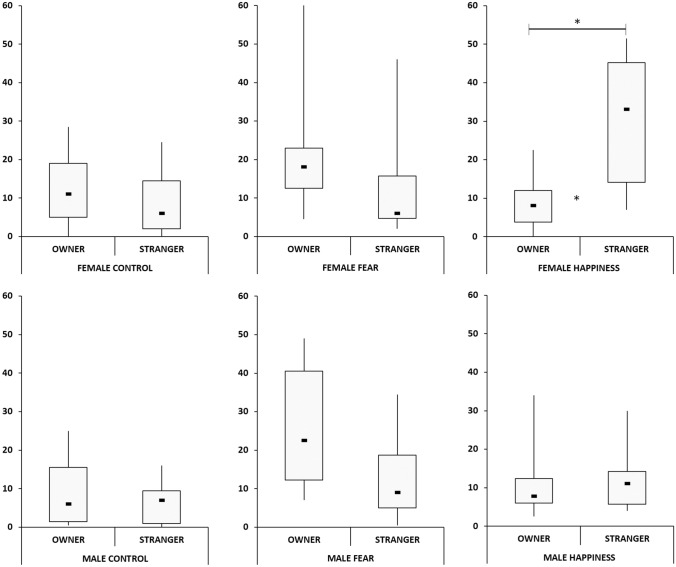
This research focuses on sex differences in the behavioral patterns of dogs when they are exposed to human chemosignals (sweat) produced in happy and fear contexts. No age, breed or apparatus-directed behavior differences were found. However, when exposed to fear chemosignals, dogs' behavior towards their owners, and their stress signals lasted longer when compared to being exposed to happiness as well as control chemosignals. In the happy odor condition, females, in contrast to males, displayed a significantly higher interest to the stranger compared to their owner. In the fear condition, dogs spent more time with their owner compared to the stranger. Behaviors directed towards the door, indicative of exit interest, had a longer duration in the fear condition than the other two conditions. Female dogs revealed a significantly longer door-directed behavior in the fear condition compared to the control condition. Overall the data shows that the effect of exposure to human emotional chemosignals is not sex dependent for behaviors related to the apparatus, the owner or the stress behaviors; however, in the happiness condition, females showed a stronger tendency to interact with the stranger.
本研究关注的是狗在接触人类化学信号(汗液)时的行为模式中的性别差异,这些化学信号分别产生于快乐和恐惧的情境中。研究未发现年龄、品种或仪器引导行为的差异。然而,当暴露于恐惧化学信号中时,与接触快乐和对照化学信号相比,狗对主人的行为和压力信号持续时间更长。在愉快气味的条件下,与男性相比,女性对陌生人的兴趣明显高于对主人的兴趣。在恐惧条件下,与陌生人相比,狗与主人呆在一起的时间更多。指向门的行为,表明有离开的兴趣,在恐惧条件下比其他两种条件持续时间更长。在恐惧条件下,与对照条件相比,雌性狗的门指向行为明显更长。总的来说,数据表明,暴露于人类情绪化学信号对与仪器、主人或应激行为相关的行为没有性别依赖性;然而,在快乐条件下,雌性表现出与陌生人互动的更强倾向。