Systems Neuroscience and Pain Lab, Department of Anesthesiology, Perioperative and Pain Medicine, Stanford University School of Medicine, Palo Alto, CA, 94304, USA.
Department of Bioengineering, Stanford University, 443 Via Ortega, Stanford, CA, 94305, USA; Department of Radiology, Stanford University, 1201 Welch Road, Stanford, CA, 94305, USA.
Neuroimage. 2021 Apr 1;229:117752. doi: 10.1016/j.neuroimage.2021.117752. Epub 2021 Jan 15.
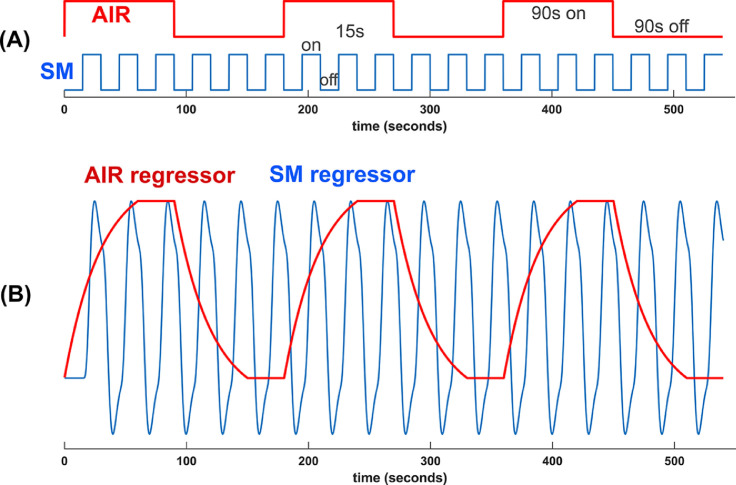
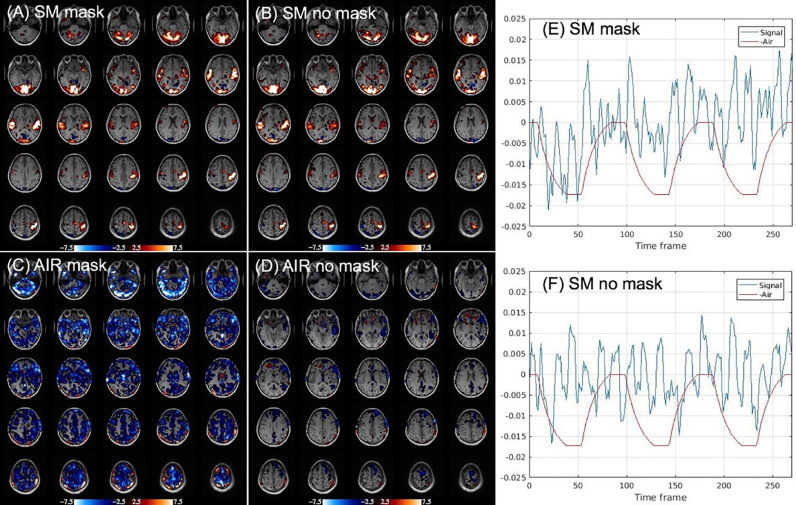
International spread of the coronavirus SARS-CoV-2 has prompted many MRI scanning facilities to require scan subjects to wear a facial covering ("mask") during scanning as a precaution against transmission of the virus. Because wearing a mask mixes expired air with the subject's inspired air stream, the concentration of inspired carbon dioxide [CO] is elevated, resulting in mild hypercapnia. Changes in the inspired gas mixture have been demonstrated to alter R2*-weighted Blood Oxygen Dependent (BOLD) contrast. In this study, we investigate a potential for face masking to alter BOLD contrast during a sensory-motor task designed to activate visual, auditory, and sensorimotor cortices in 8 subjects. We utilize a nasal cannula to supply air to the subject wearing a surgical mask in on-off blocks of 90s to displace expired CO, while the subject performs the sensory-motor task. While only a small fraction (2.5%) of the sensory-motor task activation is related to nasal air modulation, a 30.0% change in gray matter BOLD signal baseline is found due to air modulation. Repeating the scan with mask removed produces a small subject-specific bias in BOLD baseline signal from nasal air supply, which may be due to cognitive influence of airflow or cannula-induced hypoxia. Measurements with capnography demonstrate wearing a mask induces an average increase in ETCO of 7.4%. Altogether, these results demonstrate that wearing a face mask during gradient-echo fMRI can alter BOLD baseline signal but minimally affects task activation.
新型冠状病毒(SARS-CoV-2)的国际传播促使许多 MRI 扫描设施要求扫描对象在扫描过程中佩戴面部覆盖物(“口罩”),以防止病毒传播。由于佩戴口罩会将过期空气与受检者的吸入气流混合,导致吸入的二氧化碳 [CO] 浓度升高,从而引起轻度高碳酸血症。研究表明,吸入气体混合物的变化会改变 R2*-加权血氧依赖(BOLD)对比。在这项研究中,我们研究了面罩在一项旨在激活 8 名受试者的视觉、听觉和感觉运动皮层的感觉运动任务中改变 BOLD 对比的可能性。我们使用鼻导管向佩戴手术口罩的受试者供气,以在 90 秒的开-关块中置换过期的 CO,同时受试者执行感觉运动任务。虽然只有一小部分(2.5%)的感觉运动任务激活与鼻空气调节有关,但由于空气调节,灰质 BOLD 信号基线的变化为 30.0%。去除口罩后重复扫描会导致由于鼻空气供应引起的 BOLD 基线信号出现小的个体特异性偏差,这可能是由于气流的认知影响或导管引起的缺氧所致。用二氧化碳描记法测量表明,佩戴口罩会使 ETCO 平均增加 7.4%。总的来说,这些结果表明,在梯度回波 fMRI 中佩戴面罩会改变 BOLD 基线信号,但对任务激活的影响很小。