Research Team for Social Participation and Community Health, Tokyo Metropolitan Institute of Gerontology, 35-2 Sakae-cho, Itabashi-ku, Tokyo, 173-0015, Japan.
Research Team for Promoting Independence and Mental Health, Tokyo Metropolitan Institute of Gerontology, 35-2 Sakae-cho, Itabashi-ku, Tokyo, 173-0015, Japan.
Nutr J. 2021 Jan 18;20(1):7. doi: 10.1186/s12937-021-00665-w.
Diet is a modifiable factor affecting sarcopenia, and accumulating evidence links dietary factors to muscle mass, strength, and function in older adults. However, few studies have examined the association of dietary patterns with sarcopenia. This study examined the association of dietary patterns derived by reduced-rank regression (RRR) with sarcopenia and its components in community-dwelling older Japanese.
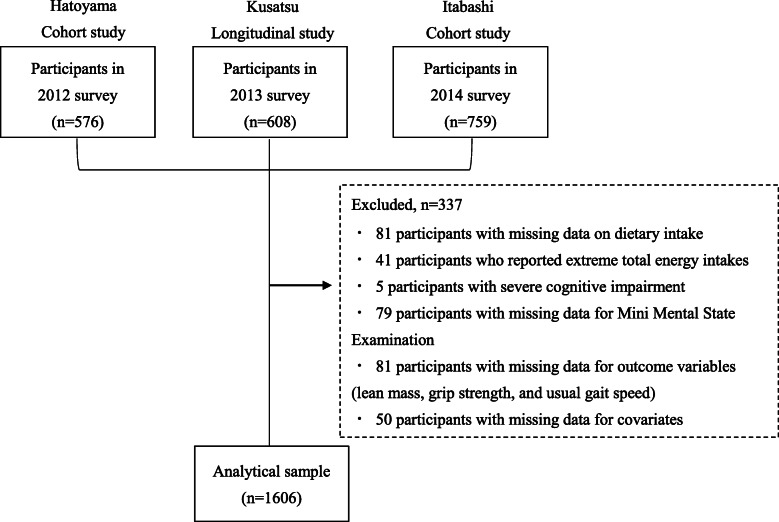
We conducted a cross-sectional study of 1606 community-dwelling adults aged 65 years or older. Dietary intake was assessed by a validated, self-administered diet history questionnaire. Nutrient-derived dietary patterns were identified by using RRR, with sarcopenia-related nutrients (protein, vitamin D, vitamin C, vitamin E, folate, vitamin K, magnesium, iron, and calcium intakes) as response variables. Sarcopenia was defined by using the algorithm of the Asian Working Group for Sarcopenia 2019. Multivariate regression and logistic regression were used to examine the association of dietary patterns with sarcopenia and its components.
The first RRR dietary pattern was characterized by high intakes of fish, soybean products, potatoes, most vegetables, mushrooms, seaweeds, and fruit and a low intake of rice and was associated with decreased prevalence of sarcopenia: the multivariable-adjusted odds ratio of sarcopenia was 0.57 (95% confidence interval, 0.34-0.94; p for trend=0.022) in the highest versus the lowest tertile of dietary pattern. This dietary pattern was also significantly positively associated with usual gait speed (β: 0.02, p=0.024).
A dietary pattern characterized by high intakes of fish, soybean products, potatoes, most vegetables, mushrooms, seaweeds, and fruits and low rice intake was inversely associated with sarcopenia in community-dwelling older Japanese.
饮食是影响肌肉减少症的可改变因素,越来越多的证据将饮食因素与老年人的肌肉质量、力量和功能联系起来。然而,很少有研究探讨饮食模式与肌肉减少症的关系。本研究探讨了基于降秩回归(RRR)的饮食模式与社区居住的日本老年人肌肉减少症及其成分的关系。
我们对 1606 名 65 岁或以上的社区居住成年人进行了横断面研究。通过经过验证的、自我管理的饮食历史问卷评估饮食摄入。使用 RRR 确定营养素衍生的饮食模式,将与肌肉减少症相关的营养素(蛋白质、维生素 D、维生素 C、维生素 E、叶酸、维生素 K、镁、铁和钙的摄入量)作为反应变量。肌肉减少症根据 2019 年亚洲肌肉减少症工作组的算法定义。使用多元回归和逻辑回归来检查饮食模式与肌肉减少症及其成分的关系。
第一个 RRR 饮食模式的特点是高摄入鱼类、大豆制品、土豆、大多数蔬菜、蘑菇、海藻和水果,低摄入米饭,与肌肉减少症的患病率降低相关:最高与最低三分位饮食模式相比,肌肉减少症的多变量调整比值比为 0.57(95%置信区间,0.34-0.94;趋势 p 值=0.022)。这种饮食模式也与通常的步行速度呈显著正相关(β:0.02,p=0.024)。
以高摄入鱼类、大豆制品、土豆、大多数蔬菜、蘑菇、海藻和水果、低摄入米饭为特征的饮食模式与社区居住的日本老年人的肌肉减少症呈负相关。