Harvard T.H. Chan School of Public Health, Boston, MA, USA.
George Washington University, Washington, DC, USA.
Reprod Health. 2021 Jan 18;18(1):10. doi: 10.1186/s12978-021-01070-6.
The Covid-19 pandemic affects maternal health both directly and indirectly, and direct and indirect effects are intertwined. To provide a comprehensive overview on this broad topic in a rapid format behooving an emergent pandemic we conducted a scoping review.
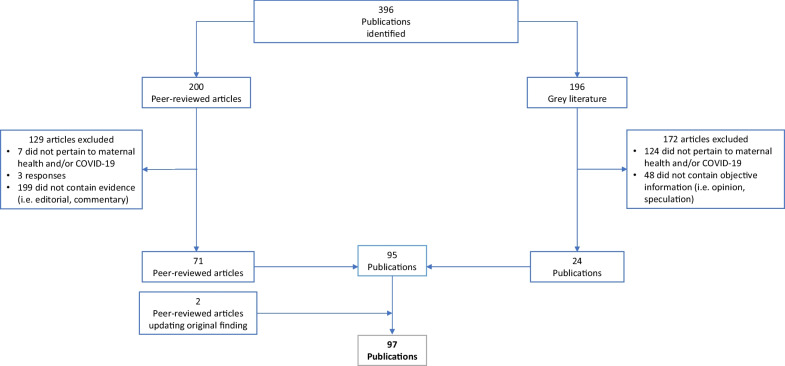
A scoping review was conducted to compile evidence on direct and indirect impacts of the pandemic on maternal health and provide an overview of the most significant outcomes thus far. Working papers and news articles were considered appropriate evidence along with peer-reviewed publications in order to capture rapidly evolving updates. Literature in English published from January 1st to September 11 2020 was included if it pertained to the direct or indirect effects of the COVID-19 pandemic on the physical, mental, economic, or social health and wellbeing of pregnant people. Narrative descriptions were written about subject areas for which the authors found the most evidence.
The search yielded 396 publications, of which 95 were included. Pregnant individuals were found to be at a heightened risk of more severe symptoms than people who are not pregnant. Intrauterine, vertical, and breastmilk transmission were unlikely. Labor, delivery, and breastfeeding guidelines for COVID-19 positive patients varied. Severe increases in maternal mental health issues, such as clinically relevant anxiety and depression, were reported. Domestic violence appeared to spike. Prenatal care visits decreased, healthcare infrastructure was strained, and potentially harmful policies implemented with little evidence. Women were more likely to lose their income due to the pandemic than men, and working mothers struggled with increased childcare demands.
Pregnant women and mothers were not found to be at higher risk for COVID-19 infection than people who are not pregnant, however pregnant people with symptomatic COVID-19 may experience more adverse outcomes compared to non-pregnant people and seem to face disproportionate adverse socio-economic consequences. High income and low- and middle-income countries alike faced significant struggles. Further resources should be directed towards quality epidemiological studies. The Covid-19 pandemic impacts reproductive and perinatal health both directly through infection itself but also indirectly as a consequence of changes in health care, social policy, or social and economic circumstances. The direct and indirect consequences of COVID-19 on maternal health are intertwined. To provide a comprehensive overview on this broad topic we conducted a scoping review. Pregnant women who have symptomatic COVID-19 may experience more severe outcomes than people who are not pregnant. Intrauterine and breastmilk transmission, and the passage of the virus from mother to baby during delivery are unlikely. The guidelines for labor, delivery, and breastfeeding for COVID-19 positive patients vary, and this variability could create uncertainty and unnecessary harm. Prenatal care visits decreased, healthcare infrastructure was strained, and potentially harmful policies are implemented with little evidence in high and low/middle income countries. The social and economic impact of COVID-19 on maternal health is marked. A high frequency of maternal mental health problems, such as clinically relevant anxiety and depression, during the epidemic are reported in many countries. This likely reflects an increase in problems, but studies demonstrating a true change are lacking. Domestic violence appeared to spike. Women were more vulnerable to losing their income due to the pandemic than men, and working mothers struggled with increased childcare demands. We make several recommendations: more resources should be directed to epidemiological studies, health and social services for pregnant women and mothers should not be diminished, and more focus on maternal mental health during the epidemic is needed.
Covid-19 大流行直接和间接地影响着产妇健康,直接和间接的影响相互交织。为了在一个适合紧急大流行的快速格式中对这个广泛的主题提供全面概述,我们进行了范围界定审查。
为了全面概述大流行对产妇健康的直接和间接影响,并提供迄今为止最重要的结果概述,我们进行了范围界定审查。除了同行评审出版物外,还考虑了工作文件和新闻文章,以捕捉快速发展的更新。如果文献与 COVID-19 大流行对孕妇身体、心理、经济或社会健康和福祉的直接或间接影响有关,则将其纳入 2020 年 1 月 1 日至 9 月 11 日期间发表的英文文献。对于作者发现证据最多的主题领域,我们编写了关于这些主题领域的描述性描述。
搜索结果产生了 396 篇出版物,其中 95 篇被纳入。与未怀孕的人相比,孕妇出现更严重症状的风险更高。宫内、垂直和母乳传播不太可能发生。COVID-19 阳性患者的分娩、分娩和母乳喂养指南各不相同。报告称,产妇心理健康问题严重增加,如临床相关焦虑和抑郁。家庭暴力似乎有所增加。产前护理就诊减少,医疗保健基础设施紧张,实施了潜在有害的政策,但证据不足。与男性相比,女性因大流行而失业的可能性更大,而且有工作的母亲在照顾孩子方面面临着更大的需求。
与未怀孕的人相比,孕妇和产妇并没有发现感染 COVID-19 的风险更高,然而,与非孕妇相比,有症状的 COVID-19 的孕妇可能会经历更多的不良后果,并且似乎面临不成比例的不利社会经济后果。高收入和中低收入国家都面临着巨大的挑战。应进一步将资源用于高质量的流行病学研究。Covid-19 大流行直接通过感染本身,也通过医疗保健、社会政策或社会和经济环境的变化,对生殖和围产期健康产生影响。COVID-19 对产妇健康的直接和间接后果相互交织。为了全面概述这个广泛的主题,我们进行了范围界定审查。与未怀孕的人相比,患有症状性 COVID-19 的孕妇可能会经历更严重的后果。宫内和母乳传播,以及病毒在分娩期间从母亲传播到婴儿的可能性不大。COVID-19 阳性患者的分娩、分娩和母乳喂养指南各不相同,这种差异可能会造成不确定性和不必要的伤害。产前护理就诊减少,医疗保健基础设施紧张,在高收入和中低收入国家实施了潜在有害的政策,但证据不足。COVID-19 对产妇健康的社会和经济影响显著。许多国家报告在疫情期间出现了较高频率的产妇心理健康问题,如临床相关的焦虑和抑郁。这可能反映了问题的增加,但缺乏证明真正变化的研究。家庭暴力似乎有所增加。与男性相比,女性因大流行而失业的可能性更大,而且有工作的母亲在照顾孩子方面面临着更大的需求。
应将更多资源用于流行病学研究,孕妇和产妇的卫生和社会服务不应减少,并且需要在大流行期间更多地关注产妇心理健康。