Julius-Von-Sachs Institut für Biowissenschaften, Universität Würzburg, Julius-von-Sachs Platz 2, 97082, Würzburg, Germany.
Photosynth Res. 2021 Aug;149(1-2):213-231. doi: 10.1007/s11120-020-00814-y. Epub 2021 Jan 19.
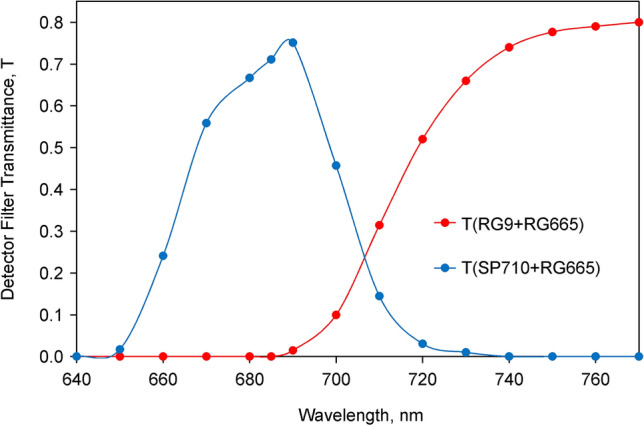
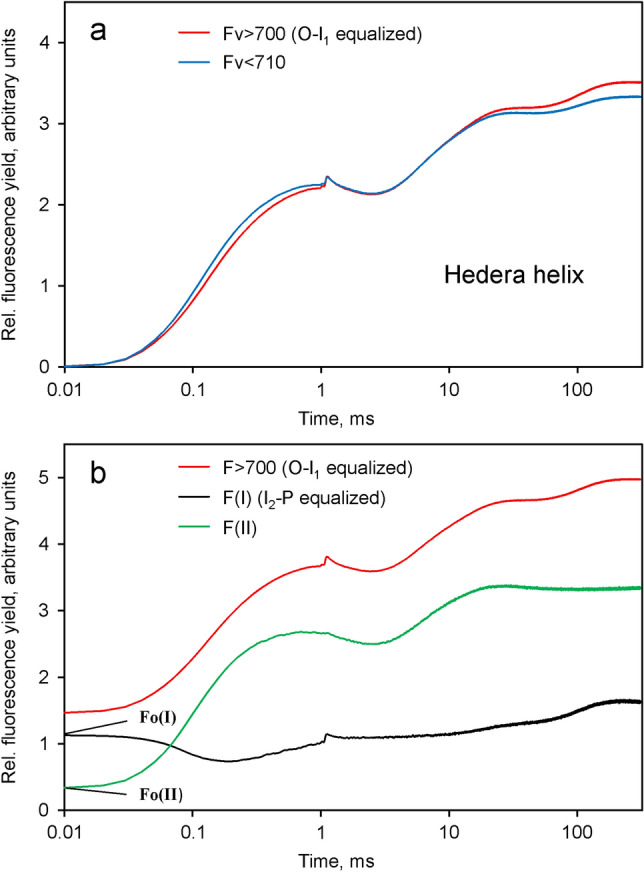
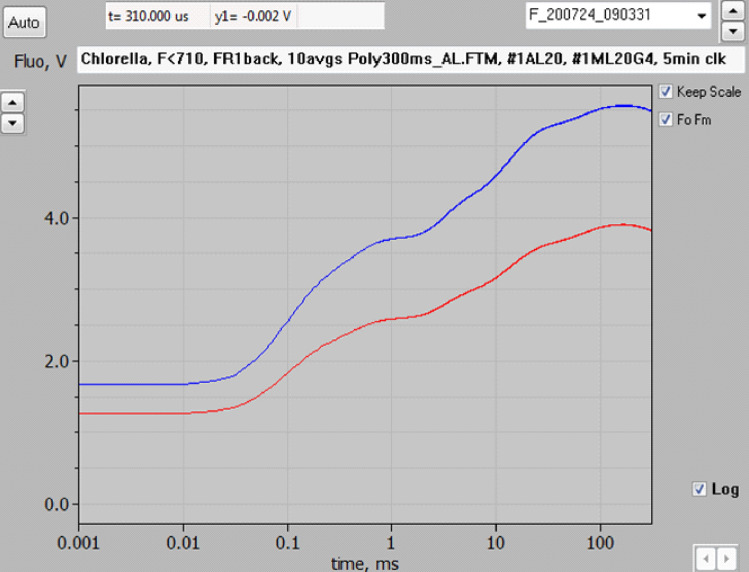
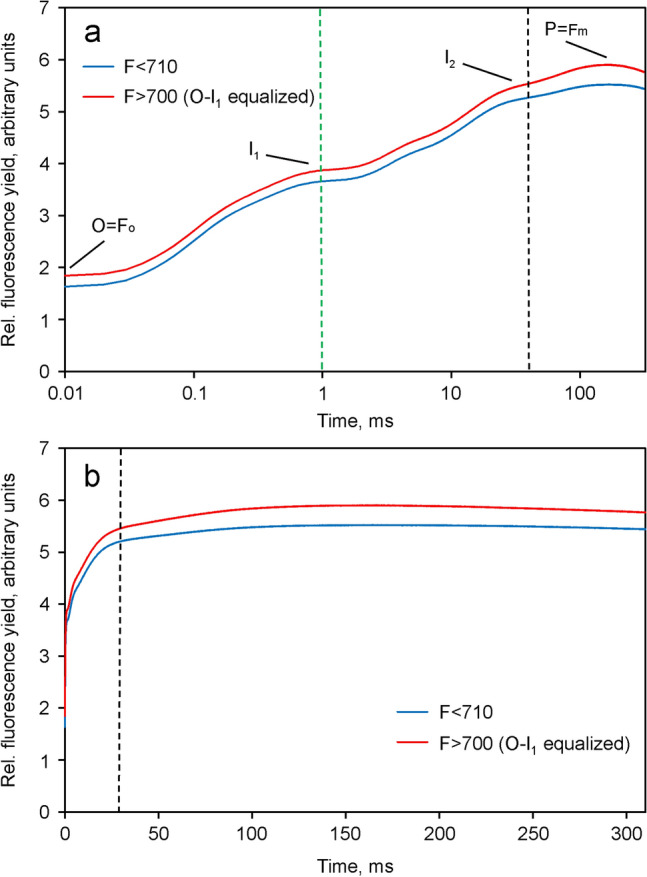
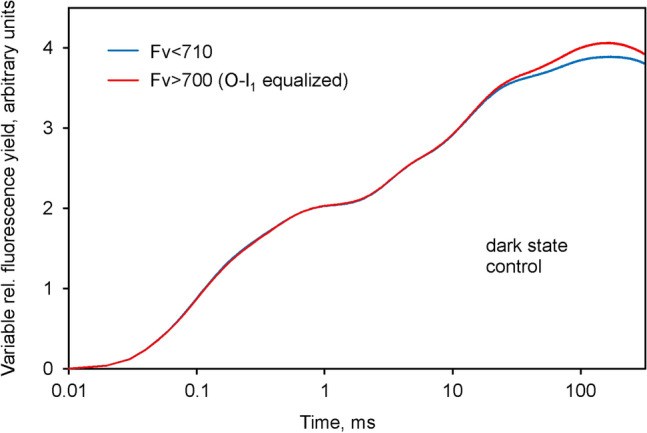
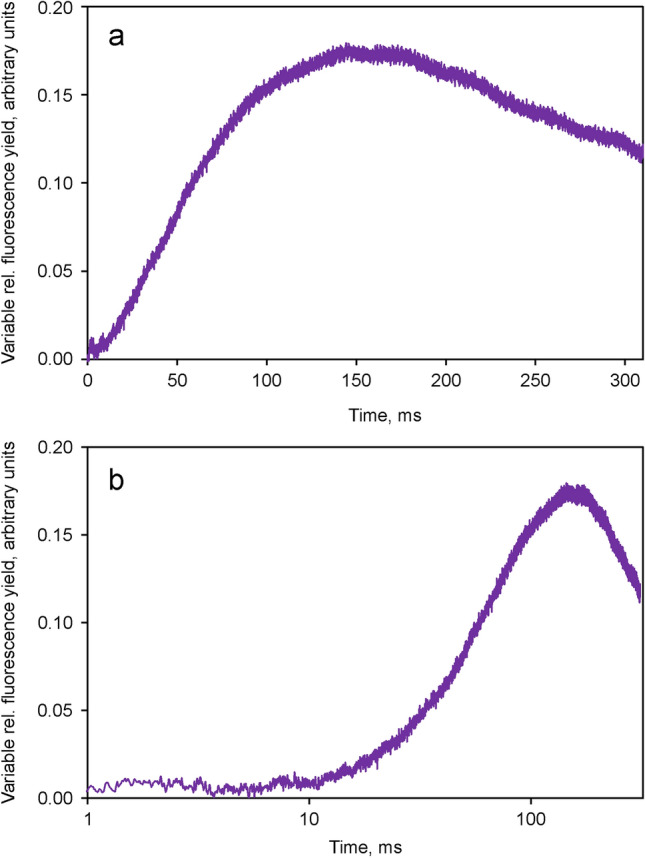
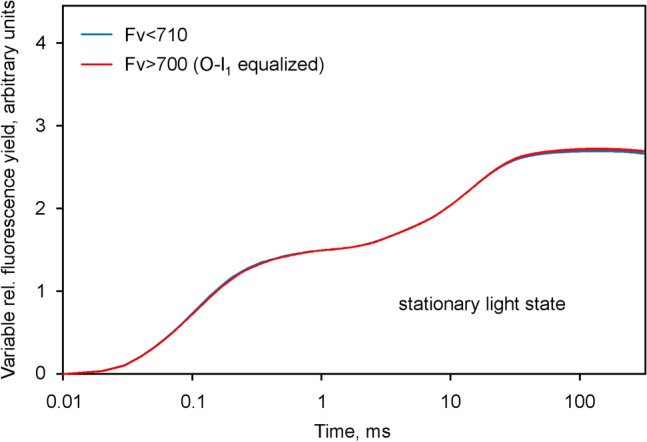
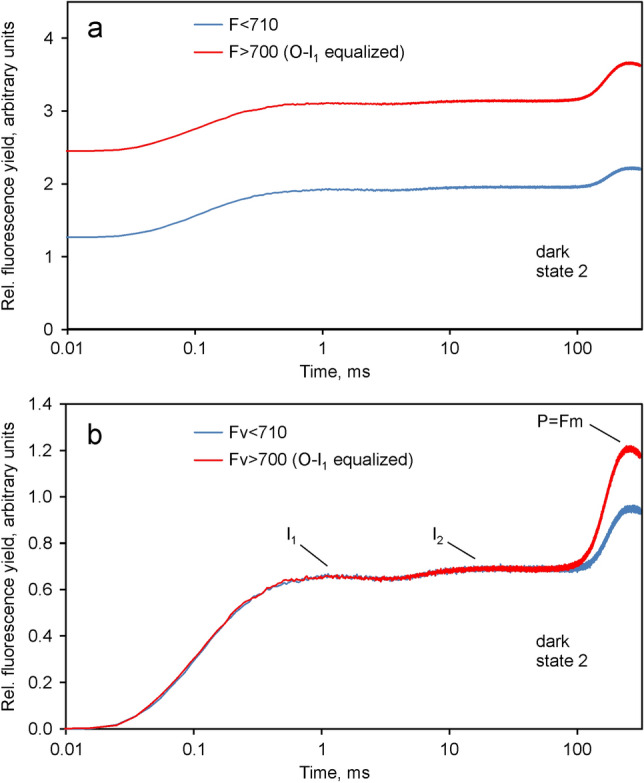
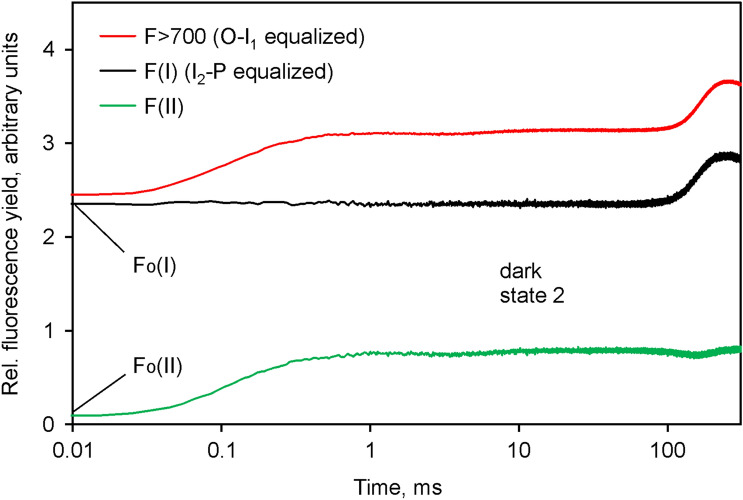
Room temperature fluorescence in vivo and its light-induced changes are dominated by chlorophyll a fluorescence excited in photosystem II, F(II), peaking around 685 nm. Photosystem I fluorescence, F(I), peaking around 730 nm, so far has been assumed to be constant in vivo. Here, we present evidence for significant contributions of F(I) to variable fluorescence in the green unicellular alga Chlorella vulgaris, the cyanobacterium Synechococcus leopoliensis and a light-green ivy leaf. A Multi-Color-PAM fluorometer was applied for measurements of the polyphasic fluorescence rise (O-I-I-P) induced by strong 440 nm light in a dilute suspension of Chlorella, with detection alternating between emission above 700 nm (F > 700) and below 710 nm (F < 710). By averaging 10 curves each of the F > 700 and F < 710 recordings even small differences could be reliably evaluated. After equalizing the amplitudes of the O-I phase, which constitutes a specific F(II) response, the O-I-I parts of the two recordings were close to identical, whereas the I-P phase was larger in F > 700 than in F < 710 by a factor of 1.42. In analogous measurements with Synechococcus carried out in the dark state 2 using strong 625 nm actinic light, after O-I equalization the I-P phase in F > 700 exceeded that in F < 710 even by a factor of 1.99. In measurements with Chlorella, the I-P phase and with it the apparent variable fluorescence of PS I, Fv(I), were suppressed by moderate actinic background light and by the plastoquinone antagonist DBMIB. Analogous measurements with leaves are rendered problematic by unavoidable light intensity gradients and the resulting heterogenic origins of F > 700 and F < 710. However, a light-green young ivy leaf gave qualitatively similar results as those obtained with the suspensions, thus strongly suggesting the existence of Fv(I) also in leaves.
活体室温荧光及其光诱导变化主要由 PSII 激发的叶绿素 a 荧光(F(II))主导,其峰值在 685nm 左右。PS I 荧光(F(I))的峰值在 730nm 左右,迄今为止,人们一直认为它在活体中是恒定的。在这里,我们提供了证据表明,在绿藻小球藻、蓝藻聚球藻和淡绿色常春藤叶中,F(I)对可变荧光有重要贡献。多色 PAM 荧光计用于测量在小球藻稀悬浮液中强 440nm 光诱导的多相荧光上升(O-I-I-P),检测在发射波长高于 700nm(F > 700)和低于 710nm(F < 710)之间交替进行。通过对每个 F > 700 和 F < 710 记录的 10 条曲线进行平均,即使是很小的差异也可以可靠地评估。在使 O-I 相的幅度相等后,该相构成了特定的 F(II)反应,两个记录的 O-I-I 部分非常相似,而 F > 700 中的 I-P 相比 F < 710 大 1.42 倍。在使用强 625nm 光作为激活光的暗态 2 中对聚球藻进行类似的测量后,在 O-I 相等化后,F > 700 中的 I-P 相甚至比 F < 710 大 1.99 倍。在对小球藻的测量中,I-P 相以及 PS I 的表观可变荧光 Fv(I)被适度的激活背景光和质体醌拮抗剂 DBMIB 抑制。由于不可避免的光强梯度和由此产生的 F > 700 和 F < 710 的异质起源,对叶片的类似测量变得复杂。然而,一个浅绿色的年轻常春藤叶给出了与悬浮液类似的定性结果,因此强烈表明 Fv(I)也存在于叶片中。