Department of Biochemistry and Center for Excellence in Protein and Enzyme Technology, Faculty of Science, Mahidol University, Bangkok, Thailand; School of Biomolecular Science and Engineering, Vidyasirimedhi Institute of Science and Technology (VISTEC), Rayong, Thailand.
School of Biomolecular Science and Engineering, Vidyasirimedhi Institute of Science and Technology (VISTEC), Rayong, Thailand.
J Biol Chem. 2021 Jan-Jun;296:100068. doi: 10.1074/jbc.RA120.016004. Epub 2020 Nov 23.
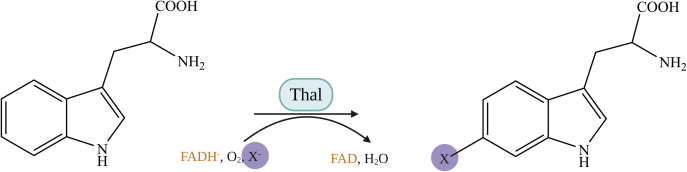
Although flavin-dependent halogenases (FDHs) are attractive biocatalysts, their practical applications are limited because of their low catalytic efficiency. Here, we investigated the reaction mechanisms and structures of tryptophan 6-halogenase (Thal) from Streptomyces albogriseolus using stopped-flow, rapid-quench flow, quantum/mechanics molecular mechanics calculations, crystallography, and detection of intermediate (hypohalous acid [HOX]) liberation. We found that the key flavin intermediate, C4a-hydroperoxyflavin (C4aOOH-FAD), formed by Thal and other FDHs (tryptophan 7-halogenase [PrnA] and tryptophan 5-halogenase [PyrH]), can react with I, Br, and Cl but not F to form C4a-hydroxyflavin and HOX. Our experiments revealed that I reacts with C4aOOH-FAD the fastest with the lowest energy barrier and have shown for the first time that a significant amount of the HOX formed leaks out as free HOX. This leakage is probably a major cause of low product coupling ratios in all FDHs. Site-saturation mutagenesis of Lys79 showed that changing Lys79 to any other amino acid resulted in an inactive enzyme. However, the levels of liberated HOX of these variants are all similar, implying that Lys79 probably does not form a chloramine or bromamine intermediate as previously proposed. Computational calculations revealed that Lys79 has an abnormally lower pKa compared with other Lys residues, implying that the catalytic Lys may act as a proton donor in catalysis. Analysis of new X-ray structures of Thal also explains why premixing of FDHs with reduced flavin adenine dinucleotide generally results in abolishment of C4aOOH-FAD formation. These findings reveal the hidden factors restricting FDHs capability which should be useful for future development of FDHs applications.
虽然黄素依赖型卤化酶(FDHs)是很有吸引力的生物催化剂,但由于其催化效率低,它们的实际应用受到限制。在这里,我们使用停流、快速淬火流、量子/力学分子力学计算、晶体学和中间产物(次卤酸[HOX])释放检测研究了来自灰色链霉菌的色氨酸 6-卤化酶(Thal)的反应机制和结构。我们发现,Thal 和其他 FDH(色氨酸 7-卤化酶[PrnA]和色氨酸 5-卤化酶[PyrH])形成的关键黄素中间体 C4a-过氧黄素(C4aOOH-FAD)可以与 I、Br 和 Cl 反应,但不能与 F 反应生成 C4a-羟基黄素和 HOX。我们的实验表明,I 与 C4aOOH-FAD 的反应最快,能垒最低,并首次表明形成的大量 HOX 作为游离 HOX 泄漏出来。这种泄漏可能是所有 FDH 产物偶联比低的主要原因。Lys79 的定点饱和突变表明,将 Lys79 突变为任何其他氨基酸都会导致酶失活。然而,这些变体释放的 HOX 水平都相似,这表明 Lys79 可能不像以前提出的那样形成氯胺或溴胺中间体。计算计算表明,与其他 Lys 残基相比,Lys79 的 pKa 异常低,这表明催化 Lys 可能在催化中充当质子供体。对 Thal 的新 X 射线结构的分析也解释了为什么 FDHs 与还原型黄素腺嘌呤二核苷酸预混合通常会导致 C4aOOH-FAD 形成的消除。这些发现揭示了限制 FDH 能力的隐藏因素,这对于未来 FDH 应用的发展应该是有用的。