Division of Infectious Disease, Department of Internal Medicine, Taoyuan Armed Forces General Hospital, Taoyuan City 325, Taiwan.
Division of Infectious Disease and Tropical Medicine, Department of Internal Medicine, Tri-Service General Hospital, National Defense Medical Center, Taipei 114, Taiwan.
Int J Environ Res Public Health. 2021 Jan 5;18(1):326. doi: 10.3390/ijerph18010326.
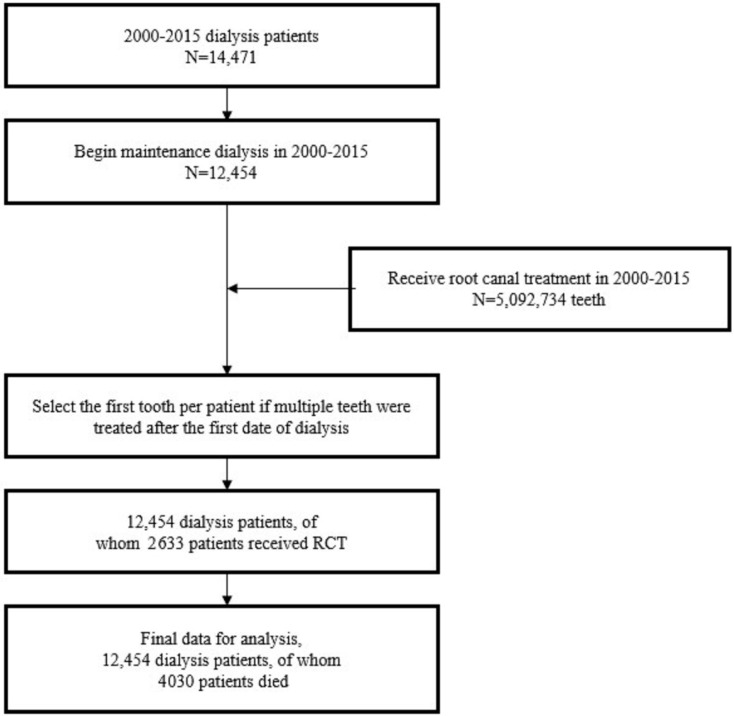
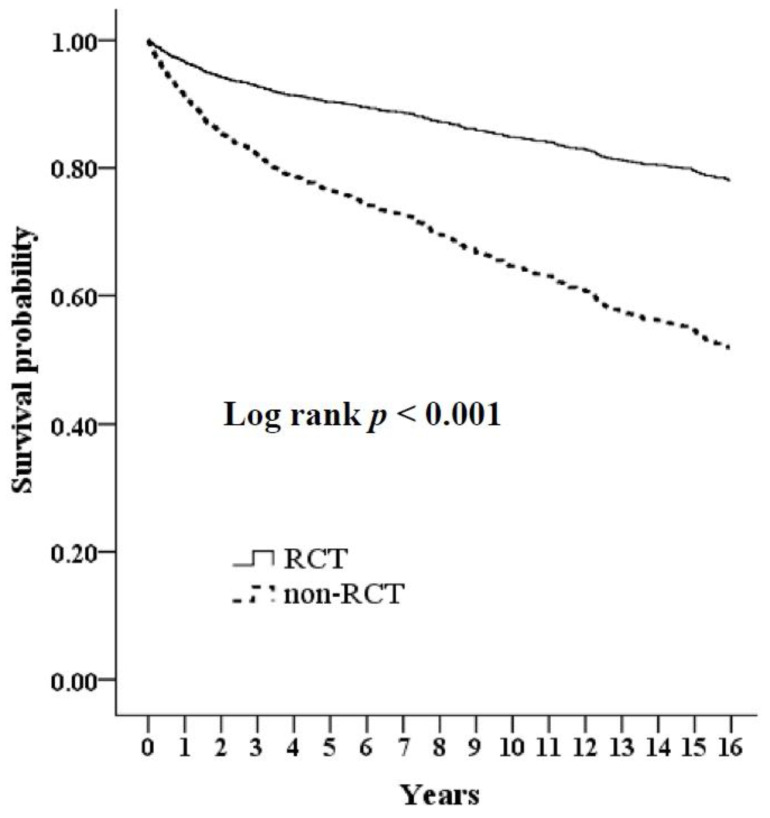
Objectives Dental problems occur widely in patients with chronic kidney disease (CKD) and may increase comorbidities. Root canal therapy (RCT) is a common procedure for advanced decayed caries with pulp inflammation and root canals. However, end-stage renal disease (ESRD) patients are considered to have a higher risk of potentially life-threatening infections after treatment and might fail to receive satisfactory dental care such as RCT. We investigated whether appropriate intervention for dental problems had a potential impact among dialysis patients. Design Men and women who began maintenance dialysis (hemodialysis or peritoneal dialysis) between January 1, 2000, and December 31, 2015, in Taiwan (total 12,454 patients) were enrolled in this study. Participants were followed up from the first reported dialysis date to the date of death or end of dialysis by December 31, 2015. Setting Data collection was conducted in Taiwan. Results A total of 2633 and 9821 patients were classified into the RCT and non-RCT groups, respectively. From the data of Taiwan's National Health Insurance, a total of 5,092,734 teeth received RCT from 2000 to 2015. Then, a total of 12,454 patients were followed within the 16 years, and 4030 patients passed away. The results showed that members of the non-RCT group (34.93%) had a higher mortality rate than those of the RCT group (22.79%; = 0.001). The multivariate-adjusted hazard ratio for the risk of death was 0.69 (RCT vs. non-RCT; = 0.001). Conclusions This study suggested that patients who had received RCT had a relatively lower risk of death among dialysis patients. Infectious diseases had a significant role in mortality among dialysis patients with non-RCT. Appropriate interventions for dental problems may increase survival among dialysis patients. Abbreviations: CKD = chronic kidney disease, ESRD = end-stage renal disease, RCT = root canal therapy.
目的
慢性肾脏病(CKD)患者常发生口腔问题,这些问题可能会增加合并症的发生。根管治疗(RCT)是一种治疗牙髓炎症和根管感染的常见方法。然而,终末期肾病(ESRD)患者在治疗后可能面临更高的潜在生命威胁感染风险,并且可能无法接受满意的牙科治疗,如 RCT。本研究旨在探讨透析患者中,针对口腔问题的适当干预是否具有潜在影响。
设计
本研究纳入了 2000 年 1 月 1 日至 2015 年 12 月 31 日期间在台湾开始维持性透析(血液透析或腹膜透析)的男性和女性患者(共 12454 例)。参与者自首次报告透析日期开始随访,至 2015 年 12 月 31 日死亡或透析结束。
设置
数据收集在台湾进行。
结果
共有 2633 例和 9821 例患者分别被归入 RCT 组和非 RCT 组。根据台湾全民健康保险数据,2000 年至 2015 年共有 5092734 颗牙齿接受了 RCT。在 16 年内共随访了 12454 例患者,有 4030 例患者死亡。结果显示,非 RCT 组(34.93%)的死亡率高于 RCT 组(22.79%; = 0.001)。多因素调整后的死亡风险比为 0.69(RCT 与非 RCT; = 0.001)。
结论
本研究表明,在透析患者中,接受 RCT 的患者死亡风险相对较低。对于未接受 RCT 的透析患者,感染性疾病是导致死亡的重要因素。针对口腔问题的适当干预可能会提高透析患者的生存率。
CKD = 慢性肾脏病,ESRD = 终末期肾病,RCT = 根管治疗