Guiyang Hospital of Stomatology, Guiyang, China.
College of Stomatology, Chongqing Medical University, Chongqing, China.
Biosci Rep. 2019 Jan 11;39(1). doi: 10.1042/BSR20181773. Print 2019 Jan 31.
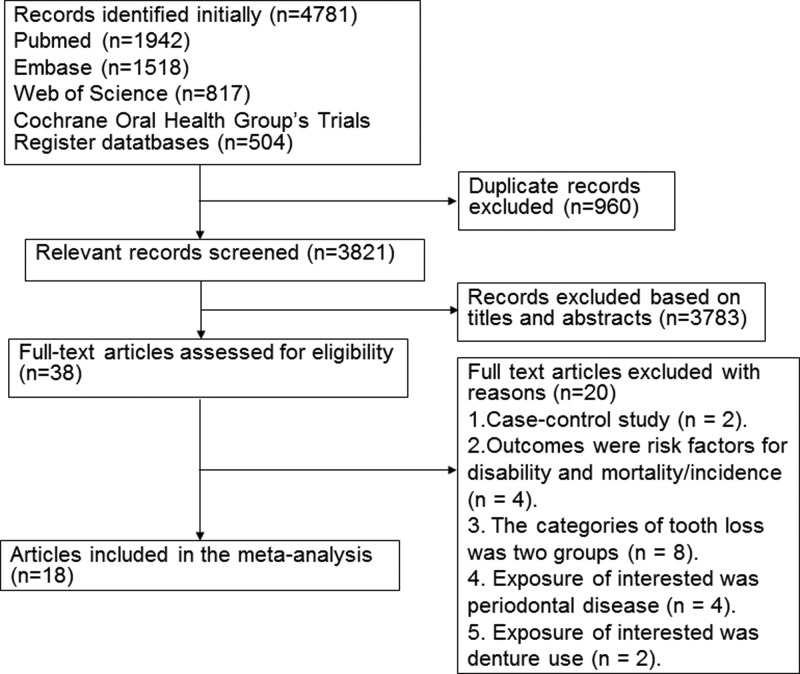
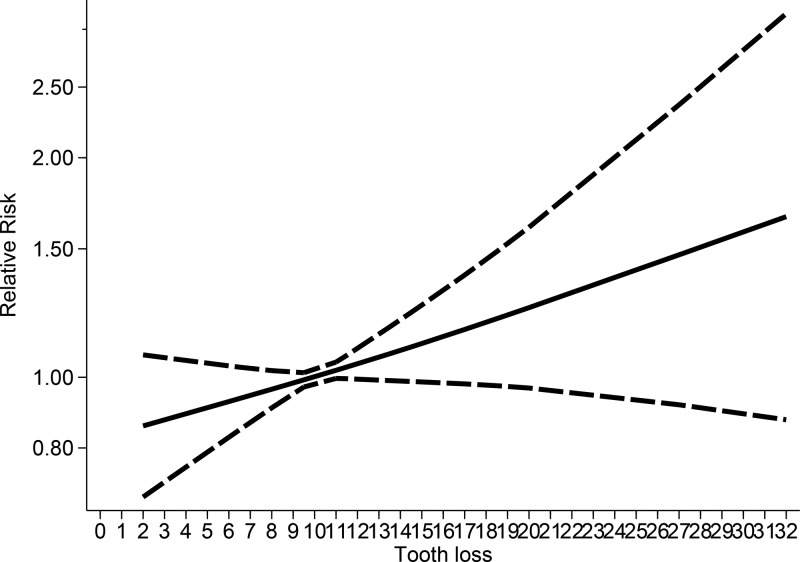
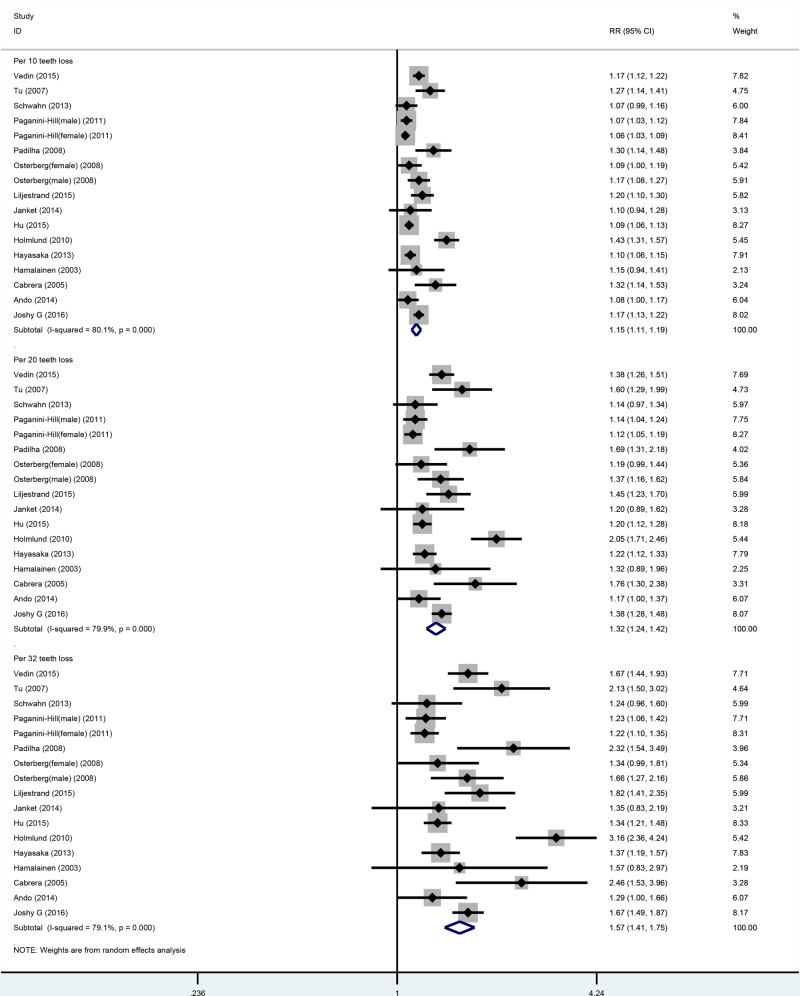
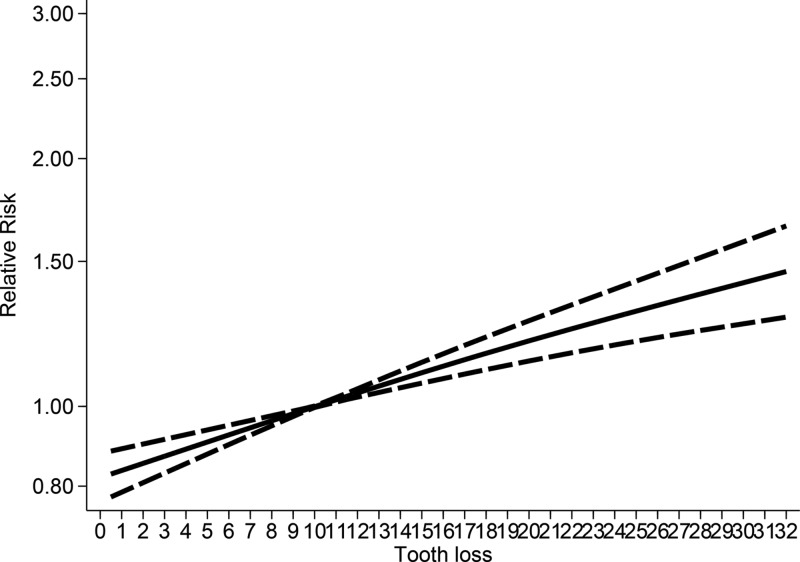
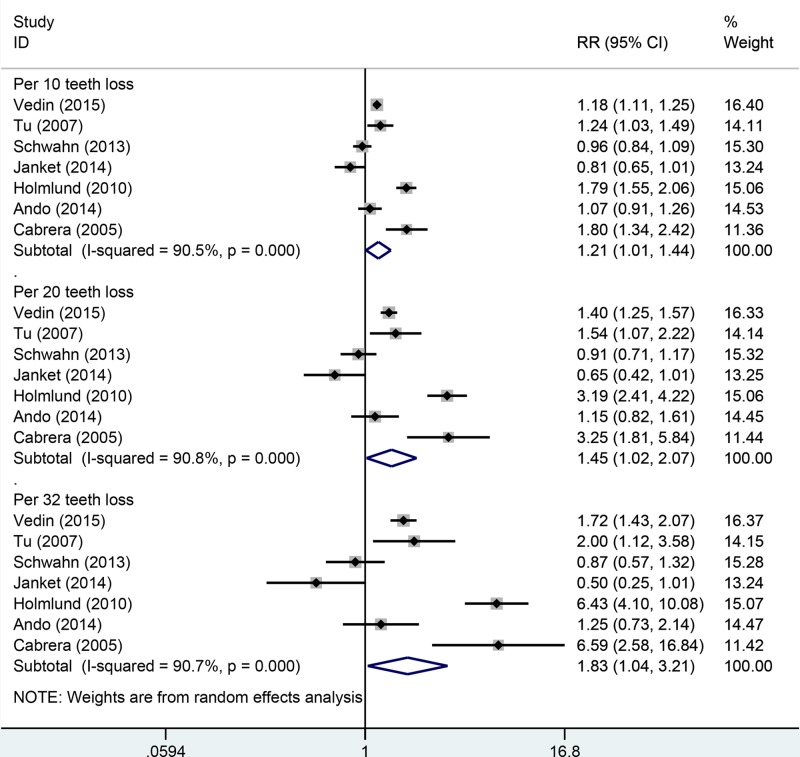
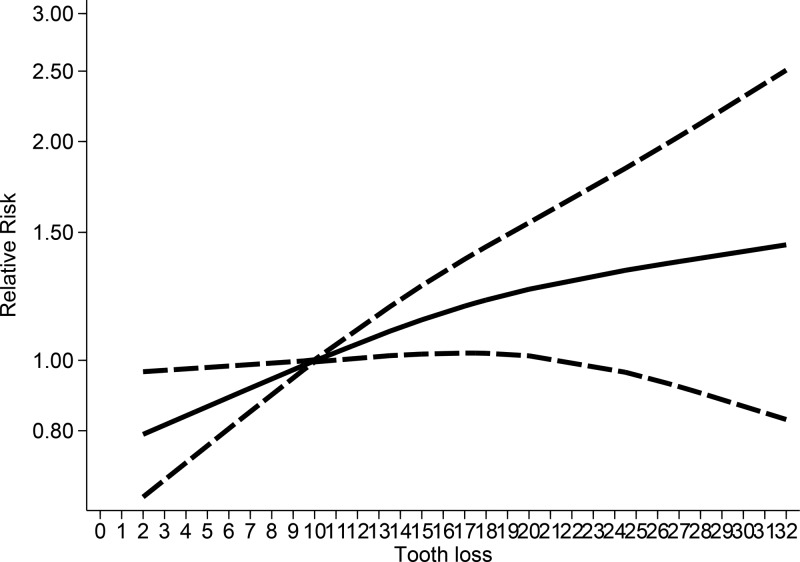
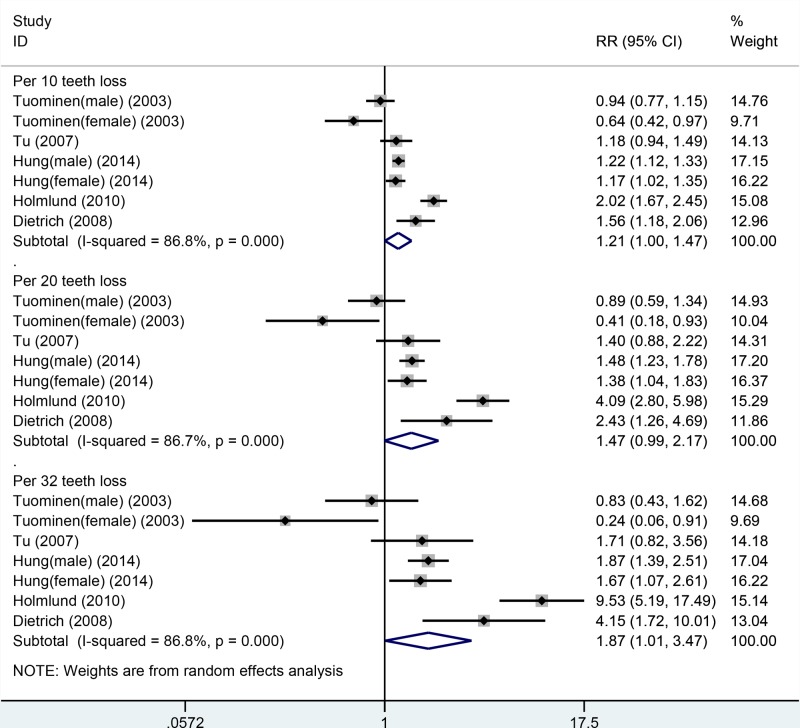
The association of tooth loss with mortality from all causes, cardiovascular diseases (CVD), and coronary heart disease (CHD) has been studied for many years; however, the results are inconsistent. PubMed, Embase, Web of Knowledge, and Cochrane Oral Health Group's Trials Register databases were searched for papers published from 1966 to August 2018. We conducted dose-response meta-analysis to quantitatively evaluate the relation between tooth loss and risk of mortality from all causes, CVD, and CHD.: In the present study, 18 prospective studies conducted until August 2018 were considered eligible for analysis. In the analysis of linear association, the summarized relative risk (RR) values for each 10-, 20-, and 32-tooth loss for all-cause mortality were 1.15 (1.11-1.19), 1.33 (1.23-1.29), and 1.57 (1.39-1.51), respectively. Subgroup and sensitivity analyses showed consistent results. A linear relationship was found among all-cause mortality, with = 0.306. The susceptibility to all-cause mortality increased by almost 1.48 times at very high tooth loss (28-32), and slight flattening of the curve was noted. However, the summarized RR values for increment for 10-, 20-, and 32-tooth loss were not or were marginally related to increased risk of mortality from CVD/CHD. Subgroup and sensitivity analyses revealed inconsistent results. Tooth loss showed linear association with CHD mortality but not with CVD mortality. The susceptibility to all-cause mortality increased by almost 1.48 and 1.70 times for CVD and CHD, respectively, at very high tooth loss (28-32). The curve exhibited slight flattening; however, no statistical significance was detected.: In the meta-analysis, our findings confirmed the positive relationship between tooth loss and susceptibility to all-cause mortality, but not for circulatory mortality. However, the finding that tooth loss might play a harmful role in the development of all-cause mortality remains inconclusive. Tooth loss may be a potential risk marker for all-cause mortality: however, their association must be further validated through large prospective studies.
本研究共纳入截至 2018 年 8 月的 18 项前瞻性研究。在对线性关联的分析中,全因死亡率每缺失 10 颗、20 颗和 32 颗牙的汇总相对风险(RR)值分别为 1.15(1.11-1.19)、1.33(1.23-1.29)和 1.57(1.39-1.51)。亚组和敏感性分析显示结果一致。在全因死亡率中发现了线性关系, = 0.306。在极高的牙齿缺失(28-32)情况下,全因死亡率的易感性增加了近 1.48 倍,并且曲线略有平坦。然而,10 颗、20 颗和 32 颗牙缺失每增加一颗的 RR 值与 CVD/CHD 死亡率增加之间没有或仅有微弱的相关性。亚组和敏感性分析显示结果不一致。牙齿缺失与 CHD 死亡率呈线性相关,但与 CVD 死亡率无关。在极高的牙齿缺失(28-32)情况下,CVD 和 CHD 死亡率的易感性分别增加了近 1.48 和 1.70 倍。曲线略有平坦,但没有统计学意义。
在荟萃分析中,我们的研究结果证实了牙齿缺失与全因死亡率易感性之间存在正相关关系,但与循环系统死亡率无关。然而,牙齿缺失可能对全因死亡率的发展产生有害作用的结论仍不明确。牙齿缺失可能是全因死亡率的一个潜在风险标志物:然而,需要通过大型前瞻性研究进一步验证它们之间的关系。