Department of Pediatrics, Memorial Sloan Kettering Cancer Center, New York, NY 10065, USA.
Int J Mol Sci. 2021 Jan 14;22(2):793. doi: 10.3390/ijms22020793.
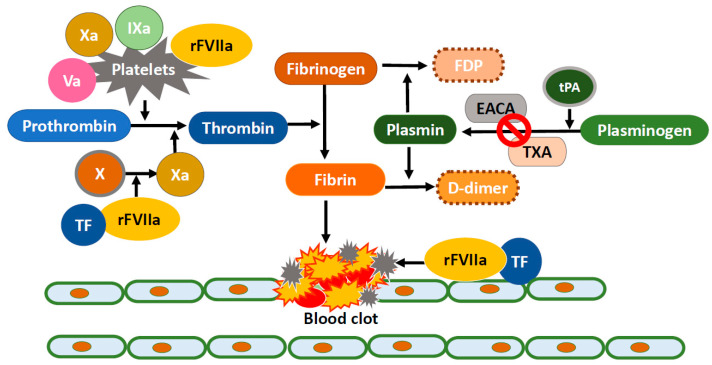
Diffuse alveolar hemorrhage (DAH) is a life-threatening pulmonary complication in patients with hematologic malignancies or systemic autoimmune disorders. Pathologic findings show pulmonary capillaritis, bland hemorrhage, diffuse alveolar damage, and hemosiderin-laden macrophages, but in the majority of cases, pathogenesis remains unclear. Despite the severity and high mortality, the current treatment options for DAH remain empirical. Systemic treatment to control inflammatory activity including high-dose corticosteroids, cyclophosphamide, and rituximab and supportive care have been applied, but largely unsuccessful in critical cases. Activated recombinant factor VII (FVIIa) can achieve rapid local hemostasis and has been administered either systemically or intrapulmonary for the treatment of DAH. However, there is no randomized controlled study to evaluate the efficacy and safety, and the use of FVIIa for DAH remains open to debate. This review discusses the pathogenesis, diverse etiologies causing DAH, diagnosis, and treatments focusing on hemostasis using FVIIa. In addition, the risks and benefits of the off-label use of FVIIa in pediatric patients will be discussed in detail.
弥漫性肺泡出血 (DAH) 是血液系统恶性肿瘤或系统性自身免疫性疾病患者发生的一种危及生命的肺部并发症。病理学发现表现为肺毛细血管炎、无炎症性出血、弥漫性肺泡损伤和含铁血黄素巨噬细胞,但在大多数情况下,其发病机制仍不清楚。尽管病情严重且死亡率高,但目前 DAH 的治疗选择仍基于经验。已经应用了包括大剂量皮质类固醇、环磷酰胺和利妥昔单抗在内的全身性治疗来控制炎症活动和支持性护理,但在危急情况下效果不佳。活化的重组凝血因子 VII (FVIIa) 可实现快速局部止血,已被系统或肺内给药用于治疗 DAH。然而,目前尚无评估其疗效和安全性的随机对照研究,因此 FVIIa 治疗 DAH 仍存在争议。本综述讨论了 DAH 的发病机制、导致 DAH 的多种病因、诊断和以 FVIIa 为重点的止血治疗。此外,还将详细讨论在儿科患者中超说明书使用 FVIIa 的风险和获益。