Department of Experimental Neuroscience, IRCCS Fondazione Santa Lucia, 00143 Rome, Italy.
Department of Systems Medicine, Università di Roma "Tor Vergata", 00133 Rome, Italy.
Int J Mol Sci. 2021 Jan 16;22(2):869. doi: 10.3390/ijms22020869.
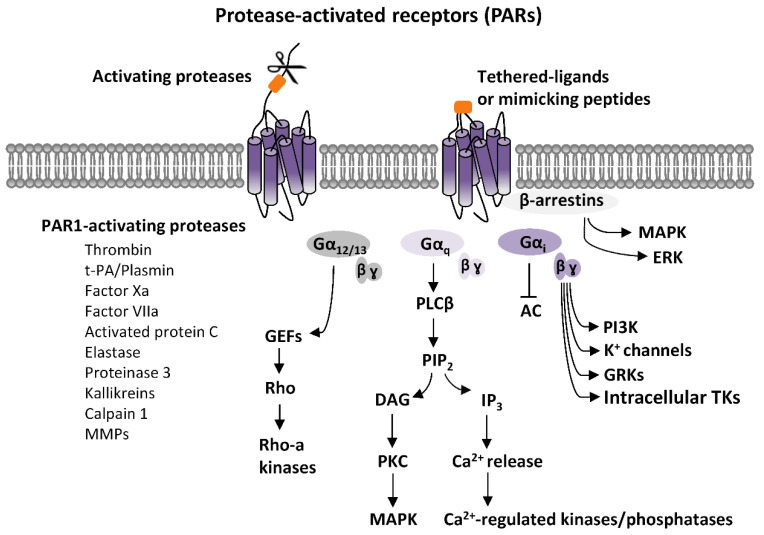
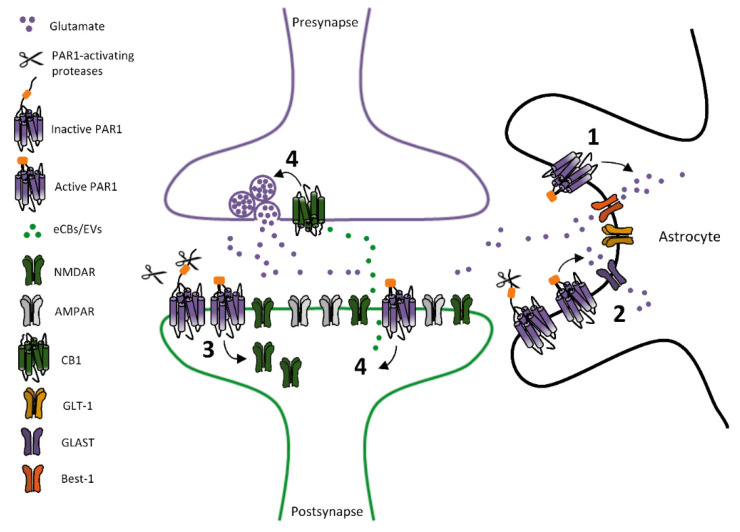
Protease-activated receptors (PARs) are a class of G protein-coupled receptors (GPCRs) with a unique mechanism of activation, prompted by a proteolytic cleavage in their N-terminal domain that uncovers a tethered ligand, which binds and stimulates the same receptor. PARs subtypes (PAR1-4) have well-documented roles in coagulation, hemostasis, and inflammation, and have been deeply investigated for their function in cellular survival/degeneration, while their roles in the brain in physiological conditions remain less appreciated. Here, we describe PARs' effects in the modulation of neurotransmission and synaptic plasticity. Available evidence, mainly concerning PAR1-mediated and PAR2-mediated regulation of glutamatergic and GABAergic transmission, supports that PARs are important modulators of synaptic efficacy and plasticity in normal conditions.
蛋白酶激活受体(PARs)是一类 G 蛋白偶联受体(GPCRs),其激活机制独特,在其 N 端结构域的蛋白水解切割作用下被激活,暴露出一个被束缚的配体,该配体与同一受体结合并刺激其活性。PARs 亚型(PAR1-4)在凝血、止血和炎症中具有明确的作用,并因其在细胞存活/退化中的功能而被深入研究,而其在生理条件下大脑中的作用则尚未得到充分认识。在这里,我们描述了 PARs 在调节神经递质传递和突触可塑性方面的作用。现有证据主要涉及 PAR1 介导和 PAR2 介导的谷氨酸能和 GABA 能传递的调节,支持 PARs 是正常情况下突触效能和可塑性的重要调节因子。