Sleep Education and Research Laboratory (SERL), UCL Institute of Education, London WC1H 0AA, UK.
Social and Affective Neuroscience Lab, Psychology Program-SSS, Nanyang Technological University, Singapore 639818, Singapore.
Int J Environ Res Public Health. 2021 Jan 16;18(2):746. doi: 10.3390/ijerph18020746.
Children with intellectual and developmental difficulties often experience sleep problems, which in turn may impact parental sleep patterns. This study explored the role of parental sleep knowledge as a moderator on the relationship between child sleep and parental sleep impairment.
582 parents or caregivers (92.6% mothers) of children with different developmental disabilities (Age = 9.34, 29.5% females) such as Down's syndrome, participated in an online survey. Multiple regression analysis was conducted.
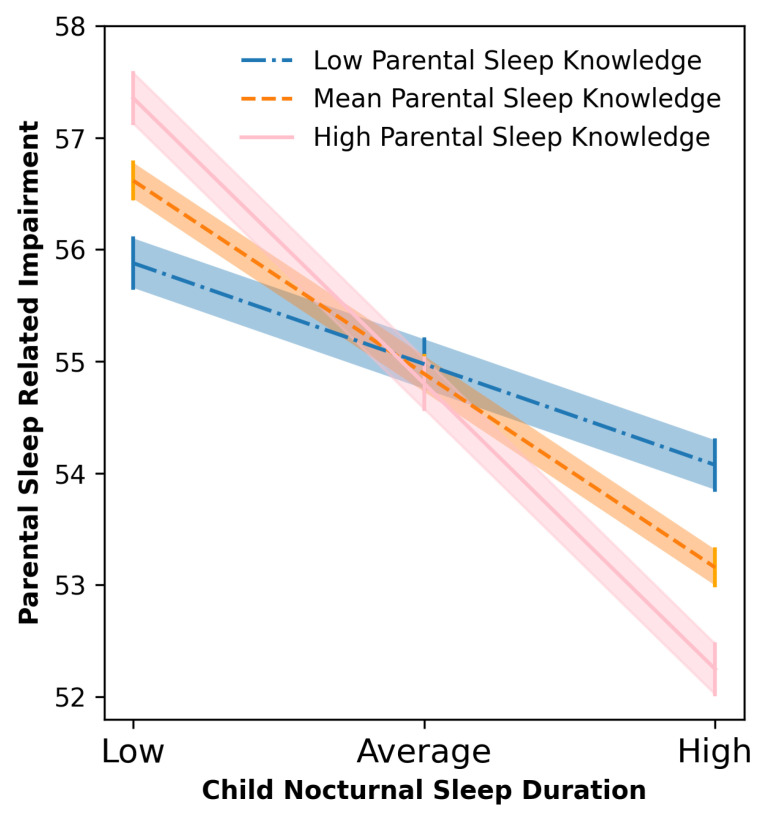
Parental sleep knowledge of child sleep was a moderating variable in the relationship between child sleep nocturnal duration and parental sleep impairment. Although overall, sleep knowledge was high in this sample, two specific knowledge gaps were identified namely child sleep duration requirements, and the recognition of signs of a well-rested child.
This study has provided evidence that increased parental sleep knowledge can positively impact both child and parental sleep outcomes.
智力和发育障碍儿童通常会出现睡眠问题,这反过来可能会影响父母的睡眠模式。本研究探讨了父母睡眠知识作为调节变量在儿童睡眠与父母睡眠障碍之间关系中的作用。
582 名患有不同发育障碍(年龄=9.34,29.5%为女性)儿童的父母或照顾者(92.6%为母亲)参与了一项在线调查。采用多元回归分析。
儿童睡眠知识是儿童夜间睡眠时间与父母睡眠障碍之间关系的调节变量。尽管总体而言,该样本中父母的睡眠知识水平较高,但仍存在两个特定的知识差距,即儿童睡眠持续时间要求和识别休息良好的儿童的迹象。
本研究提供了证据表明,增加父母的睡眠知识可以对儿童和父母的睡眠结果产生积极影响。