Brown Ann F, Brooks Samantha J, Smith Sawyer R, Stephens Joelle M, Lotstein Alexandria K, Skiles Chad M, Alfiero Christopher J, Meenan Melanie J
Department of Movement Sciences, College of Education, Health & Human Sciences, University of Idaho, 875 Perimeter Drive MS 2401, Moscow, ID 83844-2401, USA.
J Funct Morphol Kinesiol. 2020 Feb 26;5(1):17. doi: 10.3390/jfmk5010017.
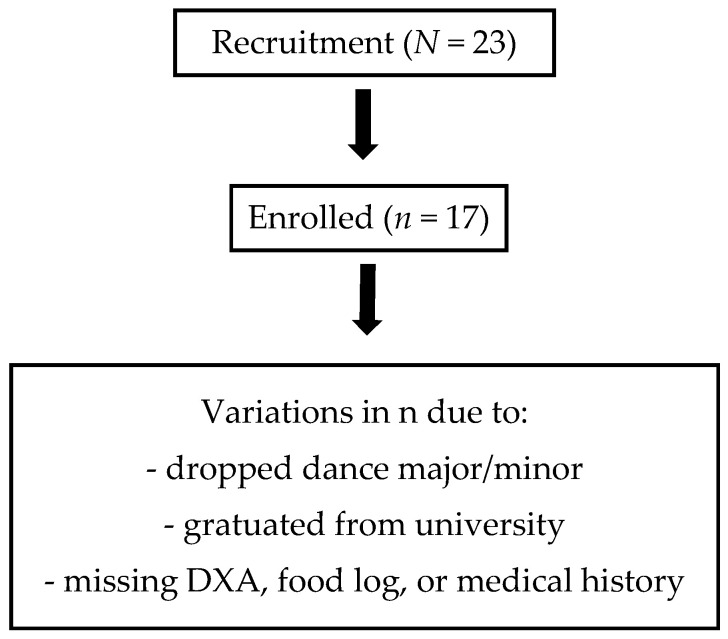
Collegiate dancers face unique challenges to maintain a lean aesthetic, optimal diet, and a high-performance level due to the various stressors in college. The purpose of this study was to examine changes in body composition (BC) and diet over two years. Participants ( = 17, 19.6 ± 1.6 years) completed two laboratory sessions per semester. Sessions included height and weight, BC, dietary intake, and a health history questionnaire. Regardless of rigorous dance training and variations in the academic calendar, no significant changes in BC or diet were observed within semesters of over two years. BMI was normal (24.9 ± 4.1 kg/m) with fat mass exceeding 30% at all timepoints. Fat mass was negatively correlated with carbohydrate, fat, and protein intake (g/kg/day; = -0.291, = 0.004; = -0.372, < 0.0001; = -0.398, < 0.0001; respectively). Energy intake was within the recommended daily allowance (2040 ± 710 kcal/day), however may be insufficient for an active dance population. Protein (1.1 ± 0.5 g/kg), carbohydrate (3.7 ± 1.6 g/kg), calcium (835 ± 405 mg/day), iron (17 ± 15 mg/day), and potassium (1628 ± 1736 mg/day) intake fell below recommendations for an active population. Alterations in dance training and the demands of the academic calendar may be contributing to suboptimal dietary intake and BC in female collegiate dancers.
由于大学中的各种压力源,大学生舞者在保持苗条身材、优化饮食和高水平表现方面面临独特挑战。本研究的目的是考察两年内身体成分(BC)和饮食的变化。参与者(n = 17,19.6 ± 1.6岁)每学期完成两次实验室测试。测试包括身高、体重、身体成分、饮食摄入量和一份健康史问卷。尽管进行了严格的舞蹈训练且学术日程有所变化,但在两年多的学期内,未观察到身体成分或饮食有显著变化。体重指数正常(24.9 ± 4.1 kg/m),所有时间点的脂肪量均超过30%。脂肪量与碳水化合物、脂肪和蛋白质摄入量(克/千克/天)呈负相关(分别为r = -0.291,p = 0.004;r = -0.372,p < 0.0001;r = -0.398,p < 0.0001)。能量摄入量在推荐的每日摄入量范围内(2040 ± 710千卡/天),然而对于活跃的舞蹈人群来说可能不足。蛋白质(1.1 ± 0.5克/千克)、碳水化合物(3.7 ± 1.6克/千克)、钙(835 ± 405毫克/天)、铁(17 ± 15毫克/天)和钾(1628 ± 1736毫克/天)的摄入量低于活跃人群的推荐量。舞蹈训练的改变和学术日程的要求可能导致女性大学生舞者的饮食摄入和身体成分不理想。