
安慰剂效应在不习惯的抗阻运动后对肌肉酸痛感知及运动表现的影响:一项初步研究。
Nocebo Effects on Perceived Muscle Soreness and Exercise Performance Following Unaccustomed Resistance Exercise: A Pilot Study.
作者信息
McLemore Blake H, McLemore Sarah G, Rogers Rebecca R, Pederson Joseph A, Williams Tyler D, Marshall Mallory R, Ballmann Christopher G
机构信息
Department of Kinesiology, Samford University, 800 Lakeshore Dr., Birmingham, AL 35229, USA.
出版信息
J Funct Morphol Kinesiol. 2020 Jun 9;5(2):40. doi: 10.3390/jfmk5020040.
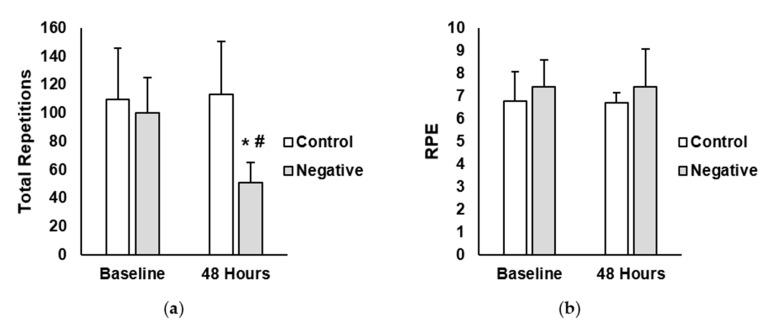
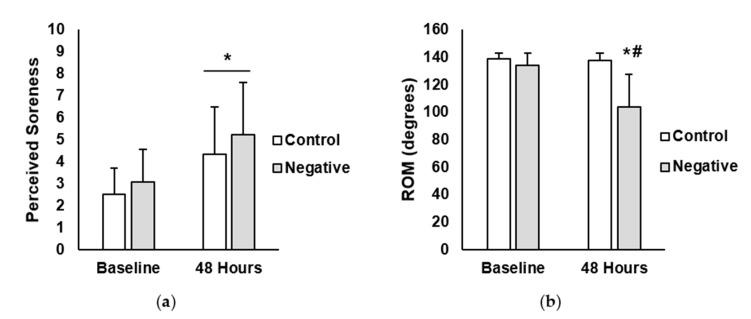
The purpose of this study was to investigate the effects of nocebo administration on perceived soreness and exercise performance following unaccustomed resistance exercise. Untrained males were randomly assigned to one of two treatments: (1) control or (2) negative-belief. For the negative-belief group, participants were given a capsule before exercise containing 400 mg of an inert substance (gluten-free cornstarch) and were told the supplement would increase muscle soreness. The control group received no treatment. An algometer and pain scale was used to obtain soreness, and a goniometer was used to measure elbow range of motion (ROM). Participants completed an eccentric bicep curl pyramid with their non-dominant arm. Rate of perceived exertion (RPE) and repetitions were recorded. Then, 48 h after the initial exercise bout, participants repeated all procedures. Perceived soreness, ROM, average RPE, and total repetitions performed were analyzed. Perceived soreness was significantly higher in both control and negative-belief groups 48 h after exercise ( < 0.001; η = 0.23). ROM was significantly lower 48 h post in the negative-belief group ( = 0.004; d = 1.83) while no differences existed for controls ( = 0.999; d = 0.16). Average RPE was unaffected between groups ( = 0.282; η = 0.07). Total repetitions were significantly lower 48 h post in the negative-belief group ( < 0.001; d = 2.51) while no differences existed for the controls ( = 0.999; d = 0.08). Findings suggest that 48 h after unaccustomed resistance exercise, negative expectation does not worsen soreness but hinders ROM and exercise performance.
本研究的目的是调查给予安慰剂对不习惯的抗阻运动后感知到的酸痛和运动表现的影响。未经训练的男性被随机分配到两种处理之一:(1) 对照组或 (2) 消极信念组。对于消极信念组,参与者在运动前服用一粒含有400毫克惰性物质(无麸质玉米淀粉)的胶囊,并被告知该补充剂会增加肌肉酸痛。对照组不接受任何处理。使用痛觉计和疼痛量表来获取酸痛程度,使用角度计测量肘部活动范围(ROM)。参与者用非优势手臂完成一组离心二头肌卷曲递增训练。记录主观用力程度(RPE)和重复次数。然后,在初次运动 bout 后48小时,参与者重复所有程序。分析感知到的酸痛、ROM、平均RPE和总重复次数。运动后48小时,对照组和消极信念组的感知酸痛均显著更高(<0.001;η=0.23)。消极信念组在运动后48小时ROM显著更低(=0.004;d=1.83),而对照组无差异(=0.999;d=0.16)。两组之间的平均RPE未受影响(=0.282;η=0.07)。消极信念组在运动后48小时的总重复次数显著更低(<0.001;d=2.51),而对照组无差异(=0.999;d=0.08)。研究结果表明,在不习惯的抗阻运动后48小时,消极期望不会加重酸痛,但会阻碍ROM和运动表现。
 Zotero 插件