Zhou Huifen, Tsou Jen-Hui, Leng Qixin, Jiang Feng
Department of Pathology, University of Maryland School of Medicine, 10 S. Pine St., Baltimore, MD 21201, USA.
Diagnostics (Basel). 2021 Jan 15;11(1):125. doi: 10.3390/diagnostics11010125.
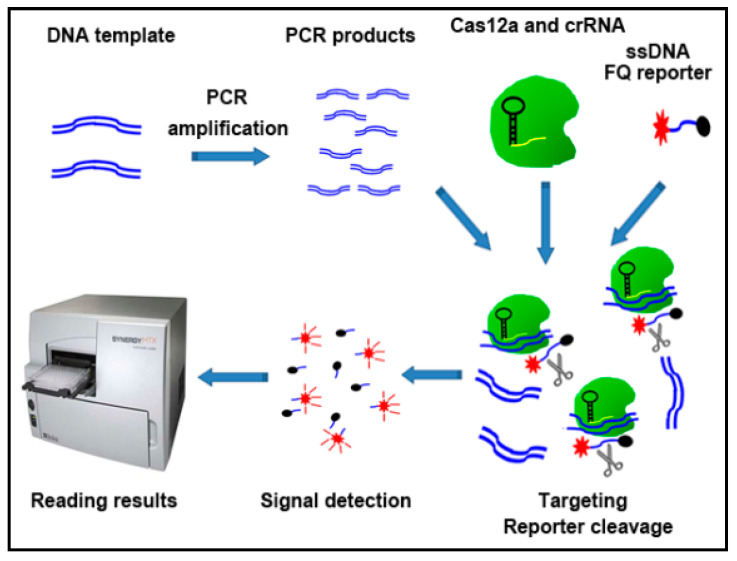
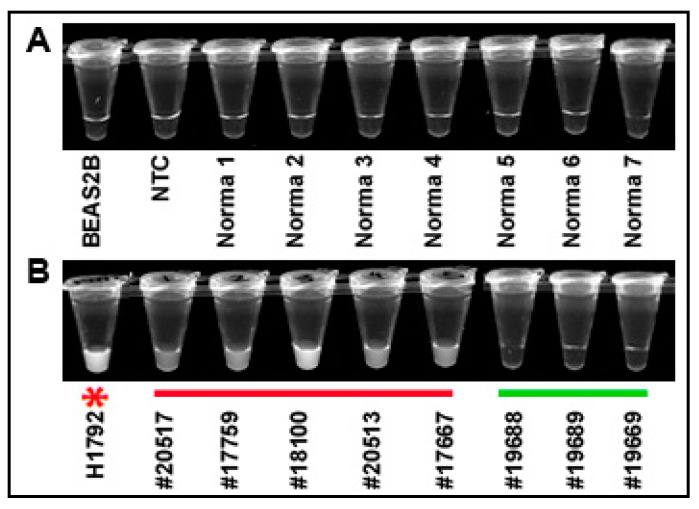
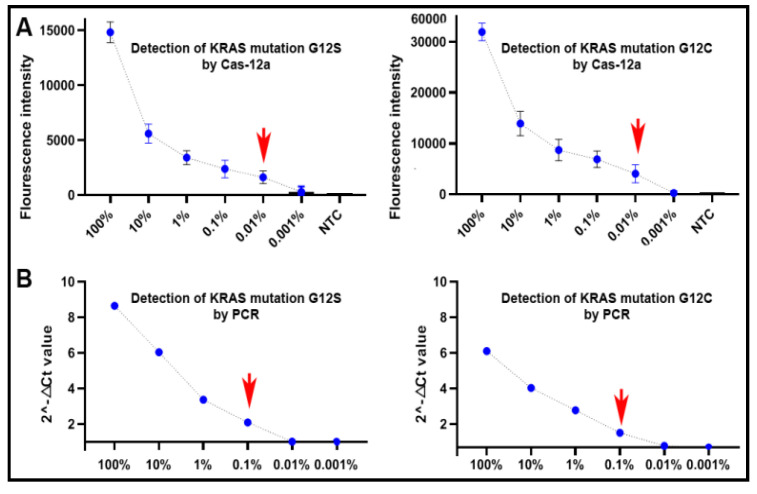
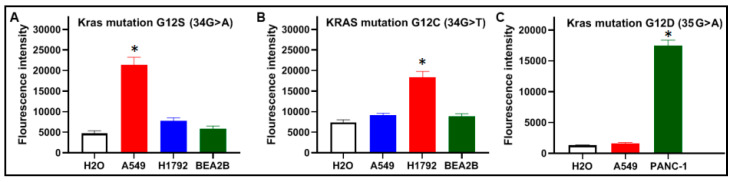
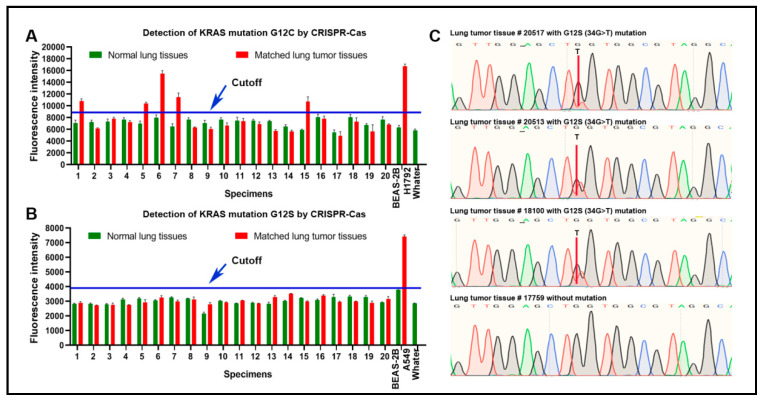
Kirsten rat sarcoma viral oncogene (KRAS) is the isoform most frequently mutated in human tumors. Testing for activating KRAS mutations has important implications for diagnosis and the personalized medicine of cancers. The current techniques for detecting KRAS mutations have moderate sensitivity. The emerging clustered regularly interspaced short palindromic repeats (CRISPR) system shows great promise in the detection of nucleic acids and is revolutionizing medical diagnostics. This study aimed to develop CRISPR-Cas12a as a sensitive test to detect KRAS mutations. Serially diluted DNA samples containing KRAS mutations are subjected to CRISPR-Cas12a and polymerase chain reaction (PCR). CRISPR-Cas12a and PCR can specifically detect 0.01% and 0.1% mutant KRAS DNA in the presence of wild-type KRAS DNA, respectively. Twenty pairs of lung tumor and noncancerous lung tissues are tested by CRISPR-Cas12a, PCR, and direct sequencing. CRISPR-Cas12a could identify the G12C mutation in five of 20 tumor tissues, while both PCR and direct sequencing discovered the KRAS mutation in three of the five tumor tissues. Furthermore, the results of CRISPR-Cas12a for testing the mutation could be directly and immediately visualized by a UV light illuminator. Altogether, CRISPR-Cas12a has a higher sensitivity for the detection of KRAS mutations compared with PCR and sequencing analysis, and thus has diagnostic and therapeutic implications. Nevertheless, the technique needs to be validated for its clinical significance in a large and prospective study.
Kirsten大鼠肉瘤病毒癌基因(KRAS)是人类肿瘤中最常发生突变的异构体。检测KRAS激活突变对癌症的诊断和个性化医疗具有重要意义。目前检测KRAS突变的技术灵敏度中等。新兴的成簇规律间隔短回文重复序列(CRISPR)系统在核酸检测方面显示出巨大潜力,正在彻底改变医学诊断。本研究旨在开发CRISPR-Cas12a作为检测KRAS突变的灵敏检测方法。将含有KRAS突变的系列稀释DNA样本进行CRISPR-Cas12a和聚合酶链反应(PCR)检测。在野生型KRAS DNA存在的情况下,CRISPR-Cas12a和PCR分别能特异性检测出0.01%和0.1%的突变型KRAS DNA。用CRISPR-Cas12a、PCR和直接测序法检测了20对肺肿瘤组织和非癌肺组织。CRISPR-Cas12a能在2�个肿瘤组织中的5个中鉴定出G12C突变,而PCR和直接测序在这5个肿瘤组织中的3个中发现了KRAS突变。此外,CRISPR-Cas12a检测突变的结果可用紫外光照明器直接即时可视化。总之,与PCR和测序分析相比,CRISPR-Cas12a检测KRAS突变具有更高的灵敏度,因此具有诊断和治疗意义。然而,该技术的临床意义需要在大规模前瞻性研究中进行验证。