Laboratório de Imunofarmacologia, Instituto Oswaldo Cruz, Fundação Oswaldo Cruz (FIOCRUZ), Rio de Janeiro 21040-900, Brazil.
Programa de Pós-Graduação em Biologia Celular e Molecular, Instituto Oswaldo Cruz, Fundação Oswaldo Cruz (FIOCRUZ), Rio de Janeiro 21040-900, Brazil.
Int J Mol Sci. 2021 Jan 15;22(2):805. doi: 10.3390/ijms22020805.
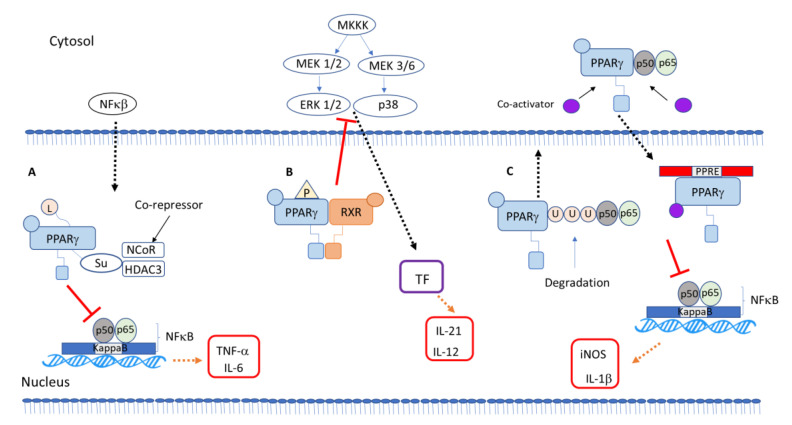
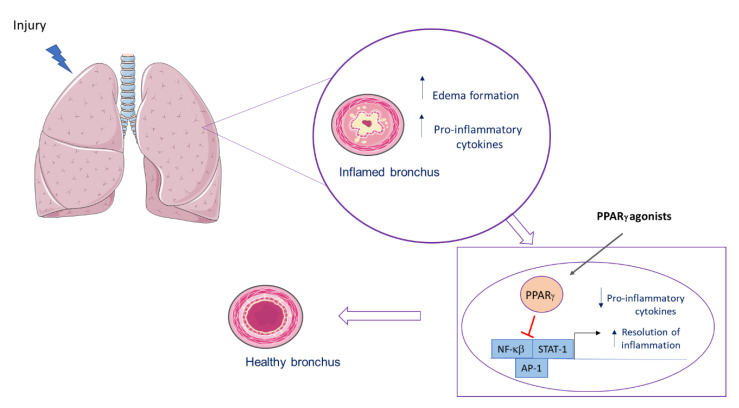
Peroxisome proliferator-activated receptors (PPARs) are members of the nuclear receptor superfamily that regulate the expression of genes related to lipid and glucose metabolism and inflammation. There are three members: PPARα, PPARβ or PPARγ. PPARγ have several ligands. The natural agonists are omega 9, curcumin, eicosanoids and others. Among the synthetic ligands, we highlight the thiazolidinediones, clinically used as an antidiabetic. Many of these studies involve natural or synthetic products in different pathologies. The mechanisms that regulate PPARγ involve post-translational modifications, such as phosphorylation, sumoylation and ubiquitination, among others. It is known that anti-inflammatory mechanisms involve the inhibition of other transcription factors, such as nuclear factor kB(NFκB), signal transducer and activator of transcription (STAT) or activator protein 1 (AP-1), or intracellular signaling proteins such as mitogen-activated protein (MAP) kinases. PPARγ transrepresses other transcription factors and consequently inhibits gene expression of inflammatory mediators, known as biomarkers for morbidity and mortality, leading to control of the exacerbated inflammation that occurs, for instance, in lung injury/acute respiratory distress. Many studies have shown the therapeutic potentials of PPARγ on pulmonary diseases. Herein, we describe activities of the PPARγ as a modulator of inflammation, focusing on lung injury and including definition and mechanisms of regulation, biological effects and molecular targets, and its role in lung diseases caused by inflammatory stimuli, bacteria and virus, and molecular-based therapy.
过氧化物酶体增殖物激活受体 (PPARs) 是核受体超家族的成员,可调节与脂质和葡萄糖代谢以及炎症相关的基因表达。该家族有 3 个成员:PPARα、PPARβ 或 PPARγ。PPARγ 有几种配体。天然激动剂有 omega 9、姜黄素、类二十烷酸等。在合成配体中,我们重点介绍噻唑烷二酮类,临床上用于治疗糖尿病。这些研究中的许多都涉及不同病理下的天然或合成产物。调节 PPARγ 的机制涉及翻译后修饰,如磷酸化、SUMO 化和泛素化等。已知抗炎机制涉及抑制其他转录因子,如核因子 kB(NFκB)、信号转导和转录激活剂(STAT)或激活蛋白 1(AP-1),或细胞内信号蛋白,如丝裂原激活蛋白(MAP)激酶。PPARγ 反式抑制其他转录因子,从而抑制炎症介质的基因表达,这些炎症介质被称为发病率和死亡率的生物标志物,导致对过度炎症的控制,例如在肺损伤/急性呼吸窘迫中发生的炎症。许多研究表明 PPARγ 在肺部疾病方面具有治疗潜力。在此,我们描述了 PPARγ 作为炎症调节剂的活性,重点关注肺损伤,包括定义和调节机制、生物学效应和分子靶点,以及其在由炎症刺激、细菌和病毒引起的肺部疾病中的作用,以及基于分子的治疗。