Beijing Key Laboratory of Biodiversity and Organic Farming, College of Resources and Environmental Sciences, China Agricultural University, Beijing, 100193, China.
Suzhou Vicheck Biotechnology Co. Ltd, Suzhou, 215128, China.
J Nanobiotechnology. 2021 Jan 19;19(1):27. doi: 10.1186/s12951-021-00773-z.
Magnetic nanoparticles such as magnetosomes modified with antibodies allow a high probability of their interaction with targets of interest. Magnetosomes biomineralized by magnetotactic bacteria are in homogeneous nanoscale size and have crystallographic structure, and high thermal and colloidal stability. Camelidae derived nanobodies (Nbs) are small in size, thermal stable, highly water soluble, easy to produce, and fusible with magnetosomes. We aimed to functionalize Nb-magnetosomes for the analysis of the insecticide fipronil.
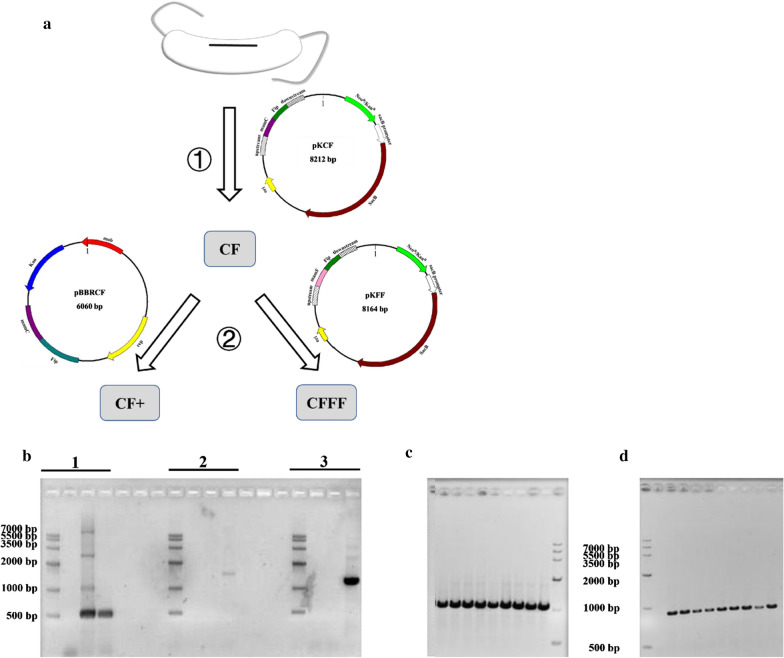
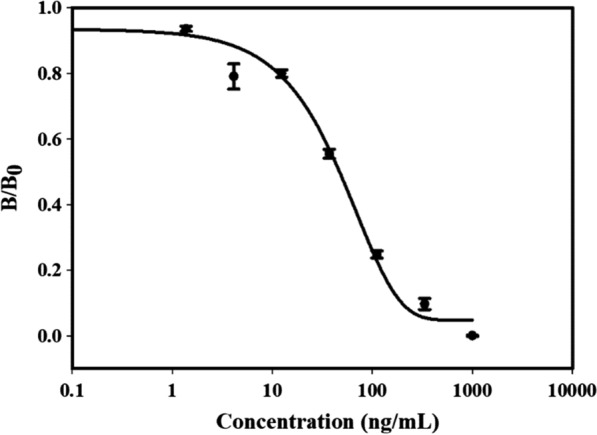
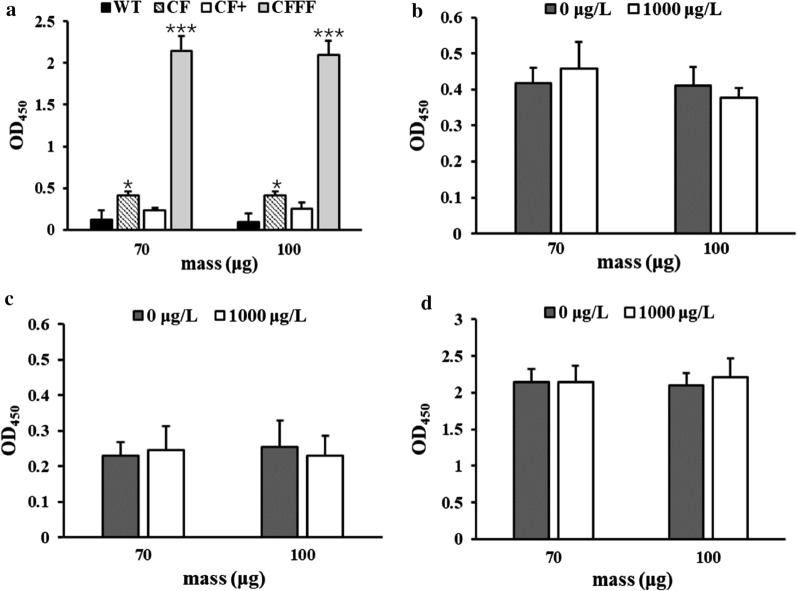
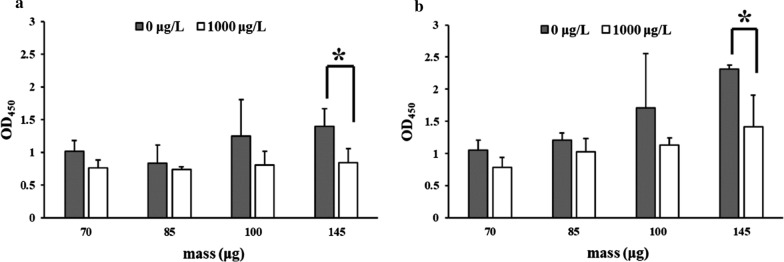
Three recombinant magnetotactic bacteria (CF, CF+ , and CFFF) biomineralizing magnetosomes with different abundance of Nbs displayed on the surface were constructed. Compared to magnetosomes from the wild type Magnetospirillum gryphiswaldense MSR-1, all of the Nb-magnetosomes biosynthesized by strains CF, CF+ , and CFFF showed a detectable level of binding capability to fipronil-horseradish peroxidase (H2-HRP), but none of them recognized free fipronil. The Nb-magnetosomes from CFFF were oxidized with HO or a glutathione mixture consisting of reduced glutathione and oxidized glutathione in vitro and their binding affinity to H2-HRP was decreased, whereas that to free fipronil was enhanced. The magnetosomes treated with the glutathione mixture were employed to develop an enzyme-linked immunosorbent assay for the detection of fipronil in water samples, with average recoveries in a range of 78-101%.
The economical and environmental-friendly Nb-magnetosomes biomineralized by the bacterial strain MSR-1 can be potentially applied to nanobody-based immunoassays for the detection of fipronil or nanobody-based assays in general.
经过抗体修饰的磁性纳米粒子,如磁小体,能够提高与目标物相互作用的可能性。由趋磁细菌生物矿化的磁小体具有均匀的纳米级尺寸和结晶结构,以及较高的热稳定性和胶体稳定性。骆驼科衍生的纳米体(Nbs)体积小、热稳定性高、高度水溶、易于生产,并且可与磁小体融合。我们旨在对 Nb-磁小体进行功能化,以分析杀虫剂氟虫腈。
构建了三种不同丰度的表面展示纳米体的重组趋磁细菌(CF、CF+和 CFFF)。与野生型格氏嗜甲基菌 MSR-1 的磁小体相比,CF、CF+和 CFFF 三株菌合成的 Nb-磁小体均表现出对氟虫腈-辣根过氧化物酶(H2-HRP)的可检测结合能力,但均不能识别游离的氟虫腈。体外将 CFFF 来源的 Nb-磁小体用 HO 或包含还原型谷胱甘肽和氧化型谷胱甘肽的谷胱甘肽混合物氧化后,其与 H2-HRP 的结合亲和力降低,而与游离氟虫腈的结合亲和力增强。利用谷胱甘肽混合物处理的磁小体开发了用于水样中氟虫腈检测的酶联免疫吸附测定法,平均回收率在 78-101%范围内。
由 MSR-1 细菌生物矿化的经济环保型 Nb-磁小体可潜在应用于基于纳米体的免疫测定法,以检测氟虫腈或一般的纳米体测定法。