Rikhtegar Reza, Mosimann Pascal John, Weber Ralph, Wallocha Marta, Yamac Elif, Mirza-Aghazadeh-Attari Mohammad, Chapot René
Department of Intracranial Endovascular Therapy, Alfried Krupp Krankenhaus Essen, Essen, Germany.
Department of Neurology, Alfried Krupp Krankenhaus Essen, Essen, Germany.
J Neurointerv Surg. 2021 Dec;13(12):1067-1072. doi: 10.1136/neurintsurg-2020-017035. Epub 2021 Jan 19.
Recent progress with smaller retrievers has expanded the ability to reach distal brain arteries. We herein report recanalization, bleeding complications and short-term clinical outcomes with the smallest currently known low profile thrombectomy device in patients with primary or secondary distal medium vessel occlusion (DMVO).
We performed a retrospective analysis of 115 patients receiving mechanical thrombectomy (MT) in DMVO using the extended Thrombolysis in Cerebral Infarction (eTICI), European Cooperative Acute Stroke Study (ECASS) II classification, The National Institutes of Health Stroke Scale (NIHSS) and modified Rankin Scale (mRS) scores at admission and discharge to evaluate outcomes. Patients were stratified into three groups: (1) primary isolated distal occlusion (n=34), (2) secondary distal occlusion after MT of a proximal vessel occlusion (n=71), or (3) during endovascular treatment of aneurysms or arteriovenous malformations (AVMs) (n=10).
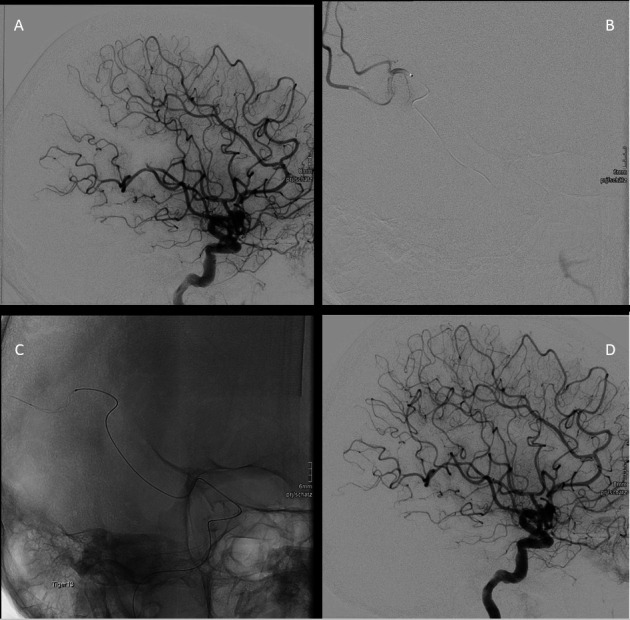
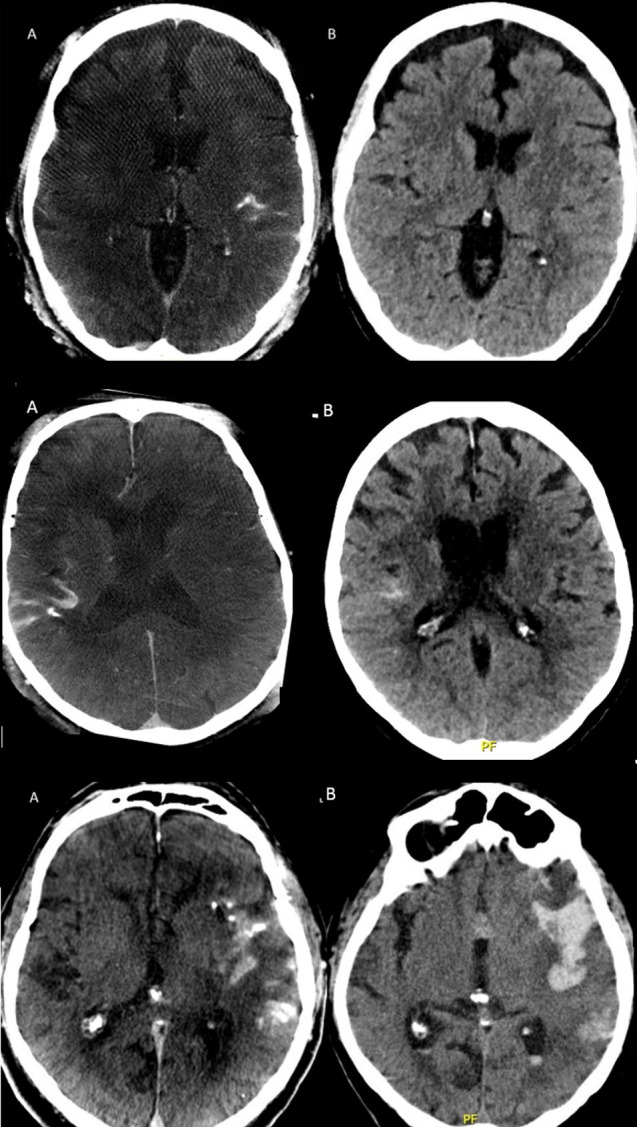
Successful distal recanalization, defined as an eTICI score of 2b67, 2c and 3, was achieved in 74.7% (86/115) of patients. More specifically, it was 70.5% (24/34), 73.2% (52/71), and 100% (10/10) of primary DMVO, secondary DMVO after proximal MT, and rescue MT during aneurysm or AVM embolization, respectively. Symptomatic intraparenchymal bleeding occurred in 6.9% (eight patients). In-hospital mortality occurred in 18.1% (19/105) of patients with stroke. The most common cause of death was large infarct, old age, and therapy limitation.
Direct or rescue MT of DMVO using a very low profile thrombectomy device is associated with a high rate of successful recanalization and a reasonable rate of symptomatic hemorrhagic complication, despite a risk of 18.1% hospital mortality in elderly patients. Further trials are needed to confirm our results and assess long-term clinical outcomes.
近年来,尺寸更小的取栓装置取得的进展扩大了到达大脑远端动脉的能力。我们在此报告使用目前已知最小的低轮廓血栓切除术装置,对原发性或继发性远端中血管闭塞(DMVO)患者进行再通、出血并发症及短期临床结局的情况。
我们对115例接受DMVO机械取栓(MT)的患者进行回顾性分析,采用脑梗死溶栓扩展(eTICI)、欧洲急性卒中协作研究(ECASS)II分类、美国国立卫生研究院卒中量表(NIHSS)及改良Rankin量表(mRS)评分,在入院和出院时评估结局。患者被分为三组:(1)原发性孤立远端闭塞(n = 34),(2)近端血管闭塞MT术后继发性远端闭塞(n = 71),或(3)在动脉瘤或动静脉畸形(AVM)血管内治疗期间(n = 10)。
74.7%(86/115)的患者实现了成功的远端再通,定义为eTICI评分为2b/67、2c和3。更具体地说,原发性DMVO、近端MT术后继发性DMVO及动脉瘤或AVM栓塞期间的补救性MT分别为70.5%(24/34)、73.2%(52/71)和100%(10/10)。症状性脑实质内出血发生在6.9%(8例患者)。18.1%(19/105)的卒中患者发生院内死亡。最常见的死亡原因是大面积梗死、高龄和治疗受限。
尽管老年患者有18.1%的院内死亡风险,但使用极低轮廓血栓切除术装置对DMVO进行直接或补救性MT与较高的成功再通率及合理的症状性出血并发症发生率相关。需要进一步试验来证实我们的结果并评估长期临床结局。