Department of Neurology, Beijing Tiantan Hospital, Capital Medical University, Beijing, China.
China National Clinical Research Center for Neurological Diseases, Beijing, China.
Stroke Vasc Neurol. 2021 Sep;6(3):359-365. doi: 10.1136/svn-2020-000430. Epub 2021 Jan 19.
Both the magnitude and cumulative exposure of atherogenic lipoproteins have an impact on the atherosclerosis risk, and the exploration focus has shifted from one single lipoprotein assessment to the cumulative exposure of lipoproteins. We aim to investigate the relationship between cumulative exposure to different lipid parameters and the risk of newly developed carotid plaque in this study.
In the Asymptomatic Polyvascular Abnormalities Community study, 2947 participants were included with follow-up every 2 years from 2006 to 2012. Lipid parameters including total cholesterol (TC), triglycerides (TGs), low-density lipoprotein cholesterol (LDLC), high-density lipoprotein cholesterol (HDLC) and non-HDLC were measured. Cumulative exposure was calculated by adding the weighted sum of the difference between the measured value and the cut-off value of each parameter. Newly developed carotid plaques were identified by carotid ultrasound performed at the third and fourth follow-ups.
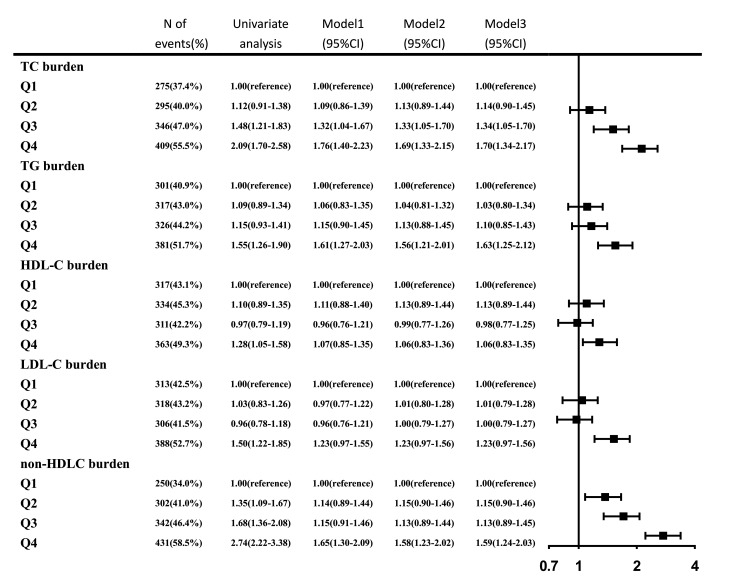
In the univariate analysis, non-HDLC burden had the highest ORs among the five lipid parameters for newly developed carotid plaque in each quartile, as 1.0 (reference), 1.35 (1.09-1.67), 1.68 (1.36-2.08) and 2.74 (2.22-3.38) from the lowest to the highest quartile. In the multivariate analysis and sensitivity analysis, we obtained similar results.
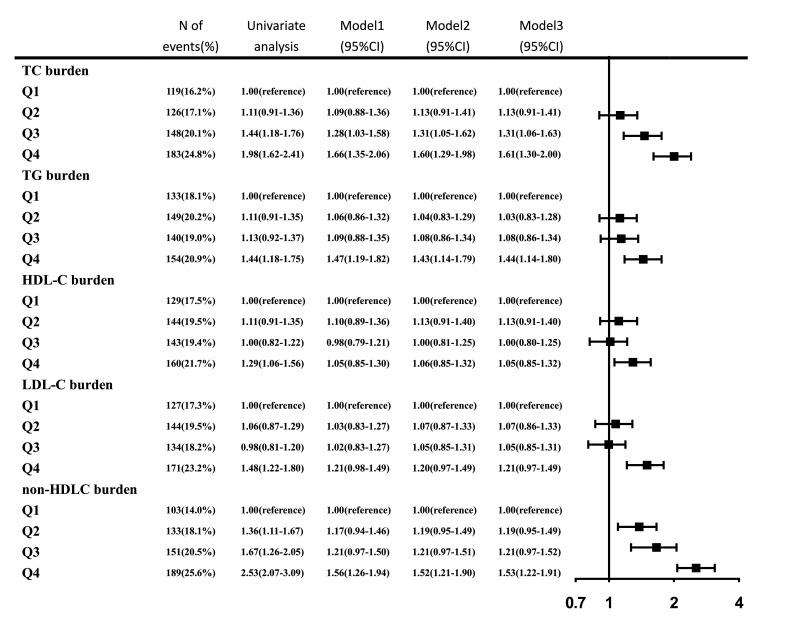
TC burden, TG burden, LDLC burden and non-HDLC burden are all independent risk factors for newly developed carotid plaque, especially for the vulnerable plaques. Among lipid parameters, non-HDLC burden is an optimal predictor. Moreover, the predictive value remained significant for participants under the age of 65 years old or free of hypertension, diabetes mellitus and hyperlipidaemia.
载脂蛋白的水平和累积暴露量都会影响动脉粥样硬化的风险,因此研究重点已从单一脂蛋白评估转移到脂蛋白的累积暴露量。本研究旨在探讨不同脂质参数的累积暴露与新发颈动脉斑块风险之间的关系。
在无症状多血管异常社区研究中,纳入了 2947 名参与者,从 2006 年至 2012 年,每 2 年进行一次随访。测量了总胆固醇(TC)、甘油三酯(TGs)、低密度脂蛋白胆固醇(LDLC)、高密度脂蛋白胆固醇(HDLC)和非高密度脂蛋白胆固醇(non-HDLC)等脂质参数。累积暴露量通过计算每个参数的测量值与截止值之间的差值的加权和来计算。通过第三次和第四次随访时进行的颈动脉超声检查来确定新发颈动脉斑块。
在单变量分析中,在每个四分位数中,非 HDLC 负荷与五种脂质参数中其他参数相比,与新发颈动脉斑块的相关性最高,其比值比(OR)分别为 1.0(参考)、1.35(1.09-1.67)、1.68(1.36-2.08)和 2.74(2.22-3.38),从最低到最高四分位数。在多变量分析和敏感性分析中,我们得到了相似的结果。
TC 负荷、TG 负荷、LDLC 负荷和非 HDLC 负荷均为新发颈动脉斑块的独立危险因素,尤其是易损斑块。在脂质参数中,非 HDLC 负荷是最佳预测指标。此外,该预测值在年龄小于 65 岁或无高血压、糖尿病和高脂血症的参与者中仍然显著。