Department of Biochemistry and Cell Biology, School of Medicine, Kyungpook National University, Daegu, 41944, Republic of Korea.
BK21 Plus KNU Biomedical Convergence Program, Department of Biomedical Science, Kyungpook National University, Daegu, 41944, Republic of Korea.
Sci Rep. 2021 Jan 19;11(1):1794. doi: 10.1038/s41598-021-81260-1.
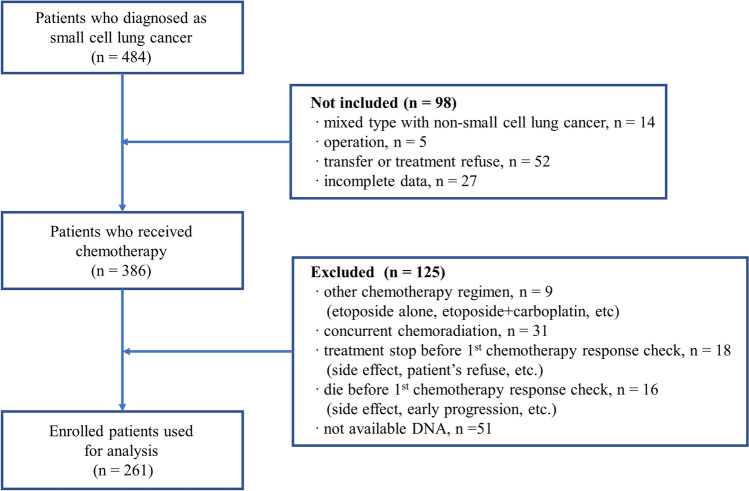
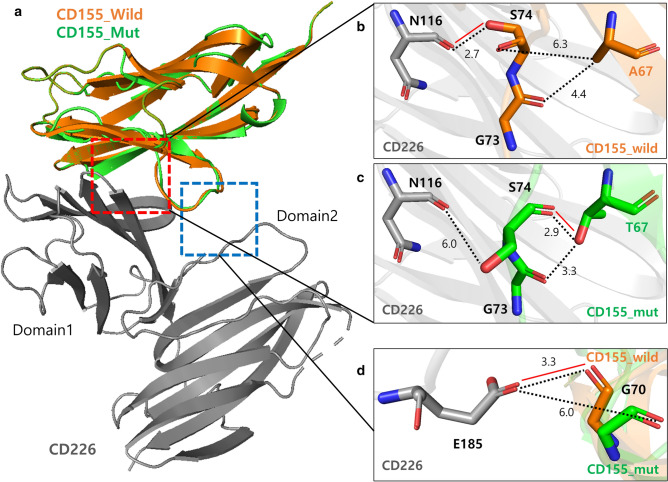
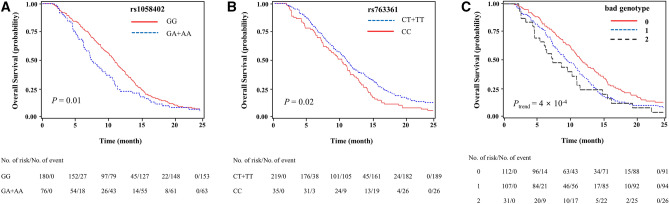
This study was conducted to investigate the impact of genetic variants of immune checkpoint genes on the treatment outcome in small cell lung cancer (SCLC). In the present study, 261 platinum doublet-treated SCLC patients were enrolled. A total of 96 polymorphisms in 33 immune checkpoint-related genes were selected, and their association with chemotherapy response and survival outcomes were analyzed. Among the polymorphisms studied, CD155 rs1058402G > A (Ala67Thr, A67T) and CD226 rs763361C > T (Gly307Ser, G307S) were significantly associated with SCLC treatment outcome. The rs1058402G > A had a worse chemotherapy response and overall survival (under a dominant model, adjusted odds ratio [aOR] = 0.52, 95% confidence interval [CI] = 0.27-0.99, P = 0.05; adjusted hazard ratio [aHR] = 1.55, 95% CI = 1.12-2.14, P = 0.01, respectively). The rs763361C > T had better chemotherapy response and overall survival (under a dominant model, aOR = 2.03, 95% CI = 1.10-3.75, P = 0.02; aHR = 0.69, 95% CI = 0.51-0.94, P = 0.02, respectively). When the rs1058402GA/AA and rs763361CC genotypes were combined, the chemotherapy response and overall survival were significantly decreased as the number of bad genotypes increased (aOR = 0.52, 95% CI = 0.33-0.81, Ptrend = 0.004; aHR = 1.48, 95% CI = 1.19-1.84, Ptrend = 4 × 10, respectively). The 3-D structural model showed that CD155 A67T created a new hydrogen bond and structural change on CD155. These changes resulted in extending the distance and losing the hydrogen bonds between CD155 and CD226, thus weakening CD155/CD226 binding activity. In conclusion, CD155 rs1058402G > A and CD226 rs763361C > T may be useful for predicting the clinical outcomes of SCLC patients after chemotherapy.
本研究旨在探讨免疫检查点基因的遗传变异对小细胞肺癌(SCLC)治疗结果的影响。本研究纳入了 261 例接受铂类双联化疗的 SCLC 患者。选择了 33 个免疫检查点相关基因中的 96 个多态性,分析它们与化疗反应和生存结局的关系。在研究的多态性中,CD155 rs1058402G>A(Ala67Thr,A67T)和 CD226 rs763361C>T(Gly307Ser,G307S)与 SCLC 治疗结果显著相关。rs1058402G>A 在显性模型下与化疗反应和总生存期较差相关(调整优势比[aOR] = 0.52,95%置信区间[CI] = 0.27-0.99,P = 0.05;调整风险比[aHR] = 1.55,95%CI = 1.12-2.14,P = 0.01)。rs763361C>T 在显性模型下与化疗反应和总生存期较好相关(调整优势比[aOR] = 2.03,95%置信区间[CI] = 1.10-3.75,P = 0.02;调整风险比[aHR] = 0.69,95%CI = 0.51-0.94,P = 0.02)。当 rs1058402GA/AA 和 rs763361CC 基因型组合时,随着不良基因型数量的增加,化疗反应和总生存期显著下降(调整优势比[aOR] = 0.52,95%置信区间[CI] = 0.33-0.81,Ptrend = 0.004;调整风险比[aHR] = 1.48,95%CI = 1.19-1.84,Ptrend = 4×10)。3D 结构模型显示,CD155 A67T 在 CD155 上产生了新的氢键和结构变化。这些变化导致 CD155 与 CD226 之间的距离延长并失去氢键,从而削弱了 CD155/CD226 结合活性。总之,CD155 rs1058402G>A 和 CD226 rs763361C>T 可能有助于预测 SCLC 患者化疗后的临床结局。