Department of Psychiatry, University of WI - Madison, 6001 Research Park Boulevard, Madison, WI, 53719-1176, USA.
Sci Rep. 2021 Jan 19;11(1):1825. doi: 10.1038/s41598-020-80776-2.
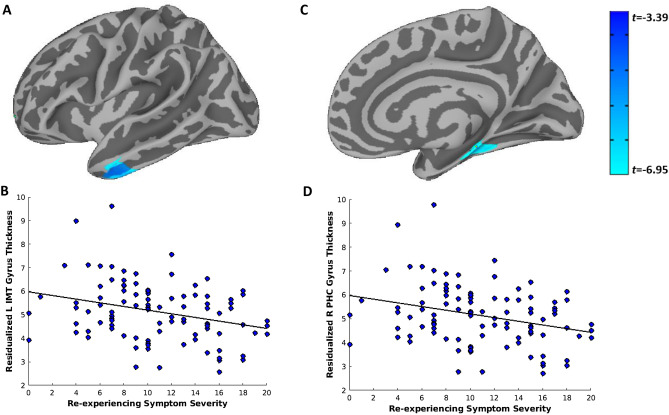
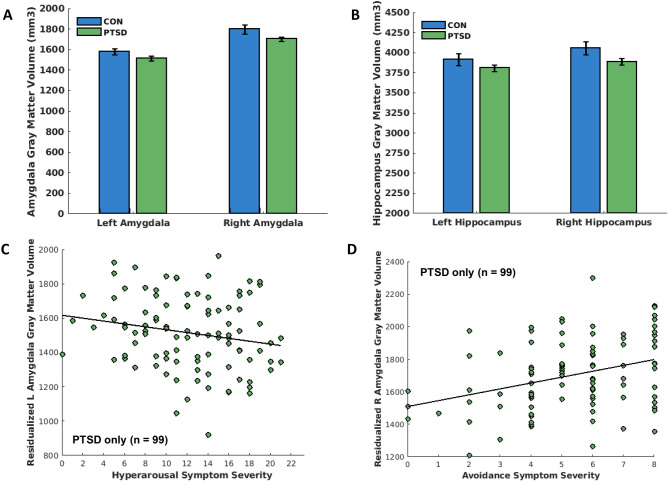
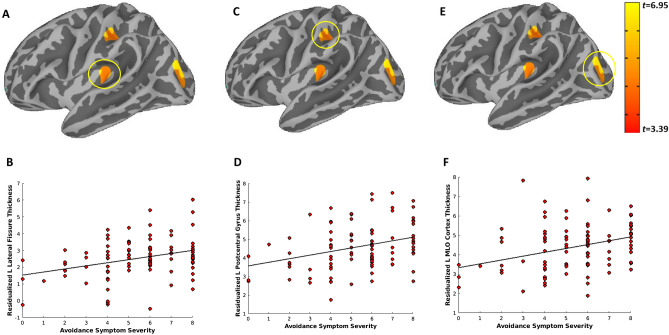
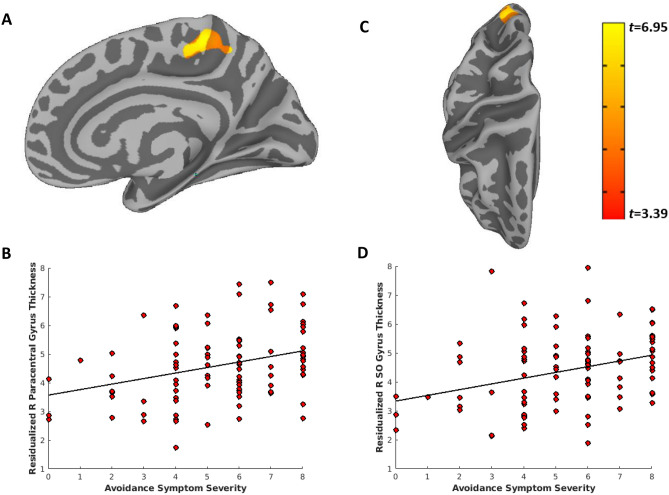
Structural neuroimaging studies of posttraumatic stress disorder (PTSD) have typically reported reduced cortical thickness (CT) and gray matter volume (GMV) in subcortical structures and networks involved in memory retrieval, emotional processing and regulation, and fear acquisition and extinction. Although PTSD is more common in women, and interpersonal violence (IPV) exposure is a more potent risk factor for developing PTSD relative to other forms of trauma, most of the existing literature examined combat-exposed men with PTSD. Vertex-wise CT and subcortical GMV analyses were conducted to examine potential differences in a large, well-characterized sample of women with PTSD stemming from IPV-exposure (n = 99) compared to healthy trauma-free women without a diagnosis of PTSD (n = 22). Subgroup analyses were also conducted to determine whether symptom severity within specific PTSD symptom clusters (e.g., re-experiencing, active avoidance, hyperarousal) predict CT and GMV after controlling for comorbid depression and anxiety. Results indicated that a diagnosis of PTSD in women with IPV-exposure did not significantly predict differences in CT across the cortex or GMV in the amygdala or hippocampus compared to healthy controls. However, within the PTSD group, greater re-experiencing symptom severity was associated with decreased CT in the left inferior and middle temporal gyrus, and decreased CT in the right parahippocampal and medial temporal gyrus. In contrast, greater active avoidance symptom severity was associated with greater CT in the left lateral fissure, postcentral gyrus, and middle/lateral occipital cortex, and greater CT in the right paracentral, posterior cingulate, and superior occipital gyrus. In terms of GMV, greater hyperarousal symptom severity was associated with reduced left amygdala GMV, while greater active avoidance symptom severity was associated with greater right amygdala GMV. These findings suggest that structural brain alterations among women with IPV-related PTSD may be driven by symptom severity within specific symptom clusters and that PTSD symptom clusters may have a differential (increased or decreased) association with brain structures.
创伤后应激障碍(PTSD)的结构神经影像学研究通常报告,在涉及记忆检索、情绪处理和调节以及恐惧获得和消退的皮质下结构和网络中,皮质厚度(CT)和灰质体积(GMV)减少。尽管 PTSD 在女性中更为常见,并且与其他形式的创伤相比,人际暴力(IPV)暴露是发展 PTSD 的更强有力风险因素,但大多数现有文献研究的是经历过战斗的 PTSD 男性。进行了顶点 CT 和皮质下 GMV 分析,以检查源自 IPV 暴露的 PTSD 女性(n=99)与无 PTSD 诊断的健康无创伤女性(n=22)之间的潜在差异。还进行了亚组分析,以确定 PTSD 特定症状群(例如,再体验、主动回避、高度警觉)内的症状严重程度是否在控制共病抑郁和焦虑后预测 CT 和 GMV。结果表明,与健康对照组相比,IPV 暴露的 PTSD 女性的诊断并不能显著预测整个大脑皮层的 CT 差异或杏仁核或海马的 GMV。然而,在 PTSD 组内,再体验症状严重程度与左侧颞下回的 CT 降低和右侧海马旁回和内侧颞叶的 CT 降低有关。相比之下,主动回避症状严重程度与左侧外侧裂、中央后回和中侧枕叶皮质的 CT 增加以及右侧旁中央、后扣带回和上顶叶的 CT 增加有关。就 GMV 而言,更大的高度警觉症状严重程度与左侧杏仁核 GMV 减少有关,而更大的主动回避症状严重程度与右侧杏仁核 GMV 增加有关。这些发现表明,与 IPV 相关 PTSD 的女性的结构脑改变可能是由特定症状群内的症状严重程度驱动的,并且 PTSD 症状群可能与大脑结构具有不同的(增加或减少)关联。