Department of Fundamental Microbiology, University of Lausanne, CH-1015, Lausanne, Switzerland.
Commun Biol. 2021 Jan 19;4(1):87. doi: 10.1038/s42003-020-01581-1.
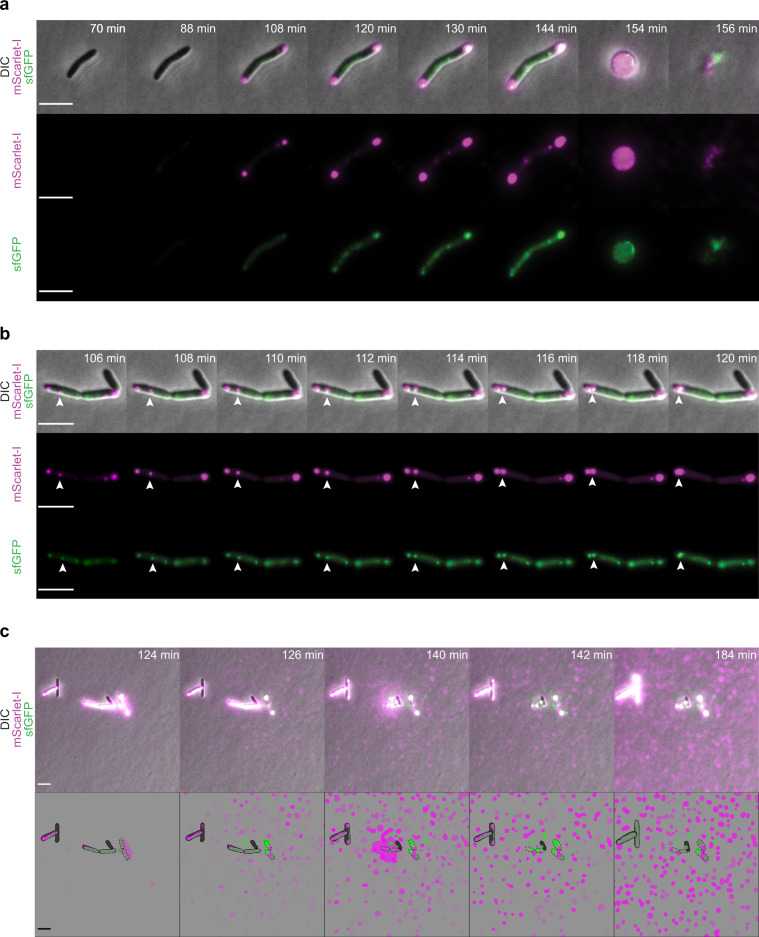
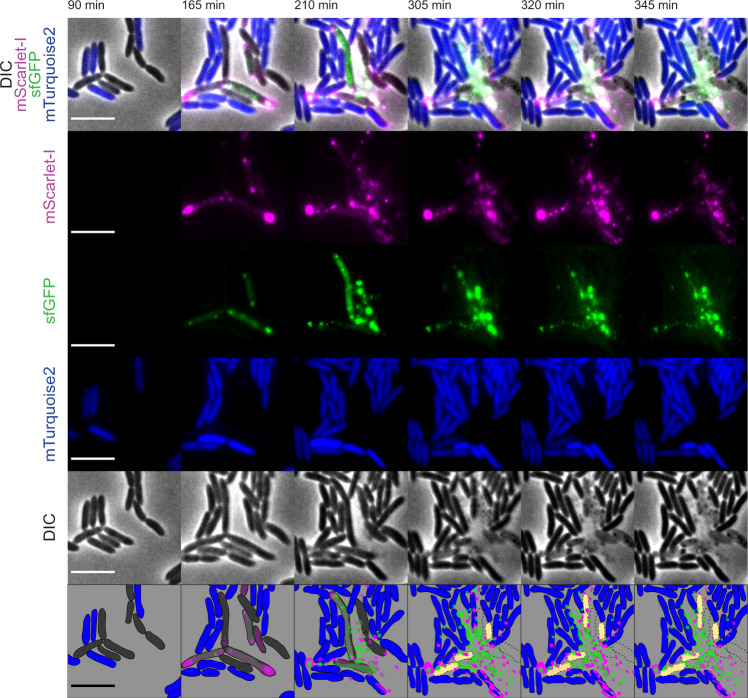
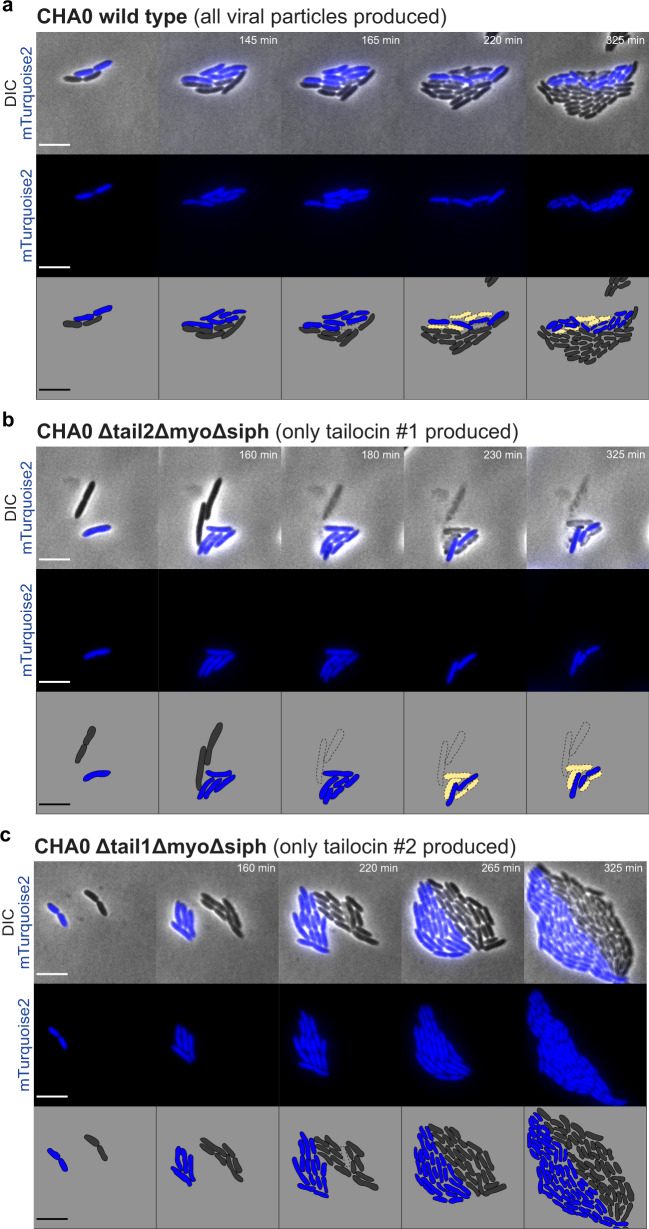
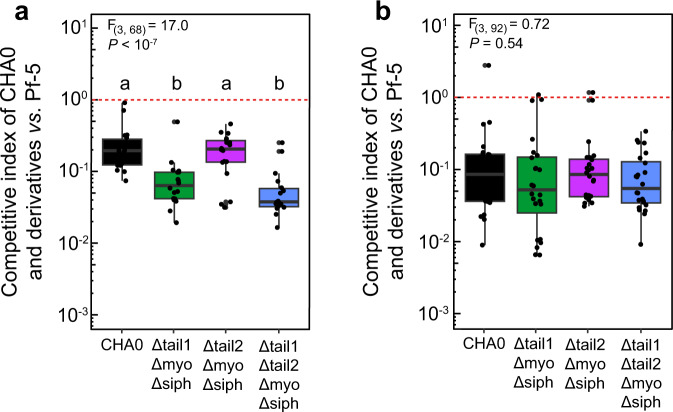
Interference competition among bacteria requires a highly specialized, narrow-spectrum weaponry when targeting closely-related competitors while sparing individuals from the same clonal population. Here we investigated mechanisms by which environmentally important Pseudomonas bacteria with plant-beneficial activity perform kin interference competition. We show that killing between phylogenetically closely-related strains involves contractile phage tail-like devices called R-tailocins that puncture target cell membranes. Using live-cell imaging, we evidence that R-tailocins are produced at the cell center, transported to the cell poles and ejected by explosive cell lysis. This enables their dispersal over several tens of micrometers to reach targeted cells. We visualize R-tailocin-mediated competition dynamics between closely-related Pseudomonas strains at the single-cell level, both in non-induced condition and upon artificial induction. We document the fatal impact of cellular self-sacrifice coupled to deployment of phage tail-like weaponry in the microenvironment of kin bacterial competitors, emphasizing the necessity for microscale assessment of microbial competitions.
当针对密切相关的竞争者时,细菌之间的干扰竞争需要高度专业化、狭窄谱的武器,同时避免来自同一克隆群体的个体受到影响。在这里,我们研究了具有植物有益活性的重要环境 Pseudomonas 细菌进行亲缘干扰竞争的机制。我们表明,具有密切亲缘关系的菌株之间的杀伤涉及称为 R-尾菌素的收缩噬菌体尾状装置,它们刺穿靶细胞膜。使用活细胞成像,我们证明 R-尾菌素在细胞中心产生,被运输到细胞两极,并通过爆炸性细胞裂解射出。这使得它们能够在数十微米的距离内扩散以到达靶细胞。我们在单细胞水平上可视化了密切相关的 Pseudomonas 菌株之间的 R-尾菌素介导的竞争动态,包括在非诱导条件下和人工诱导下。我们记录了细胞自我牺牲与噬菌体尾状武器在亲缘细菌竞争者微环境中的部署相结合的致命影响,强调了在微生物竞争的微尺度评估的必要性。