Sobolewska Marta, Krzyżanowska Dorota M, Borowicz Marcin, Czajkowski Robert
Laboratory of Biologically Active Compounds, Intercollegiate Faculty of Biotechnology, University of Gdańsk and Medical University of Gdańsk, University of Gdańsk, A. Abrahama 58, Gdańsk, 80-307, Poland.
Laboratory of Plant Microbiology, Intercollegiate Faculty of Biotechnology, University of Gdańsk and Medical University of Gdańsk, University of Gdańsk, A. Abrahama 58, Gdańsk, 80-307, Poland.
Sci Rep. 2025 Jul 26;15(1):27234. doi: 10.1038/s41598-025-13158-1.
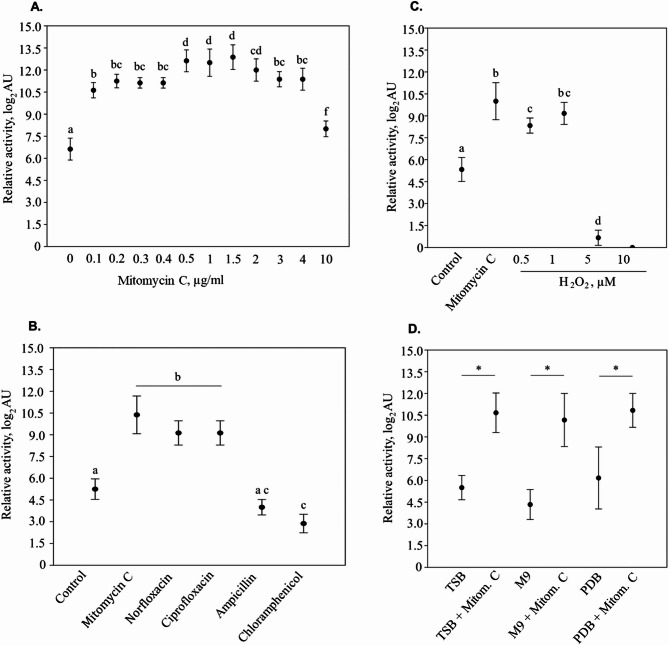
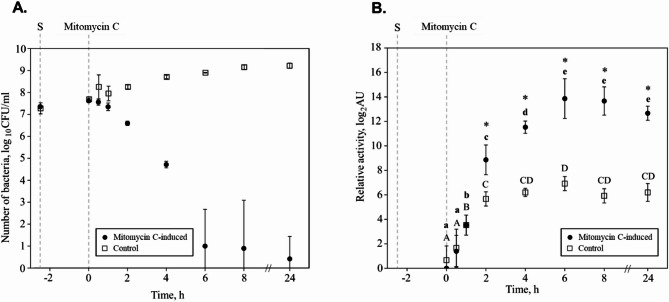
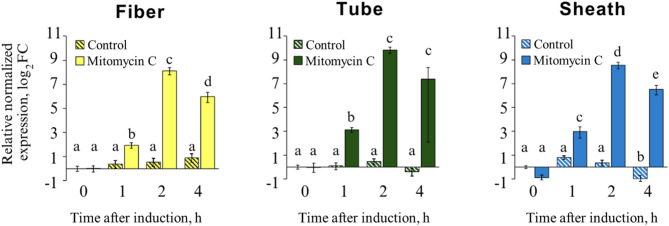
Tailocins are bacteriocins resembling bacteriophage tails. Previously, we reported the production of tailocins in the plant pathogen Dickeya dadantii 3937, the synthesis of which was upregulated upon treatment with mitomycin C. In this study, we investigated how mitomycin treatment over time influences the expression of tailocin-related genes, the accumulation of tailocin particles, and the survival of producer cells. The expression of tailocin P2D1 structural genes peaks two hours after the addition of mitomycin C as measured with an RT-qPCR assay. Simultaneous measurements of tailocin titer revealed that the concentration of the particles in the culture supernatant peaked 6 h after induction and remained stable for at least 18 h. Progressive accumulation of P2D1 that occurred from 2 to 6 h after mitomycin C treatment was associated with a substantial decrease in viable cells of the tailocin-producing strain (ca. 100,000-fold). Decreased cell viability upon tailocin production indicates that they are released from the cells upon cell lysis. Likewise, we found new potent inducers, viz., hydrogen peroxide and antibiotics affecting DNA replication and repair (viz. norfloxacin and ciprofloxacin), that can increase tailocin yield in D. dadantii 3937.
尾菌素是一类类似于噬菌体尾部的细菌素。此前,我们报道了植物病原菌达旦氏果胶杆菌3937能够产生尾菌素,其合成在丝裂霉素C处理后会上调。在本研究中,我们调查了丝裂霉素随时间的处理如何影响尾菌素相关基因的表达、尾菌素颗粒的积累以及产生菌细胞的存活情况。用RT-qPCR分析测定,尾菌素P2D1结构基因的表达在添加丝裂霉素C两小时后达到峰值。同时测量尾菌素效价发现,培养上清液中颗粒浓度在诱导6小时后达到峰值,并至少稳定18小时。丝裂霉素C处理后2至6小时发生的P2D1的逐步积累与尾菌素产生菌株的活细胞大量减少(约100,000倍)相关。尾菌素产生时细胞活力的降低表明它们是在细胞裂解时从细胞中释放出来的。同样,我们发现了新的有效诱导剂,即过氧化氢和影响DNA复制和修复的抗生素(即诺氟沙星和环丙沙星),它们可以提高达旦氏果胶杆菌3937中尾菌素的产量。