Department of Health Administration and Public Health, John G. Rangos School of Health Sciences, Duquesne University, 600 Forbes Avenue, Pittsburgh, PA, 15282, USA.
Rollins School of Public Health, Emory University, Atlanta, GA, USA.
J Racial Ethn Health Disparities. 2022 Feb;9(1):367-375. doi: 10.1007/s40615-021-00965-1. Epub 2021 Jan 19.
This study's objective was to examine the association of the percentage of county population residing in concentrated disadvantage and Black-concentrated census tracts with county-level confirmed COVID-19 deaths in the USA, concentrated disadvantage and Black concentration at census tract-level measure socioeconomic segregation and racial segregation, respectively.
We performed secondary data analysis using tract (N = 73,056) and county (N = 3142) level data from the US Census Bureau and other sources for the USA. Confirmed COVID-19 deaths per 100,000 population was our outcome measure. We performed mixed-effect negative binomial regression to examine the association of county population's percentage residing in concentrated disadvantage and Black-concentrated tracts with COVID-19 deaths while controlling for several other characteristics.
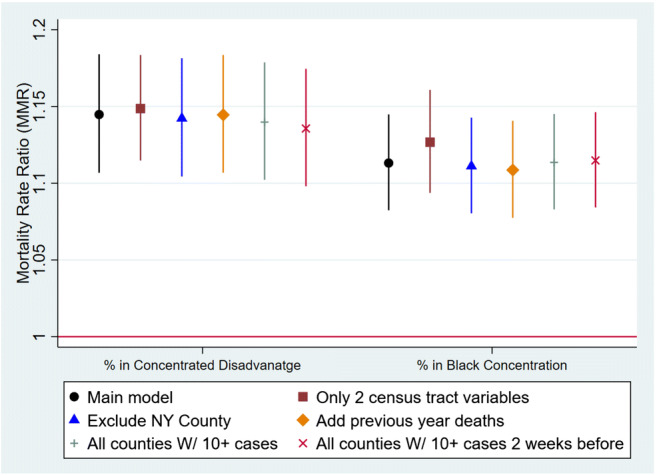
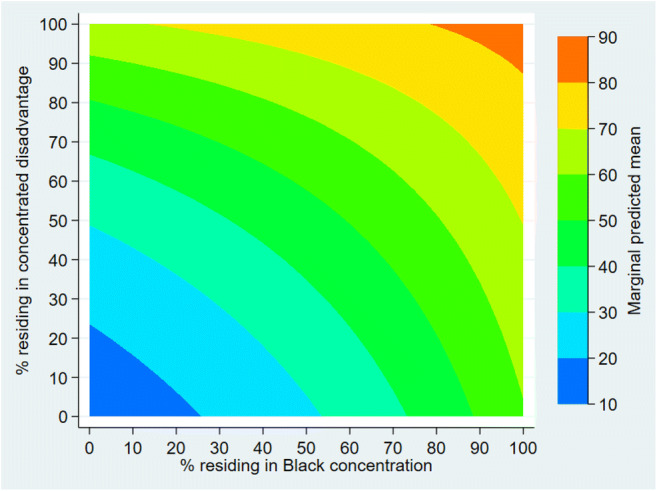
For every 10% increase in the percentage of county population residing in concentrated disadvantage and Black-concentrated tracts, the rate for confirmed COVID-19 deaths per 100,000 population increases by a factor of 1.14 (mortality rate ratio [MMR] = 1.14; 95% confidence interval [CI]:1.11, 1.18) and 1.11 (MMR = 1.11; 95% CI:1.08, 1.14), respectively. These relations stayed significant in all models in further sensitivity analyses. Moreover, a joint increase in the percentage of county population residing in racial and socioeconomic segregation was associated with a much greater increase in COVID-19 deaths.
It appears that people living in socioeconomically and racially segregated neighborhoods may be disproportionately impacted by COVID-19 deaths. Future multilevel and longitudinal studies with data at both individual and aggregated tract level can help isolate the potential impacts of the individual-level characteristics and neighborhood-level socioeconomic and racial segregation with more precision and confidence.
本研究旨在探讨美国县人口居住在集中劣势和黑人聚居区的比例与县一级确诊 COVID-19 死亡人数之间的关联,集中劣势和黑人聚居区的比例分别衡量社会经济隔离和种族隔离。
我们使用美国人口普查局和其他来源的县(N=3142)和普查区(N=73056)水平数据进行二次数据分析。每 10 万人口确诊 COVID-19 死亡人数是我们的结果衡量标准。我们进行混合效应负二项回归分析,以控制其他几个特征,检验县人口居住在集中劣势和黑人聚居区的比例与 COVID-19 死亡之间的关联。
每增加 10%的县人口居住在集中劣势和黑人聚居区的比例,每 10 万人口确诊 COVID-19 死亡人数的增长率为 1.14(死亡率比 [MMR] = 1.14;95%置信区间 [CI]:1.11,1.18)和 1.11(MMR=1.11;95% CI:1.08,1.14)。在所有模型中,这些关系在进一步的敏感性分析中仍然显著。此外,县人口居住在种族和社会经济隔离程度增加与 COVID-19 死亡人数的增加呈正相关。
生活在社会经济和种族隔离社区的人似乎受到 COVID-19 死亡的不成比例的影响。未来在个体和聚合普查区层面都有数据的多层次和纵向研究可以帮助更准确和有信心地隔离个体层面特征和邻里层面社会经济和种族隔离的潜在影响。