Biomedical Science Department, College of Health Sciences, Biomedical Research Center, Qatar University, P.O. Box 2713, Doha, Qatar.
School of Life Sciences, University of Nottingham, University Park, Nottingham, NG7 2RD, UK.
Parasit Vectors. 2021 Jan 20;14(1):63. doi: 10.1186/s13071-020-04449-9.
The rapid growth of Qatar in the last two decades has been associated with an enormous expansion of building programs in its cities and in the provision of new service industries. This in turn has attracted a large influx of immigrant workers seeking employment in jobs associated with food handling, domestic service, and the building industry. Many of these immigrants come from countries in the tropics and subtropics where intestinal parasitic infections are common. In this study, we explored the environmental and socio-demographic characteristics of immigrant workers in Doha Qatar, which might explain the persistence of the parasites that they harbor.
This cross-sectional survey was conducted among 2486 newly arrived immigrant workers and those who visited Qatar previously during the period 2012-2014. Through questionnaires and census data, we characterized the socio-demographic conditions at an individual, family, and neighborhood levels.
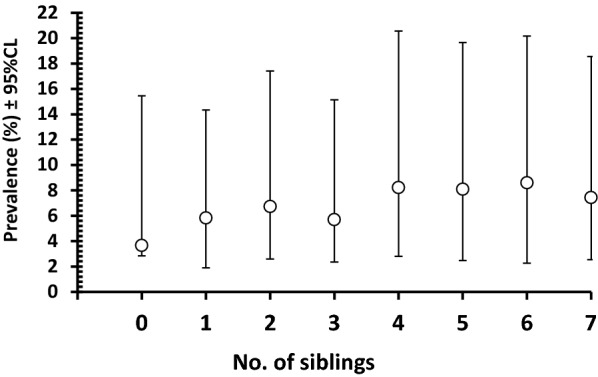
Overall, the prevalence of combined protozoan infection was 11.7% and that of helminth was 7.0%. Combined protozoan infections were significantly associated with immigrant workers arriving in Doha for the first time. In univariate log-linear statistical models fitted in phase 1 of the analysis, significant associations were observed between the prevalence of combined protozoan infections and personal and familial factors that included religion, the level of education of subjects, both parents' educational levels and their jobs, and the number of siblings. Furthermore, environmental effects on the prevalence of protozoan infections including the country of origin, the floor of the house, toilet type, household content index, provision of household water, farming background showed strong associations with protozoan infections. However, in phase 2, multifactorial binary logistic generalized linear models focusing only on the significant effects identified in phase 1, showed that only five factors retained significance (age class, floor of the house, household contents index, father's education, and the number of siblings). The only factors that had a significant effect on the prevalence of helminth infections were the subjects' age class and the mother's educational level.
The prevalence of intestinal protozoan parasites among immigrant workers in Qatar is clearly multifactorial in origin determined by key familial relationships of subjects and also the environment, in which the subjects lived prior to their arrival in Qatar. Moreover, our results suggest that screening protocols for applicants for visas/work permits need to be revised giving more careful attention to the intestinal protozoan infections that potential immigrant workers may harbor.
在过去的二十年中,卡塔尔经历了快速发展,城市建设和新服务行业的飞速扩张。这反过来又吸引了大量移民工人前来寻求与食品处理、家政服务和建筑行业相关的工作。这些移民工人很多来自热带和亚热带国家,那里常见肠道寄生虫感染。在这项研究中,我们探索了卡塔尔多哈移民工人的环境和社会人口学特征,这些特征可能解释了他们所携带的寄生虫的持续存在。
这项横断面调查是在 2012 年至 2014 年间新抵达的 2486 名移民工人和之前曾访问过卡塔尔的移民工人中进行的。通过问卷调查和人口普查数据,我们描述了个体、家庭和社区层面的社会人口学状况。
总体而言,原生动物合并感染的患病率为 11.7%,蠕虫感染的患病率为 7.0%。原生动物合并感染与首次抵达多哈的移民工人显著相关。在分析第一阶段拟合的单变量对数线性统计模型中,观察到原生动物合并感染的患病率与个人和家庭因素之间存在显著关联,包括宗教、调查对象的教育水平、父母双方的教育水平和职业以及兄弟姐妹的数量。此外,原生动物感染的环境影响,包括原籍国、房屋楼层、厕所类型、家庭内容指数、家庭供水提供情况、农耕背景等,与原生动物感染呈强烈关联。然而,在第二阶段,仅关注第一阶段确定的显著影响的多因素二元逻辑广义线性模型显示,只有五个因素具有显著性(年龄组、房屋楼层、家庭内容指数、父亲教育程度和兄弟姐妹数量)。对蠕虫感染患病率有显著影响的唯一因素是受检者的年龄组和母亲的教育水平。
卡塔尔移民工人中肠道原生动物寄生虫的患病率显然是多因素的,这是由受检者的主要家庭关系以及他们在抵达卡塔尔之前所处的环境决定的。此外,我们的研究结果表明,签证/工作许可证申请人的筛选方案需要进行修订,更仔细地关注潜在移民工人可能携带的肠道原生动物感染。