Department of Medicine, University of Tennessee Health Science Center, Memphis, TN, USA.
Department of Microbiology, Immunology & Biochemistry, University of Tennessee Health Science Center, Memphis, TN, USA.
Endocrinology. 2021 Apr 1;162(4). doi: 10.1210/endocr/bqab011.
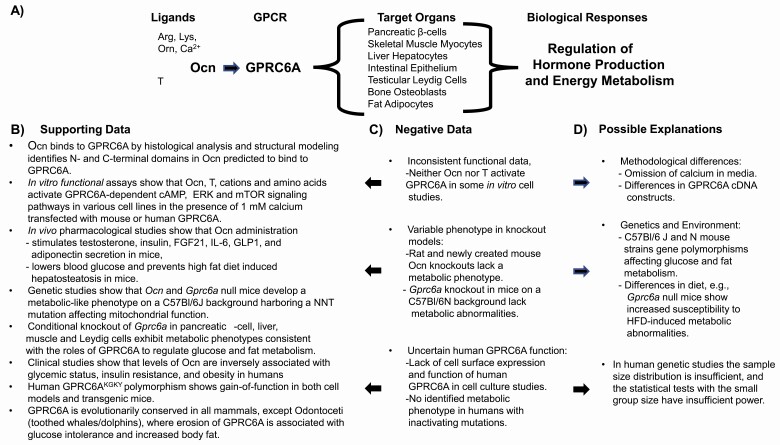
A new schema proposes that the bone-derived osteocalcin (Ocn) peptide hormone activates the G-protein-coupled receptor GPRC6A to directly regulate glucose and fat metabolism in liver, muscle, and fat, and to stimulate the release of metabolism-regulating hormones, including insulin, fibroblast growth factor 21, glucagon-like peptide 1, testosterone, and interleukin 6. Ocn/GPRC6A activation has also been implicated in cancer progression. GPRC6A is activated by cations, amino acids, and testosterone. The multiligand specificity, the regulation of energy metabolism in diverse tissues, and the coordinated release of metabolically active hormones make the GPRC6A endocrine networks unique. Recently, the significance of Ocn/GPRCA has been questioned. There is a lack of metabolic abnormalities in newly created genetically engineered Ocn- and Gprc6a-deficient mouse models. There are also paradoxical observations that GPRC6A may function as a tumor suppressor. In addition, discordant published studies have cast doubt on the function of the most prevalent uniquely human GPRC6A-KGKY polymorphism. Explanations for these divergent findings are elusive. We provide evidence that the metabolic susceptibility of genetically engineered Ocn- and Gprc6a-deficient mice is influenced by environmental challenges and genetic differences in mouse strains. In addition, the GPRC6A-KGKY polymorphism appears to be a gain-of-function variant. Finally, alternatively spliced isoforms of GPRC6A may alter ligand specificity and signaling that modulate oncogenic effects. Thus, genetic, post-translational and environmental factors likely account for the variable results regarding the functions of GPRC6A in animal models. Pending additional information, GPRC6A should remain a potential therapeutic target for regulating energy and fat metabolism, hormone production, and cancer progression.
一种新的模式表明,骨源性的骨钙素 (Ocn) 肽激素激活 G 蛋白偶联受体 GPRC6A,直接调节肝脏、肌肉和脂肪中的葡萄糖和脂肪代谢,并刺激代谢调节激素的释放,包括胰岛素、成纤维细胞生长因子 21、胰高血糖素样肽 1、睾酮和白细胞介素 6。Ocn/GPRC6A 的激活也与癌症进展有关。GPRC6A 被阳离子、氨基酸和睾酮激活。多配体特异性、不同组织中能量代谢的调节以及代谢活性激素的协调释放,使 GPRC6A 内分泌网络具有独特性。最近,Ocn/GPRCA 的意义受到了质疑。新创建的基因工程 Ocn 和 Gprc6a 缺陷型小鼠模型中没有代谢异常。也有矛盾的观察结果表明,GPRC6A 可能作为肿瘤抑制因子发挥作用。此外,不一致的已发表研究对最普遍的人类特有的 GPRC6A-KGKY 多态性的功能提出了质疑。对于这些不同发现的解释仍然难以捉摸。我们提供的证据表明,基因工程 Ocn 和 Gprc6a 缺陷型小鼠的代谢易感性受到环境挑战和小鼠品系遗传差异的影响。此外,GPRC6A-KGKY 多态性似乎是一种功能获得性变体。最后,GPRC6A 的剪接异构体可能改变调节致癌作用的配体特异性和信号转导。因此,遗传、翻译后和环境因素可能解释了 GPRC6A 在动物模型中的功能的可变结果。在获得更多信息之前,GPRC6A 仍应是调节能量和脂肪代谢、激素产生和癌症进展的潜在治疗靶点。