Division of Structural Biology, The Institute of Cancer Research, London, United Kingdom; California Institute for Quantitative Biosciences (QB3), University of California, Berkeley, Berkeley, California; Molecular Biophysics and Integrative Bio-Imaging Division, Lawrence Berkeley National Laboratory, Berkeley, California.
California Institute for Quantitative Biosciences (QB3), University of California, Berkeley, Berkeley, California.
Biophys J. 2021 Feb 16;120(4):677-686. doi: 10.1016/j.bpj.2020.12.030. Epub 2021 Jan 19.
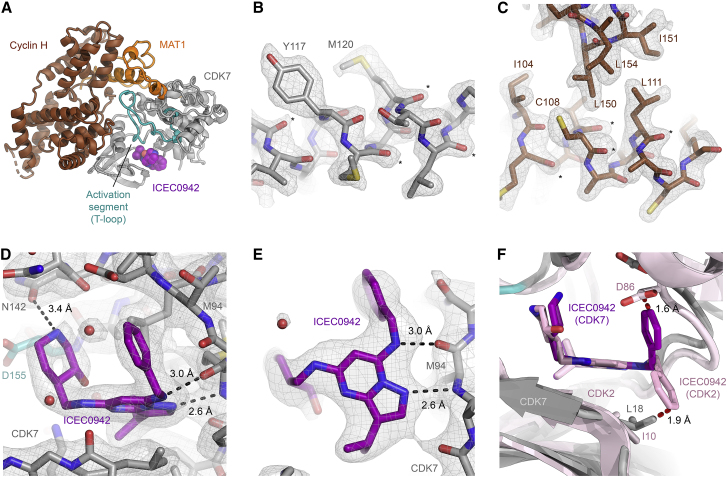
The human CDK-activating kinase (CAK), composed of CDK7, cyclin H, and MAT1, is involved in the control of transcription initiation and the cell cycle. Because of these activities, it has been identified as a promising target for cancer chemotherapy. A number of CDK7 inhibitors have entered clinical trials, among them ICEC0942 (also known as CT7001). Structural information can aid in improving the affinity and specificity of such drugs or drug candidates, reducing side effects in patients. Here, we have determined the structure of the human CAK in complex with ICEC0942 at 2.5 Å-resolution using cryogenic electron microscopy. Our structure reveals conformational differences of ICEC0942 compared with previous X-ray crystal structures of the CDK2-bound complex, and highlights the critical ability of cryogenic electron microscopy to resolve structures of drug-bound protein complexes without the need to crystalize the protein target.
人类 CDK 激活激酶(CAK)由 CDK7、cyclin H 和 MAT1 组成,参与转录起始和细胞周期的控制。由于这些活性,它已被确定为癌症化疗的有前途的靶标。许多 CDK7 抑制剂已进入临床试验,其中包括 ICEC0942(也称为 CT7001)。结构信息可以帮助提高此类药物或候选药物的亲和力和特异性,减少患者的副作用。在这里,我们使用低温电子显微镜确定了与 ICEC0942 复合的人 CAK 的结构,分辨率为 2.5Å。我们的结构揭示了 ICEC0942 与先前 CDK2 结合复合物的 X 射线晶体结构相比的构象差异,并突出了低温电子显微镜在无需结晶蛋白质靶标即可解析药物结合蛋白复合物结构方面的关键能力。