Shires Courtney Brooke, Klug Theodore, Dryden Stephen, Ford Joshua
West Cancer Center, 7945 Wolf River Blvd, Germantown, TN 38104, United States.
West Cancer Center, 7945 Wolf River Blvd, Germantown, TN 38104, United States.
Int J Surg Case Rep. 2021 Feb;79:164-168. doi: 10.1016/j.ijscr.2021.01.043. Epub 2021 Jan 15.
Peptoniphilus indolicus is not usually seen in the eye or paranasal sinuses but is a commensal of the human vagina and gut. However, with COVID-19, eye infections and other unusual complications are possible with such unsuspected bacteria.
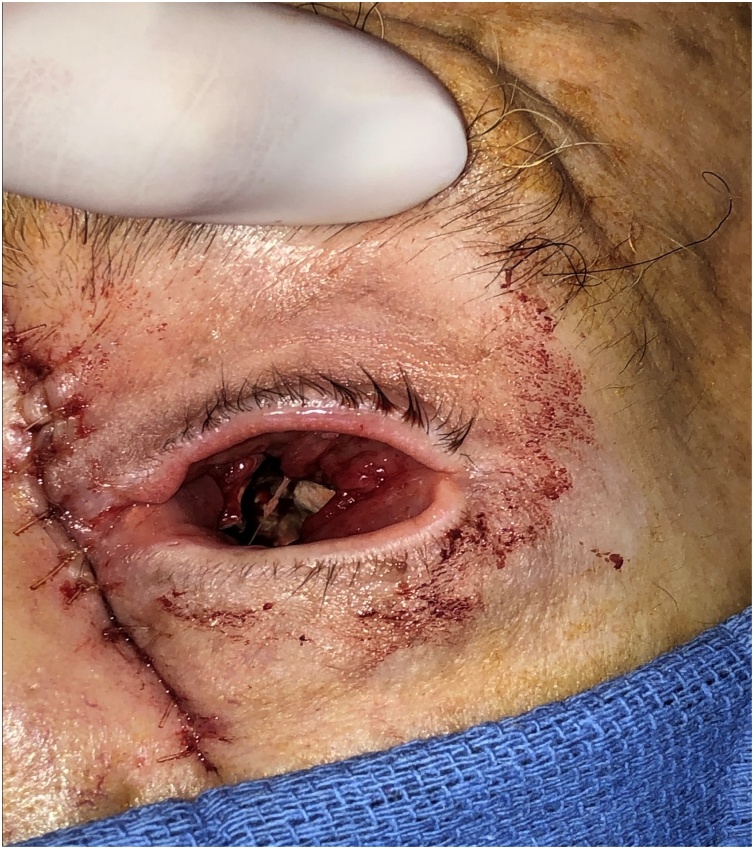
The patient is a 76-year-old white male from a nursing home tested positive for COVID-19 and was sent from a nursing facility for left eye drainage and psychiatric evaluation. Upon presentation, the patient was not fully oriented and could not provide a history of the eye drainage. CT scan showed sinusitis with left orbital and periorbital abscess formation, cellulitis, and extensive osteomyelitis. He underwent endoscopic transnasal drainage and orbiotomy. Cultures returned positive for methicillin-resistant Stapholococcus aureus (MRSA), Streptococcus constellatus, and Peptoniphilus indolicus. He was maintained on several days of IV antibiotics and returned to the nursing home. He then presented 2 months later and required enucleation of his globe, due to the presence of multiple scleral perforations in the setting of orbital abscess, as well as removal of necrotic orbital bone.
Given the concomitant infection with COVID-19 and unusual presentation, the patient's sinus cultures support the notion that COVID-19 can affect the presence of bacteria within certain anatomical regions. Specifically, Peptoniphilus indolicus is not normally found outside of the vagina or gut biome. Avascular, pale mucosa and bone of the nasal cavity was noted during surgery of this COVID-19 infected patient, which is in contrast to the friable and edematous tissue typically found in acutely infected sinuses. Our patient's orbital abscess began to drain spontaneously through the skin, which is rare for orbital abscesses. Also uncommon with orbital abscesses is the need for enucleation, which in this case was deemed necessary given that the abscess had perforated the sclera in multiple locations.
吲哚类消化链球菌通常不见于眼部或鼻窦,而是人类阴道和肠道的共生菌。然而,在新冠肺炎疫情期间,这类原本未被怀疑的细菌可能导致眼部感染及其他异常并发症。
该患者为一名76岁的白人男性,来自一家养老院,新冠肺炎检测呈阳性,从护理机构被送来接受左眼引流及精神科评估。就诊时,患者意识未完全清醒,无法提供眼部引流的病史。CT扫描显示鼻窦炎伴左侧眼眶及眶周脓肿形成、蜂窝织炎和广泛的骨髓炎。他接受了内镜经鼻引流和眶切开术。培养结果显示耐甲氧西林金黄色葡萄球菌(MRSA)、星座链球菌和吲哚类消化链球菌呈阳性。他接受了数天的静脉抗生素治疗,之后返回养老院。两个月后他再次就诊,由于眼眶脓肿导致多处巩膜穿孔,以及坏死眼眶骨的存在,需要摘除眼球,同时还需切除坏死的眼眶骨。
鉴于该患者同时感染新冠肺炎且临床表现异常,其鼻窦培养结果支持新冠肺炎可影响某些解剖区域内细菌存在情况这一观点。具体而言,吲哚类消化链球菌通常不会在阴道或肠道生物群落之外被发现。在对这名新冠肺炎感染患者进行手术时,发现鼻腔黏膜和骨质无血管且苍白,这与急性感染鼻窦中通常发现的脆弱、水肿组织形成对比。我们的患者眼眶脓肿开始通过皮肤自发引流,这在眼眶脓肿中较为罕见。眼眶脓肿需要摘除眼球的情况也不常见,在本病例中,鉴于脓肿已在多个位置穿透巩膜,摘除眼球被认为是必要的。