Bellosta Raffaello, Luzzani Luca, Natalini Giuseppe, Pegorer Matteo Alberto, Attisani Luca, Cossu Luisa Giuseppina, Ferrandina Camillo, Fossati Alessandro, Conti Elena, Bush Ruth L, Piffaretti Gabriele
Divisions of Vascular Surgery, Department of Cardiovascular Surgery, Fondazione Poliambulanza, Brescia, Italy.
Divisions of Vascular Surgery, Department of Cardiovascular Surgery, Fondazione Poliambulanza, Brescia, Italy.
J Vasc Surg. 2020 Dec;72(6):1864-1872. doi: 10.1016/j.jvs.2020.04.483. Epub 2020 Apr 29.
The aim of our study was to determine the incidence, characteristics, and clinical outcomes of patients with the novel coronavirus (COVID-19) infection who had presented with and been treated for acute limb ischemia (ALI) during the 2020 coronavirus pandemic.
We performed a single-center, observational cohort study. The data from all patients who had tested positive for COVID-19 and had presented with ALI requiring urgent operative treatment were collected in a prospectively maintained database. For the present series, successful revascularization of the treated arterial segment was defined as the absence of early (<30 days) re-occlusion or major amputation or death within 24 hours. The primary outcomes were successful revascularization, early (≤30 days) and late (≥30 days) survival, postoperative (≤30 days) complications, and limb salvage.
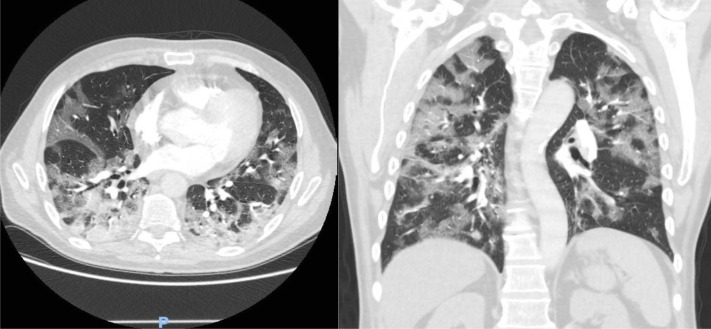
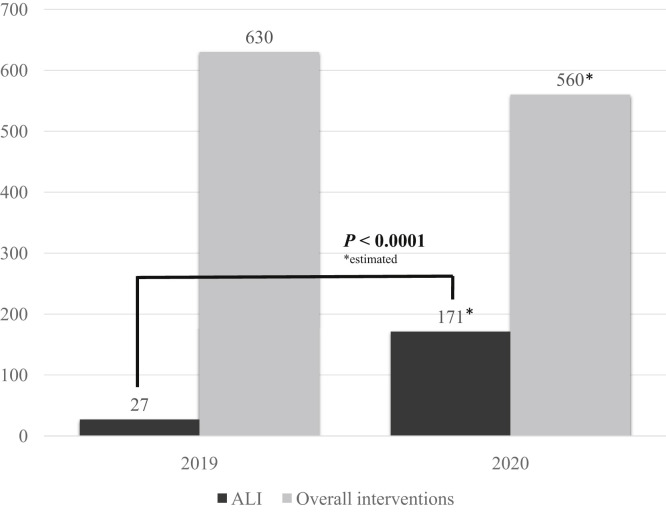
We evaluated the data from 20 patients with ALI who were positive for COVID-19. For the period from January to March, the incidence rate of patients presenting with ALI in 2020 was significantly greater than that for the same months in 2019 (23 of 141 [16.3%] vs 3 of 163 [1.8%]; < .001)]. Of the 20 included patients, 18 were men (90%) and two were women (10%). Their mean age was 75 ± 9 years (range, 62-95 years). All 20 patients already had a diagnosis of COVID-19 pneumonia. Operative treatment was performed in 17 patients (85%). Revascularization was successful in 12 of the 17 (70.6%). Although successful revascularization was not significantly associated with the postoperative use of intravenous heparin (64.7% vs 83.3%; = .622), no patient who had received intravenous heparin required reintervention. Of the 20 patients, eight (40%) had died in the hospital. The patients who had died were significantly older (81 ± 10 years vs 71 ± 5 years; = .008). The use of continuous postoperative systemic heparin infusion was significantly associated with survival (0% vs 57.1%; = .042).
In our preliminary experience, the incidence of ALI has significantly increased during the COVID-19 pandemic in the Italian Lombardy region. Successful revascularization was lower than expected, which we believed was due to a virus-related hypercoagulable state. The use of prolonged systemic heparin might improve surgical treatment efficacy, limb salvage, and overall survival.
我们研究的目的是确定在2020年新冠疫情期间出现急性肢体缺血(ALI)并接受治疗的新型冠状病毒(COVID-19)感染患者的发病率、特征和临床结局。
我们进行了一项单中心观察性队列研究。将所有COVID-19检测呈阳性且出现需要紧急手术治疗的ALI患者的数据收集到一个前瞻性维护的数据库中。对于本系列研究,治疗动脉段成功再血管化的定义为在24小时内无早期(<30天)再闭塞、无大截肢或死亡。主要结局包括成功再血管化、早期(≤30天)和晚期(≥30天)生存、术后(≤30天)并发症以及肢体保全。
我们评估了20例COVID-19阳性的ALI患者的数据。在1月至3月期间,2020年出现ALI的患者发病率显著高于2019年同期(141例中的23例[16.3%]对163例中的3例[1.8%];P<0.001)。在纳入的20例患者中,18例为男性(90%),2例为女性(10%)。他们的平均年龄为75±9岁(范围62 - 95岁)。所有20例患者均已诊断为COVID-19肺炎。17例患者(85%)接受了手术治疗。17例中有12例(70.6%)再血管化成功。尽管成功再血管化与术后静脉使用肝素无显著相关性(64.7%对83.3%;P = 0.622),但接受静脉肝素治疗的患者均无需再次干预。20例患者中有8例(40%)在医院死亡。死亡患者年龄显著更大(81±10岁对71±5岁;P = 0.008)。术后持续全身性肝素输注的使用与生存显著相关(0%对57.1%;P = 0.042)。
根据我们的初步经验,在意大利伦巴第地区的COVID-19大流行期间,ALI的发病率显著增加。成功再血管化低于预期,我们认为这是由于病毒相关的高凝状态所致。延长全身性肝素的使用可能会提高手术治疗效果、肢体保全率和总体生存率。