Walker Christopher, Nguyen Tuan-Minh, Jessel Shlomit, Alvero Ayesha B, Silasi Dan-Arin, Rutherford Thomas, Draghici Sorin, Mor Gil
Department of Obstetrics and Gynecology, Wayne State University, Detroit, MI 48201, USA.
Department of Computer Science, Wayne State University, Detroit, MI 48201, USA.
Cancers (Basel). 2021 Jan 17;13(2):325. doi: 10.3390/cancers13020325.
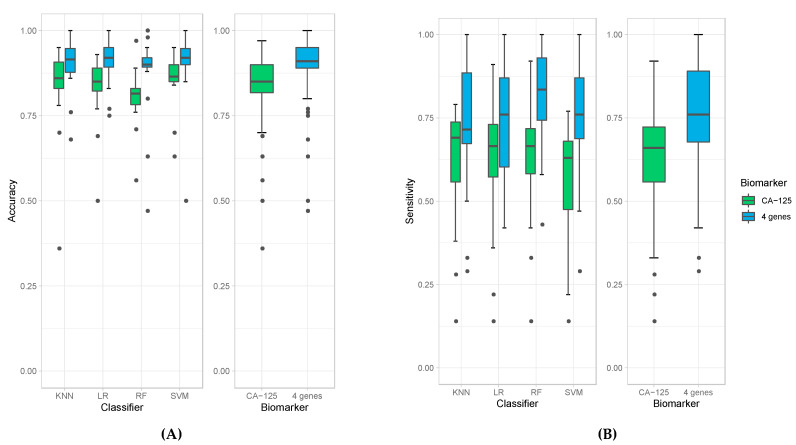
: Mortality from ovarian cancer remains high due to the lack of methods for early detection. The difficulty lies in the low prevalence of the disease necessitating a significantly high specificity and positive-predictive value (PPV) to avoid unneeded and invasive intervention. Currently, cancer antigen- 125 (CA-125) is the most commonly used biomarker for the early detection of ovarian cancer. In this study we determine the value of combining macrophage migration inhibitory factor (MIF), osteopontin (OPN), and prolactin (PROL) with CA-125 in the detection of ovarian cancer serum samples from healthy controls. : A total of 432 serum samples were included in this study. 153 samples were from ovarian cancer patients and 279 samples were from age-matched healthy controls. The four proteins were quantified using a fully automated, multi-analyte immunoassay. The serum samples were divided into training and testing datasets and analyzed using four classification models to calculate accuracy, sensitivity, specificity, PPV, negative predictive value (NPV), and area under the receiver operating characteristic curve (AUC). : The four-protein biomarker panel yielded an average accuracy of 91% compared to 85% using CA-125 alone across four classification models ( = 3.224 × 10). Further, in our cohort, the four-protein biomarker panel demonstrated a higher sensitivity (median of 76%), specificity (median of 98%), PPV (median of 91.5%), and NPV (median of 92%), compared to CA-125 alone. The performance of the four-protein biomarker remained better than CA-125 alone even in experiments comparing early stage (Stage I and Stage II) ovarian cancer to healthy controls. : Combining MIF, OPN, PROL, and CA-125 can better differentiate ovarian cancer from healthy controls compared to CA-125 alone.
由于缺乏早期检测方法,卵巢癌的死亡率仍然很高。困难在于该疾病的低发病率,这就需要非常高的特异性和阳性预测值(PPV),以避免不必要的侵入性干预。目前,癌抗原125(CA - 125)是卵巢癌早期检测中最常用的生物标志物。在本研究中,我们确定将巨噬细胞迁移抑制因子(MIF)、骨桥蛋白(OPN)和催乳素(PROL)与CA - 125联合用于检测来自健康对照的卵巢癌血清样本的价值。
本研究共纳入432份血清样本。153份样本来自卵巢癌患者,279份样本来自年龄匹配的健康对照。使用全自动多分析物免疫测定法定量这四种蛋白质。血清样本被分为训练集和测试集,并使用四种分类模型进行分析,以计算准确性、敏感性、特异性、PPV、阴性预测值(NPV)和受试者工作特征曲线下面积(AUC)。
在四种分类模型中,与单独使用CA - 125(= 3.224 × 10)时的85%相比,四种蛋白质生物标志物组合的平均准确率为91%。此外,在我们的队列中,与单独使用CA - 125相比,四种蛋白质生物标志物组合表现出更高的敏感性(中位数为76%)、特异性(中位数为98%)、PPV(中位数为91.5%)和NPV(中位数为92%)。即使在比较早期(I期和II期)卵巢癌与健康对照的实验中,四种蛋白质生物标志物的性能仍优于单独使用CA - 125。
与单独使用CA - 125相比,将MIF、OPN、PROL和CA - 125联合使用能更好地将卵巢癌与健康对照区分开来。