Thaler Martin, Dammerer Dietmar, Ban Michael, Leitner Hermann, Khosravi Ismail, Nogler Michael
Department of Orthopaedics and Traumatology, Medical University Innsbruck, Anichstr. 35, 6020 Innsbruck, Austria.
Institute of Epidemiology, Tirol Kliniken Innsbruck, Anichstraße 35, 6020 Innsbruck, Austria.
J Clin Med. 2021 Jan 18;10(2):337. doi: 10.3390/jcm10020337.
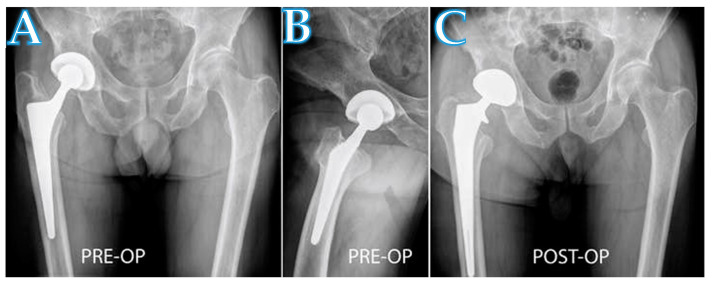
we report the clinical outcomes for femoral revision total hip replacement (THR) using the Direct Anterior Approach (DAA) interval.
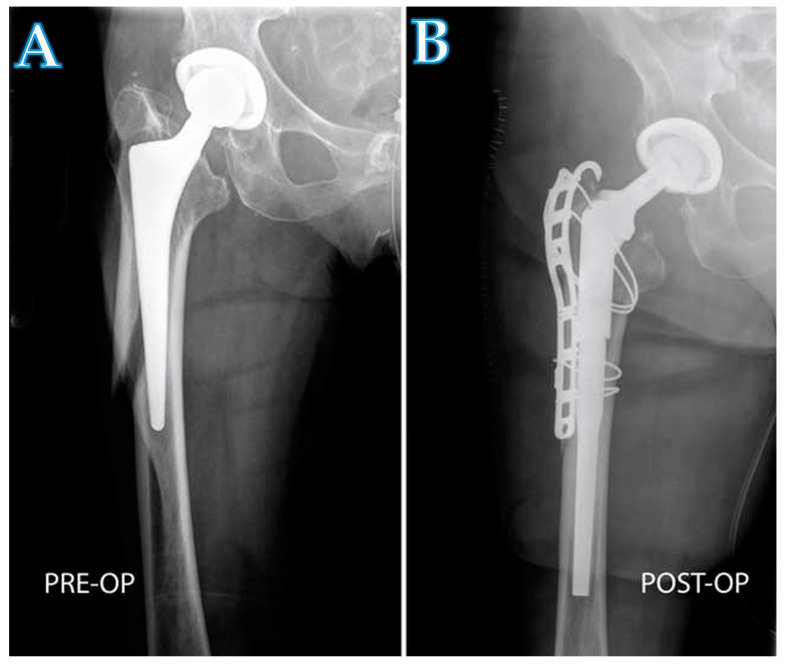
149 patients (165 hips) with a mean age of 68.9 years (range, 33.2-91.0 years) and a mean follow-up of 4.2 years (1.1-8.9 years) were included. The indication for revision surgery was aseptic stem loosening in 131 (79.4%) hips, periprosthetic fracture in 29 (17.6%) hips, revision for stem malalignment in one (0.6%) hip, and prosthetic failure in four (2.4%) hips.
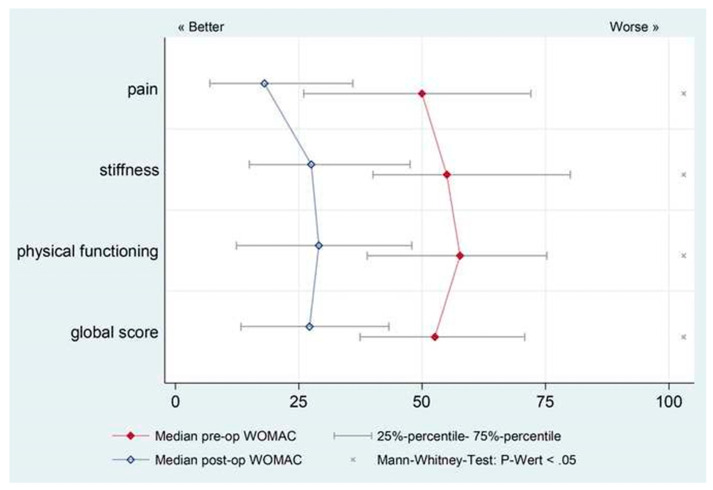
an endofemoral approach was used for 156 hips, and a Wagner transfemoral osteotomy was used for nine hips. An additional cup revision was done in 52 hips (uncemented cup: = 29; cemented cup: = 21; acetabular cage: = 2). The overall complication rate was 14.5% (24 complications). Ten patients (10 hips) were revised (8 cups, 2 liners, 2 stems) with an average time to revision of 6 months (range, 3-23 months). The median preoperative Western Ontario McMasters Osteoarthritis Score (WOMAC) score was 52.5 (Inter Quartile Range (IQR): 33.3), which improved to 27.2 (IQR: 30) postoperatively ( < 0.01).
use of the DAA achieved similar results when compared with other surgical approaches in terms of clinical outcomes and complications, including dislocation rate. These results suggest that femoral revision using the DAA interval can be a safe and reliable procedure.
我们报告了采用直接前路入路(DAA)间隙进行股骨翻修全髋关节置换术(THR)的临床结果。
纳入149例患者(165髋),平均年龄68.9岁(范围33.2 - 91.0岁),平均随访4.2年(1.1 - 8.9年)。翻修手术的指征为131髋(79.4%)无菌性假体柄松动,29髋(17.6%)假体周围骨折,1髋(0.6%)因假体柄排列不齐进行翻修,4髋(2.4%)假体失败。
156髋采用股骨髓腔内入路,9髋采用瓦格纳股骨截骨术。52髋进行了额外的髋臼翻修(非骨水泥髋臼杯:= 29;骨水泥髋臼杯:= 21;髋臼笼:= 2)。总体并发症发生率为14.5%(24例并发症)。10例患者(10髋)进行了再次翻修(8个髋臼杯、2个内衬、2个假体柄),平均翻修时间为6个月(范围3 - 23个月)。术前西安大略和麦克马斯特大学骨关节炎指数(WOMAC)评分中位数为52.5(四分位间距(IQR):33.3),术后改善至27.2(IQR:30)(<0.01)。
在临床结果和并发症方面,包括脱位率,与其他手术入路相比,采用DAA取得了相似的结果。这些结果表明,采用DAA间隙进行股骨翻修可以是一种安全可靠的手术方法。