Buizza Giulia, Paganelli Chiara, D'Ippolito Emma, Fontana Giulia, Molinelli Silvia, Preda Lorenzo, Riva Giulia, Iannalfi Alberto, Valvo Francesca, Orlandi Ester, Baroni Guido
Department of Electronics, Information and Bioengineering, Politecnico di Milano, Piazza Leonardo da Vinci 32, 20133 Milan, Italy.
Radiotherapists Unit, National Center of Oncological Hadrontherapy (CNAO), Strada Campeggi, 53, 27100 Pavia, Italy.
Cancers (Basel). 2021 Jan 18;13(2):339. doi: 10.3390/cancers13020339.
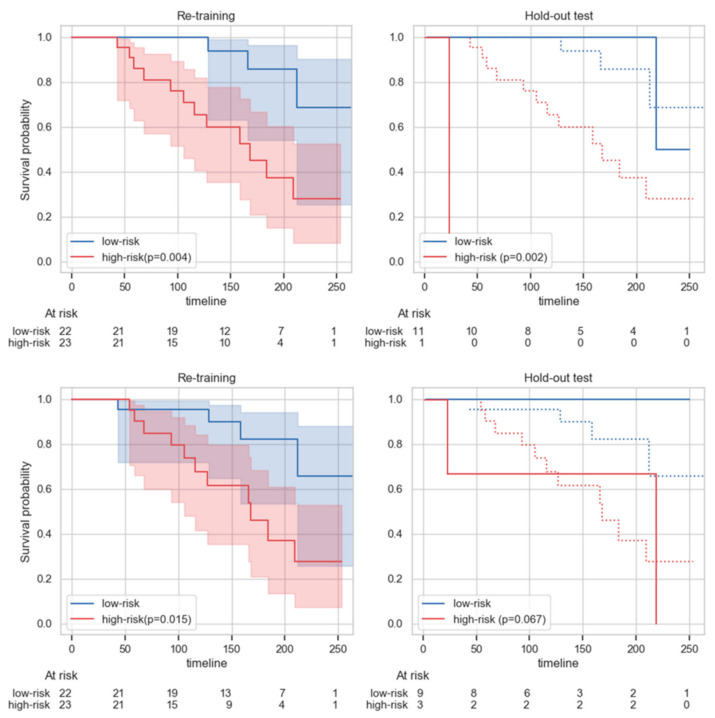
Skull-base chordoma (SBC) can be treated with carbon ion radiotherapy (CIRT) to improve local control (LC). The study aimed to explore the role of multi-parametric radiomic, dosiomic and clinical features as prognostic factors for LC in SBC patients undergoing CIRT. Before CIRT, 57 patients underwent MR and CT imaging, from which tumour contours and dose maps were obtained. MRI and CT-based radiomic, and dosiomic features were selected and fed to two survival models, singularly or by combining them with clinical factors. Adverse LC was given by in-field recurrence or tumour progression. The dataset was split in development and test sets and the models' performance evaluated using the concordance index (C-index). Patients were then assigned a low- or high-risk score. Survival curves were estimated, and risk groups compared through log-rank tests (after Bonferroni correction α = 0.0083). The best performing models were built on features describing tumour shape and dosiomic heterogeneity (median/interquartile range validation C-index: 0.80/024 and 0.79/0.26), followed by combined (0.73/0.30 and 0.75/0.27) and CT-based models (0.77/0.24 and 0.64/0.28). Dosiomic and combined models could consistently stratify patients in two significantly different groups. Dosiomic and multi-parametric radiomic features showed to be promising prognostic factors for LC in SBC treated with CIRT.
颅底脊索瘤(SBC)可采用碳离子放疗(CIRT)进行治疗以提高局部控制率(LC)。本研究旨在探讨多参数影像组学、剂量组学和临床特征作为接受CIRT治疗的SBC患者LC预后因素的作用。在CIRT治疗前,57例患者接受了磁共振成像(MR)和计算机断层扫描(CT)检查,从中获取肿瘤轮廓和剂量图。选择基于MRI和CT的影像组学及剂量组学特征,并将其单独或与临床因素相结合输入两个生存模型。野内复发或肿瘤进展被视为不良LC。数据集被分为训练集和测试集,并使用一致性指数(C指数)评估模型性能。然后为患者分配低风险或高风险评分。估计生存曲线,并通过对数秩检验(经Bonferroni校正后α = 0.0083)比较风险组。表现最佳的模型基于描述肿瘤形状和剂量组学异质性的特征构建(中位数/四分位数间距验证C指数:0.80/0.24和0.79/0.26),其次是联合模型(0.73/0.30和0.75/0.27)和基于CT的模型(0.77/0.24和0.64/0.28)。剂量组学和联合模型能够将患者一致地分层为两个显著不同的组。剂量组学和多参数影像组学特征显示出有望成为接受CIRT治疗的SBC患者LC的预后因素。