Zerva Ioanna, Remmas Nikolaos, Kagalou Ifigeneia, Melidis Paraschos, Ariantsi Marina, Sylaios Georgios, Ntougias Spyridon
Department of Environmental Engineering, Laboratory of Wastewater Management and Treatment Technologies, Democritus University of Thrace, Vas. Sofias 12, 67132 Xanthi, Greece.
Department of Civil Engineering, Democritus University of Thrace, Vas. Sofias 12, 67132 Xanthi, Greece.
Life (Basel). 2021 Jan 19;11(1):68. doi: 10.3390/life11010068.
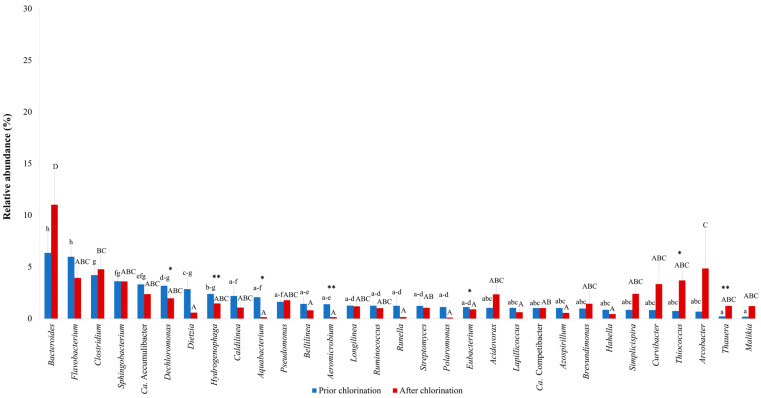
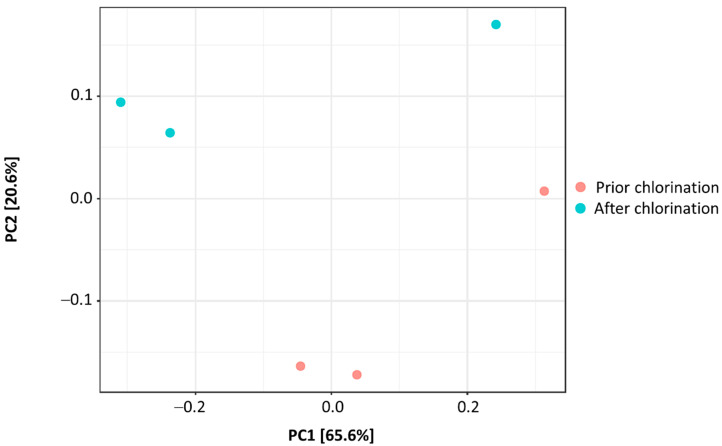
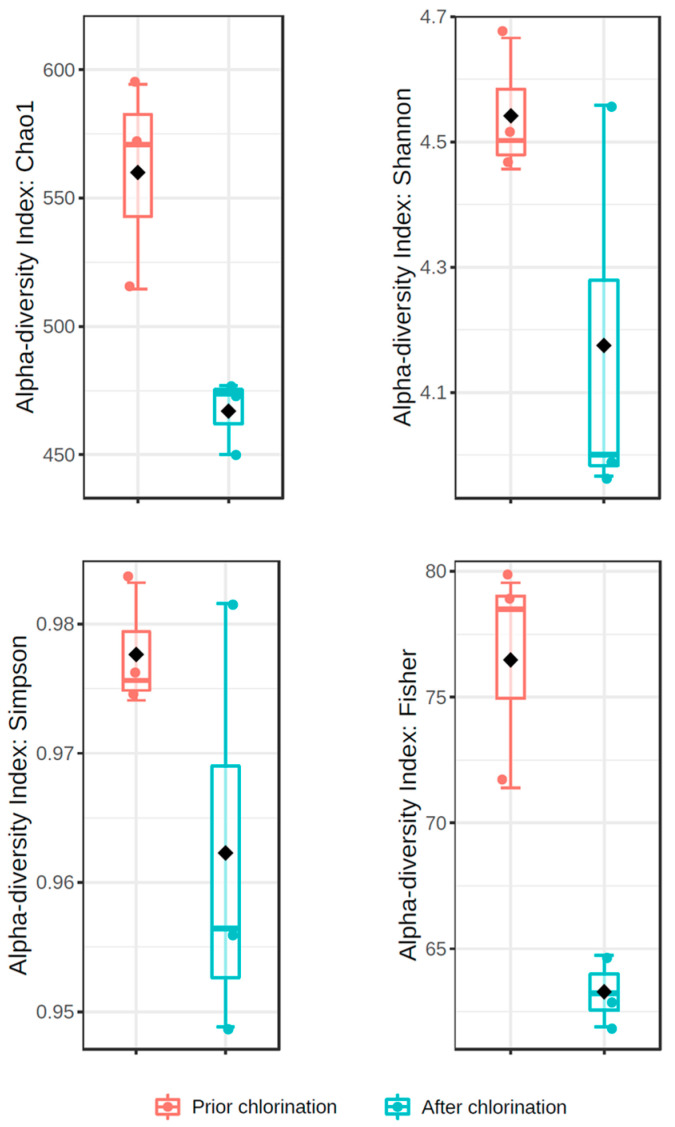
The evaluation of effluent wastewater quality mainly relies on the assessment of conventional bacterial indicators, such as fecal coliforms and enterococci; however, little is known about opportunistic pathogens, which can resist chlorination and may be transmitted in aquatic environments. In contrast to conventional microbiological methods, high-throughput molecular techniques can provide an accurate evaluation of effluent quality, although a limited number of studies have been performed in this direction. In this work, high-throughput amplicon sequencing was employed to assess the effectiveness of chlorination as a disinfection method for secondary effluents. Common inhabitants of the intestinal tract, such as , and , and activated sludge denitrifiers capable of forming biofilms, such as , and , were identified in the chlorinated effluent. with dechlorination capability and the bacteria involved in enhanced biological phosphorus removal, i.e., Accumulibacter and Competibacter, were also found to resist chlorination. No detection of indicates the lack of fecal coliform contamination. spp. were absent in the chlorinated effluent, whereas toxin-producing cyanobacteria of the genera and were identified in low abundances. Chlorination significantly affected the filamentous bacteria and , whereas proliferated in the disinfected effluent. Moreover, perchlorate/chlorate- and organochlorine-reducing bacteria resisted chlorination.
废水水质评估主要依赖于对常规细菌指标的评估,如粪大肠菌群和肠球菌;然而,对于能够抵抗氯化作用并可能在水生环境中传播的机会性病原体,人们了解甚少。与传统微生物学方法不同,高通量分子技术能够对废水质量进行准确评估,尽管在这方面开展的研究数量有限。在本研究中,采用高通量扩增子测序来评估氯化作为二级废水消毒方法的有效性。在氯化后的废水中鉴定出了常见的肠道微生物,如[具体微生物名称1]、[具体微生物名称2]和[具体微生物名称3],以及能够形成生物膜的活性污泥反硝化菌,如[具体微生物名称4]、[具体微生物名称5]和[具体微生物名称6]。还发现具有脱氯能力的[具体微生物名称7]以及参与强化生物除磷的细菌,即聚磷菌属(Accumulibacter)和竞争杆菌属(Competibacter)也能抵抗氯化作用。未检测到[具体微生物名称8]表明不存在粪大肠菌群污染。氯化后的废水中未检测到[具体微生物名称9]属细菌,而在低丰度水平下鉴定出了产毒素的[具体蓝藻属1]属和[具体蓝藻属2]属蓝细菌。氯化作用对丝状细菌[具体丝状细菌名称1]和[具体丝状细菌名称2]有显著影响,而[具体微生物名称10]在消毒后的废水中大量繁殖。此外,高氯酸盐/氯酸盐还原菌和有机氯还原菌能够抵抗氯化作用。