Department of Hematopoiesis, Sanquin Research and Landsteiner Laboratory, Amsterdam UMC, University of Amsterdam, 1012 WX Amsterdam, The Netherlands.
Dynamics of Fluids, Experimental Physics, Saarland University, 66123 Saarbrücken, Germany.
Int J Mol Sci. 2021 Jan 19;22(2):955. doi: 10.3390/ijms22020955.
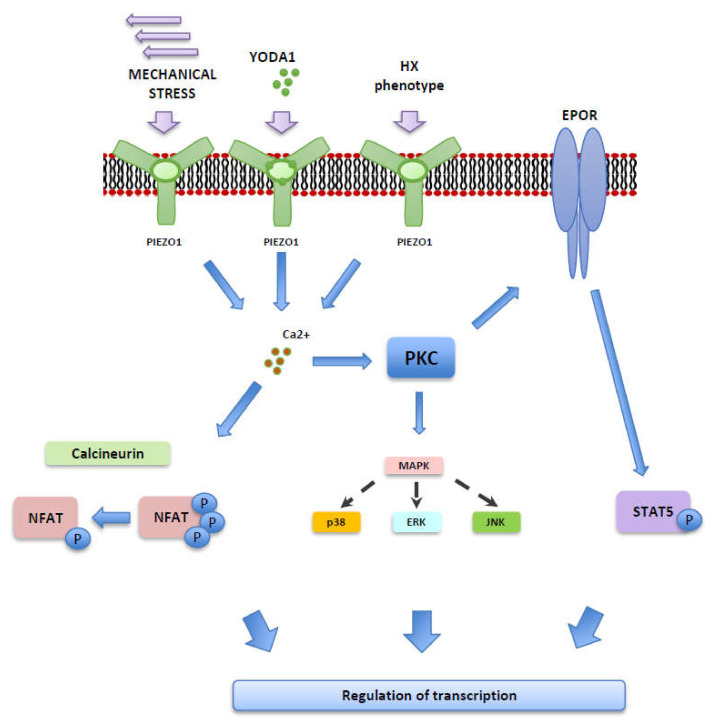
Bioreactors are increasingly implemented for large scale cultures of various mammalian cells, which requires optimization of culture conditions. Such upscaling is also required to produce red blood cells (RBC) for transfusion and therapy purposes. However, the physiological suitability of RBC cultures to be transferred to stirred bioreactors is not well understood. PIEZO1 is the most abundantly expressed known mechanosensor on erythroid cells. It is a cation channel that translates mechanical forces directly into a physiological response. We investigated signaling cascades downstream of PIEZO1 activated upon transitioning stationary cultures to orbital shaking associated with mechanical stress, and compared the results to direct activation of PIEZO1 by the chemical agonist Yoda1. Erythroblasts subjected to orbital shaking displayed decreased proliferation, comparable to incubation in the presence of a low dose of Yoda1. Epo (Erythropoietin)-dependent STAT5 phosphorylation, and Calcineurin-dependent NFAT dephosphorylation was enhanced. Phosphorylation of ERK was also induced by both orbital shaking and Yoda1 treatment. Activation of these pathways was inhibited by intracellular Ca chelation (BAPTA-AM) in the orbital shaker. Our results suggest that PIEZO1 is functional and could be activated by the mechanical forces in a bioreactor setup, and results in the induction of Ca-dependent signaling cascades regulating various aspects of erythropoiesis. With this study, we showed that Yoda1 treatment and mechanical stress induced via orbital shaking results in comparable activation of some Ca-dependent pathways, exhibiting that there are direct physiological outcomes of mechanical stress on erythroblasts.
生物反应器越来越多地用于各种哺乳动物细胞的大规模培养,这需要优化培养条件。为了输血和治疗目的生产红细胞 (RBC),也需要进行这种放大。然而,将 RBC 培养物转移到搅拌式生物反应器的生理适宜性尚不清楚。PIEZO1 是红细胞上表达最丰富的已知机械感受器。它是一种阳离子通道,可将机械力直接转化为生理反应。我们研究了在从静止培养物过渡到与机械应力相关的轨道摇晃时 PIEZO1 激活的下游信号级联,并将结果与化学激动剂 Yoda1 直接激活 PIEZO1 进行了比较。轨道摇晃处理的红细胞显示增殖减少,与在低剂量 Yoda1 存在下孵育相当。Epo(促红细胞生成素)依赖性 STAT5 磷酸化和钙调神经磷酸酶依赖性 NFAT 去磷酸化增强。ERK 的磷酸化也被轨道摇晃和 Yoda1 处理诱导。这些途径的激活被轨道摇床中的细胞内 Ca 螯合剂 (BAPTA-AM) 抑制。我们的结果表明 PIEZO1 是功能性的,并且可以被生物反应器设置中的机械力激活,并且导致调节红细胞生成各个方面的 Ca 依赖性信号级联的诱导。通过这项研究,我们表明 Yoda1 处理和通过轨道摇晃诱导的机械应激导致一些 Ca 依赖性途径的可比激活,表明机械应激对红细胞有直接的生理影响。