Sanquin Research and Landsteiner Laboratory, Department of Hematopoiesis, Amsterdam UMC, Amsterdam, The Netherlands.
Department of Biotechnology, Faculty of Applied Sciences, Delft University of Technology, Delft, The Netherlands.
Biotechnol Bioeng. 2022 Nov;119(11):3096-3116. doi: 10.1002/bit.28193. Epub 2022 Aug 5.
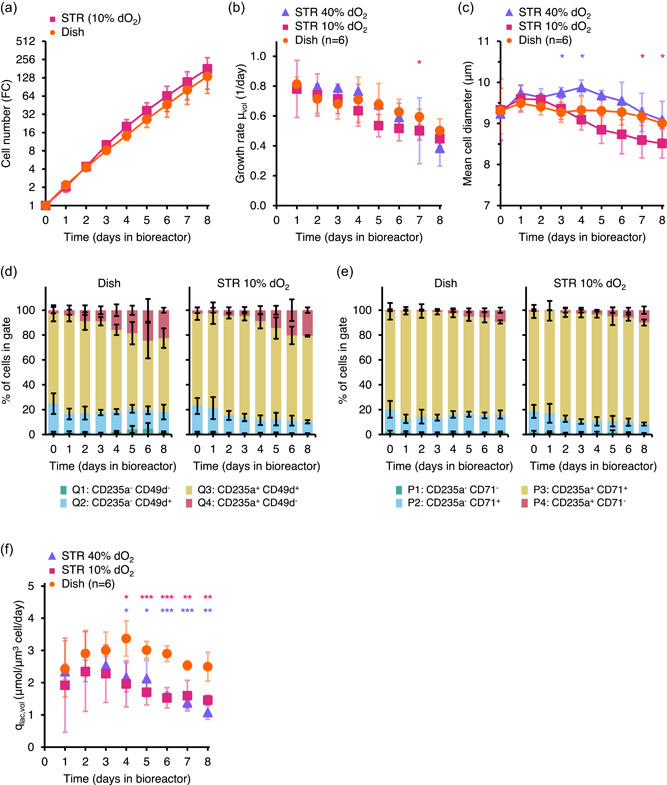
Transfusion of donor-derived red blood cells (RBCs) is the most common form of cell therapy. Production of transfusion-ready cultured RBCs (cRBCs) is a promising replacement for the current, fully donor-dependent therapy. A single transfusion unit, however, contains 2 × 10 RBC, which requires large scale production. Here, we report on the scale-up of cRBC production from static cultures of erythroblasts to 3 L stirred tank bioreactors, and identify the effect of operating conditions on the efficiency of the process. Oxygen requirement of proliferating erythroblasts (0.55-2.01 pg/cell/h) required sparging of air to maintain the dissolved oxygen concentration at the tested setpoint (2.88 mg O /L). Erythroblasts could be cultured at dissolved oxygen concentrations as low as 0.7 O mg/ml without negative impact on proliferation, viability or differentiation dynamics. Stirring speeds of up to 600 rpm supported erythroblast proliferation, while 1800 rpm led to a transient halt in growth and accelerated differentiation followed by a recovery after 5 days of culture. Erythroblasts differentiated in bioreactors, with final enucleation levels and hemoglobin content similar to parallel cultures under static conditions.
输注供体来源的红细胞(RBC)是最常见的细胞治疗形式。生产即用型培养红细胞(cRBC)是替代当前完全依赖供体的治疗方法的一种很有前途的方法。然而,一个输血单位含有 2×10 RBC,这需要大规模生产。在这里,我们报告了从静态培养的红细胞到 3L 搅拌罐生物反应器的 cRBC 生产的放大,并确定了操作条件对该过程效率的影响。增殖红细胞的需氧量(0.55-2.01 pg/细胞/小时)需要通过吹入空气来维持测试设定点(2.88 mg O/L)的溶解氧浓度。红细胞可以在低至 0.7 O mg/ml 的溶解氧浓度下培养,而不会对增殖、活力或分化动力学产生负面影响。高达 600 rpm 的搅拌速度支持红细胞的增殖,而 1800 rpm 会导致生长暂时停止,并在 5 天的培养后加速分化,然后恢复。红细胞在生物反应器中分化,最终去核水平和血红蛋白含量与静态条件下的平行培养相似。