Department of Obstetrics and Gynecology, University Hospital Munich, LMU, 80337 Munich, Germany.
Department of General, Visceral, Transplant, Vascular and Thoracic Surgery, LMU, Marchioninistraße 15, 81377 Munich, Germany.
Int J Mol Sci. 2021 Jan 19;22(2):957. doi: 10.3390/ijms22020957.
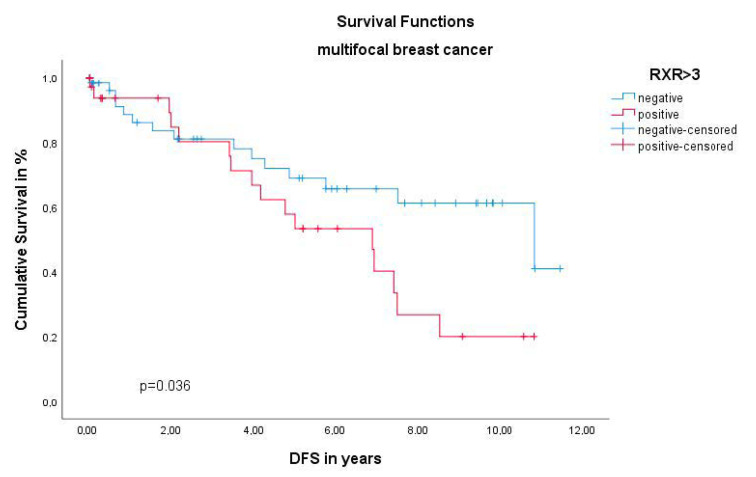
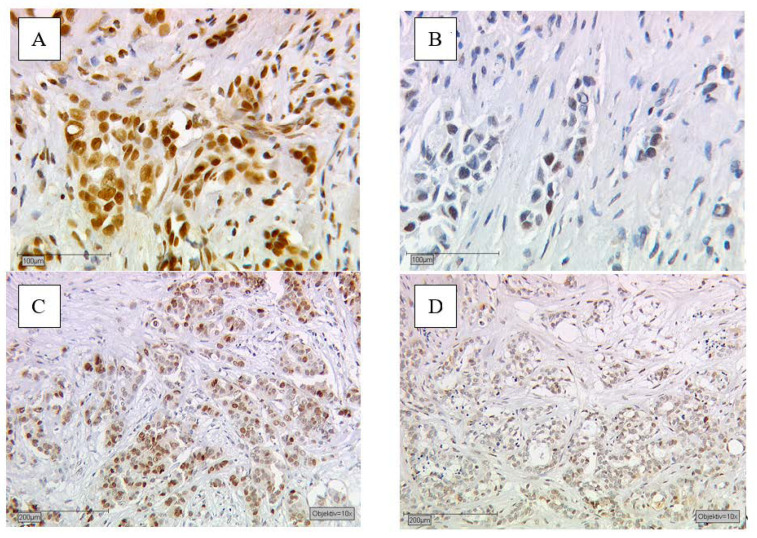
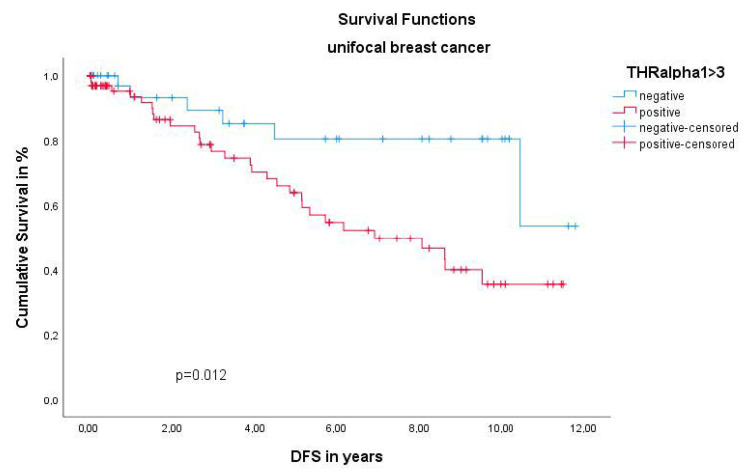
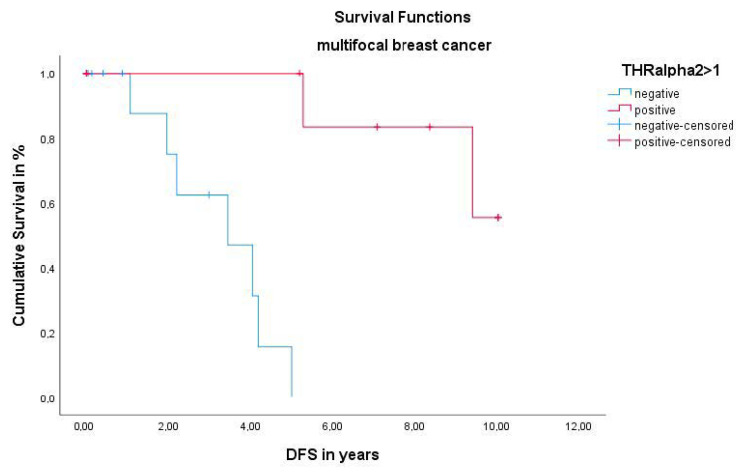
The aim of this study was to assess the prognostic value of the steroid hormone receptor expression, counting the retinoid X receptor (RXR) and thyroid hormone receptors (THRs), on the two different breast cancer (BC) entities: multifocal/multicentric versus unifocal. The overall and disease-free survival were considered as the prognosis determining aspects and analyzed by uni- and multi-variate analysis. Furthermore, histopathological grading and TNM staging (T = tumor size, N = lymph node involvement, M = distant metastasis) were examined in relation to RXR and THRs expression. A retrospective statistical analysis was carried out on survival-related events in a series of 319 sporadic BC patients treated at the Department of Gynecology and Obstetrics at the Ludwig-Maximillian's University in Munich between 2000 and 2002. The expression of RXR and THRs, including its two major isoforms THRα1 and THRα2, was analyzed by immunohistochemistry and showed to have a significant correlation for both BC entities in regard to survival analysis. Patients with multifocal/multicentric BC were exposed to a significantly worse disease-free survival (DFS) when expressing RXR. Patients with unifocal BC showed a significantly worse DFS when expressing THRα1. In contrast, a statistically significant positive association between THRα2 expression and enhanced DFS in multifocal/multicentric BC was shown. Especially the RXR expression in multifocal/multicentric BC was found to play a remarkably contradictory role for BC prognosis. The findings imply the need for a critical review of possible molecular therapies targeting steroid hormone receptors in BC treatment. Our results strengthen the need to further investigate the behavior of the nuclear receptor family, especially in relation to BC focality.
本研究旨在评估类固醇激素受体表达(包括视黄酸 X 受体 [RXR] 和甲状腺激素受体 [THRs])对两种不同乳腺癌(BC)实体的预后价值:多灶/多中心与单灶。总体生存率和无病生存率被认为是决定预后的方面,并通过单变量和多变量分析进行分析。此外,还检查了组织病理学分级和 TNM 分期(T = 肿瘤大小,N = 淋巴结受累,M = 远处转移)与 RXR 和 THRs 表达的关系。对 2000 年至 2002 年期间在慕尼黑路德维希-马克西米利安大学妇产科治疗的 319 例散发性 BC 患者的生存相关事件进行了回顾性统计分析。通过免疫组织化学分析了 RXR 和 THRs 的表达,包括其两个主要亚型 THRα1 和 THRα2,并显示出对两种 BC 实体的生存分析具有显著相关性。表达 RXR 的多灶/多中心 BC 患者的无病生存率(DFS)明显较差。表达 THRα1 的单灶 BC 患者的 DFS 明显较差。相反,多灶/多中心 BC 中 THRα2 表达与 DFS 增强之间存在统计学上显著的正相关。特别是在多灶/多中心 BC 中 RXR 的表达对 BC 预后起着明显矛盾的作用。这些发现意味着需要对针对 BC 治疗中类固醇激素受体的可能分子治疗进行批判性审查。我们的研究结果加强了需要进一步研究核受体家族的行为,特别是与 BC 局灶性的关系。