Section of Psychiatry, Clinical Psychology and Rehabilitation, Department of Medicine, University of Perugia, Perugia, Italy.
Center for Translational, Phenomenological and Developmental Psychopathology (CTPDP), Perugia University Hospital, Perugia, Italy.
Schizophr Bull. 2021 Jul 8;47(4):1007-1017. doi: 10.1093/schbul/sbaa201.
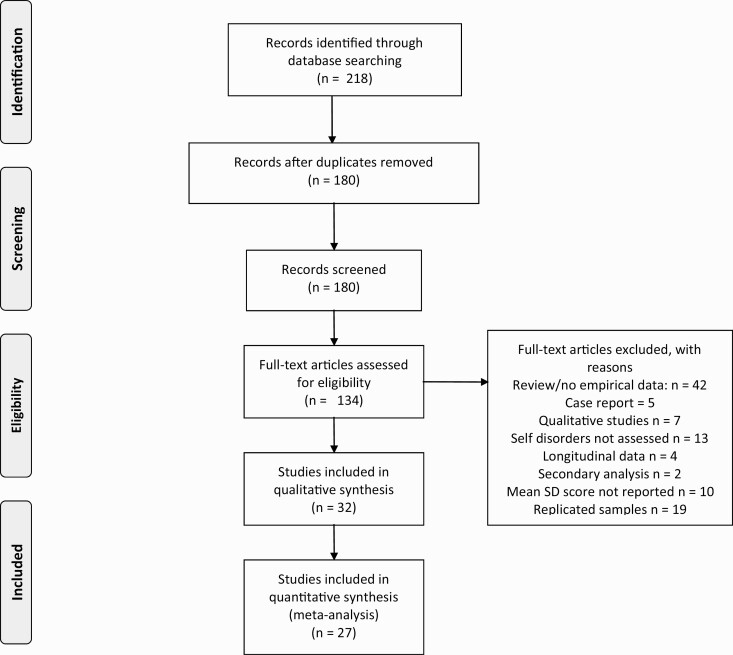
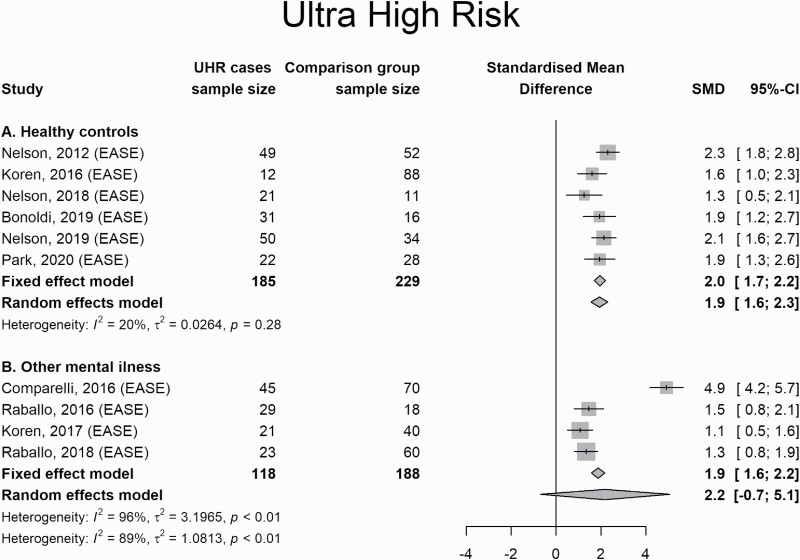
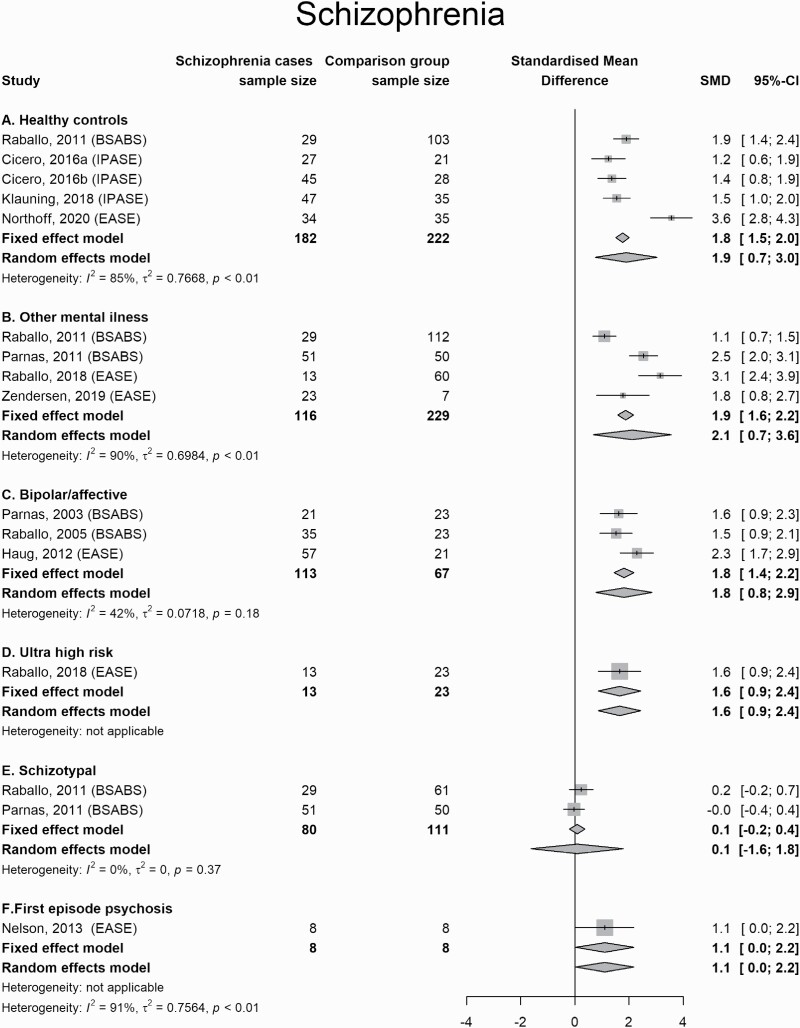
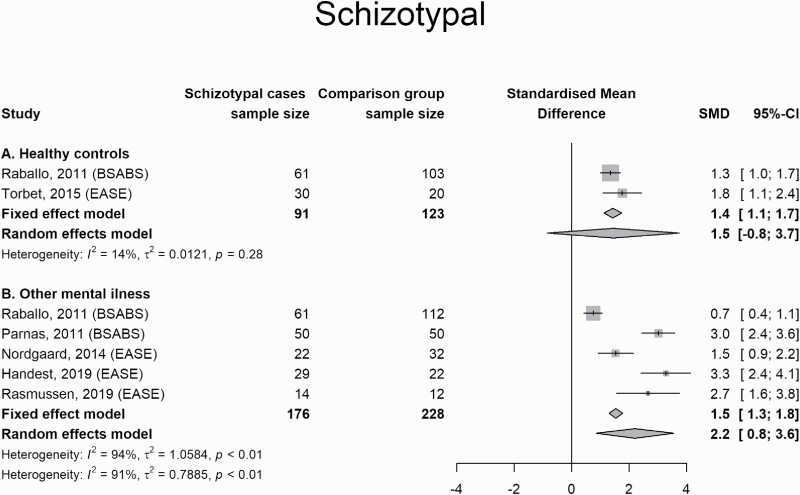
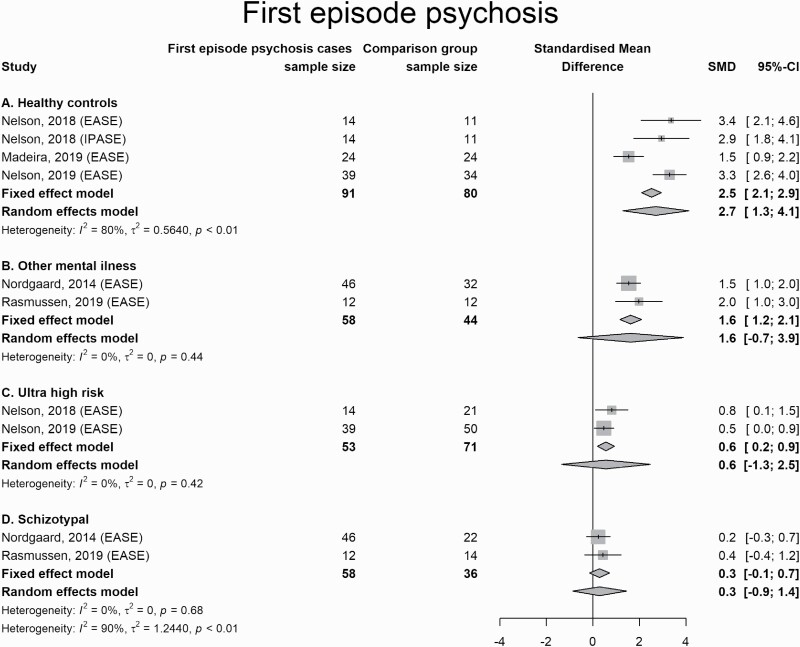
Disturbed self-experience has been reported as a characteristic feature of schizophrenia since the first formulation of its diagnostic concept; however, only in the last 2 decades an explicit notion of basic Self-disturbance, or Self-Disorders (SD), has emerged as target for a systematic research program. We conducted systematic searches in bibliographical databases to identify cross-sectional studies that explored SD across different diagnostic groups and explored diagnostic ascription within or outside schizophrenia spectrum disorders (SSD) as main outcome. Data were pooled using fixed- and random-effects meta-analysis models. Heterogeneity was assessed using stratified meta-analyses and meta-regression. Of 218 identified studies, 32 were included in the systematic review and 27 in the meta-analysis. Patients diagnosed with SSD scored higher on measures of SD than healthy controls (HC) (Hedges' g = 1.8; 95% CI = 1.5 to 2.0), individuals diagnosed with other mental illness (OMI) (1.9; 1.6 to 2.2), bipolar or affective disorders (1.8; 1.4 to 2.2), and clinical high risk for psychosis (CHR) (1.6; 0.9 to 2.4). Patients with schizotypy or schizotypal personality disorder scored higher on measures of SD than OMI (1.5; 1.3 to 1.8) and HC (1.4; 1.1 to 1.7). Patients with first-episode psychosis scored higher on measures of SD than HC (2.5; 2.1 to 2.9) and OMI (1.6; 1.2 to 2.1). Subjects at CHR scored higher on measures of SD than HC (2.0; 1.7 to 2.2) and OMI (19; 1.6 to 2.2). Overall, heterogeneity ranged from negligible to high, especially in comparisons of the target group with OMI, probably as a reflection of the immanent diagnostic heterogeneity of this group. The findings suggest that SD selectively aggregate within schizophrenia spectrum disorders as compared to other mental disorders and that they could be a central phenotypic marker of vulnerability to schizophrenia across the different shades of severity of its spectrum of disorders.
自精神分裂症诊断概念首次提出以来,人们就一直报告称,自我体验障碍是其特征之一;然而,直到过去 20 年,基本的自我障碍或自我障碍(SD)的明确概念才作为一个系统研究计划的目标出现。我们在文献数据库中进行了系统搜索,以确定探索不同诊断组中 SD 的横断面研究,并探讨了精神分裂症谱系障碍(SSD)内外的诊断归属作为主要结果。使用固定效应和随机效应荟萃分析模型对数据进行汇总。使用分层荟萃分析和荟萃回归评估异质性。在确定的 218 项研究中,有 32 项被纳入系统评价,27 项被纳入荟萃分析。与健康对照组(HC)相比,被诊断为 SSD 的患者在 SD 测量上的得分更高(Hedges'g=1.8;95%CI=1.5 至 2.0),与其他精神疾病(OMI)(1.9;1.6 至 2.2)、双相或情感障碍(1.8;1.4 至 2.2)以及精神病临床高风险(CHR)(1.6;0.9 至 2.4)患者相比。具有精神分裂症特质或精神分裂症人格障碍的患者在 SD 测量上的得分高于 OMI(1.5;1.3 至 1.8)和 HC(1.4;1.1 至 1.7)。首发精神病患者在 SD 测量上的得分高于 HC(2.5;2.1 至 2.9)和 OMI(1.6;1.2 至 2.1)。处于 CHR 的受试者在 SD 测量上的得分高于 HC(2.0;1.7 至 2.2)和 OMI(19;1.6 至 2.2)。总体而言,异质性从可忽略不计到高,尤其是在将目标组与 OMI 进行比较时,这可能反映了该组固有的诊断异质性。研究结果表明,与其他精神障碍相比,SD 选择性聚集在精神分裂症谱系障碍中,并且它们可能是精神分裂症易感性的核心表型标志物,跨越其疾病谱的不同严重程度。