Cozza Federica, Lizio Andrea, Greco Lucia Catherine, Bona Stefania, Donvito Giordana, Carraro Elena, Tavazzi Silvia, Ticozzi Nicola, Poletti Barbara, Sansone Valeria Ada, Lunetta Christian
Neuromuscular Omnicentre (NEMO), Fondazione Serena Onlus, Milan, Italy.
Materials Science Department & COMiB Research Center, University of Milano Bicocca, Milan, Italy.
J Clin Neurol. 2021 Jan;17(1):96-105. doi: 10.3988/jcn.2021.17.1.96.
The study aimed to obtain optometric findings of amyotrophic lateral sclerosis (ALS) patients in different stages of the disease, and to determine the relation between ocular data and ALS-related features; that is, functional and cognitive impairment and staging.
The optometric protocol included tests of the ocular motility [broad-H test and Northeastern State University College of Optometry (NSUCO) test], near point of convergence (NPC), error refraction, best-corrected visual acuity, and binocular visual alignment, and an ocular symptoms questionnaire. The functional measures included the Amyotrophic Lateral Sclerosis Functional Rating Scale-revised (ALSFRS-r) and Milano-Torino staging (MiToS), and cognitive impairment was assessed using the Edinburgh Cognitive and Behavioural ALS Screen (ECAS). Demographic and clinical features were also collected, including whether the patients used an eye-tracking communication device (ETCD).
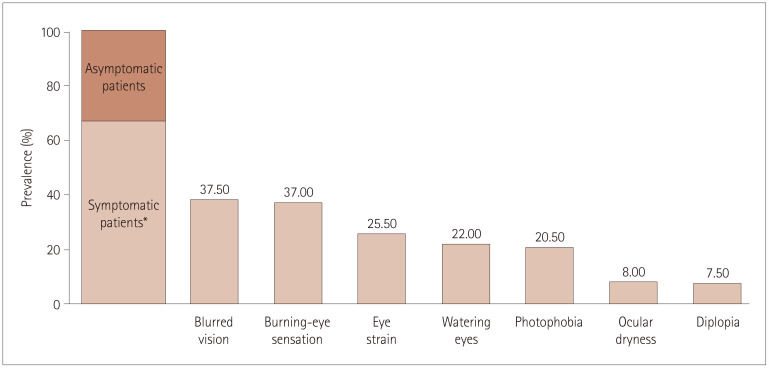
Two-hundred consecutive ALS patients (median age of 64 years, 118 males and 82 females) in different stages of disease were recruited. Nearly 70% of patients reported at least one ocular symptom, and the use of an ETCD was found to be significantly related to the presence of most symptoms. Moreover, the severely symptomatic group was characterized by significantly lower ALSFRS-r total and subscale scores, and higher MiToS. Abnormal NPC values were significantly related to lower ALSFRS-r total and bulbar-subscale scores. Patients with acceptable NSUCO test values exhibited significantly higher ECAS scores.
The presence of ocular alteration in patients in different stages of ALS supports the idea that this is a multisystem disorder and emphasizes the importance of optometric evaluations in multidisciplinary assessments to address ocular impairment early in the disease process.
本研究旨在获取肌萎缩侧索硬化症(ALS)患者在疾病不同阶段的验光结果,并确定眼部数据与ALS相关特征之间的关系,即功能和认知障碍以及分期。
验光方案包括眼动测试[宽视野-H测试和东北州立大学视光学院(NSUCO)测试]、集合近点(NPC)、验光误差、最佳矫正视力、双眼视觉对准以及一份眼部症状问卷。功能测量包括修订的肌萎缩侧索硬化症功能评定量表(ALSFRS-r)和米兰-都灵分期(MiToS),并使用爱丁堡认知与行为性ALS筛查(ECAS)评估认知障碍。还收集了人口统计学和临床特征,包括患者是否使用眼动追踪通信设备(ETCD)。
招募了200例处于疾病不同阶段的连续ALS患者(中位年龄64岁,男性118例,女性82例)。近70%的患者报告至少有一种眼部症状,并且发现使用ETCD与大多数症状的存在显著相关。此外,症状严重组的特征是ALSFRS-r总分和各子量表得分显著更低,以及MiToS更高。NPC值异常与ALSFRS-r总分和延髓子量表得分更低显著相关。NSUCO测试值可接受的患者表现出显著更高的ECAS得分。
ALS不同阶段患者存在眼部改变支持了这是一种多系统疾病的观点,并强调了验光评估在多学科评估中的重要性,以便在疾病过程早期解决眼部损害问题。