Skoda Eva-Maria, Spura Anke, De Bock Freia, Schweda Adam, Dörrie Nora, Fink Madeleine, Musche Venja, Weismüller Benjamin, Benecke Anke, Kohler Hannah, Junne Florian, Graf Johanna, Bäuerle Alexander, Teufel Martin
Klinik für Psychosomatische Medizin und Psychotherapie, LVR-Klinikum Essen, Universität Duisburg-Essen, Virchowstr. 174, 45147, Essen, Deutschland.
Bundeszentrale für gesundheitliche Aufklärung (BZgA), Köln, Deutschland.
Bundesgesundheitsblatt Gesundheitsforschung Gesundheitsschutz. 2021 Mar;64(3):322-333. doi: 10.1007/s00103-021-03278-0. Epub 2021 Jan 22.
The potential impact of the COVID-19 pandemic on mental health was evident early on. The extent of the effects, especially cumulative over the long period of the pandemic, has not yet been fully investigated for Germany.
The aim of the study was to determine psychological burden as well as COVID-19-related experience and behavior patterns and to show how they changed during the different phases of the pandemic in Germany.
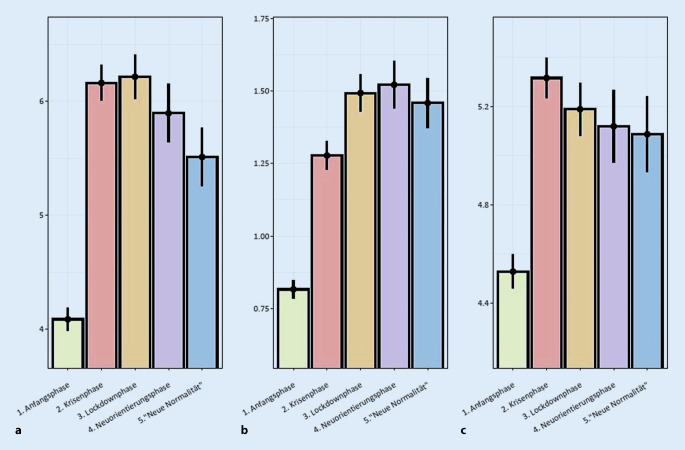
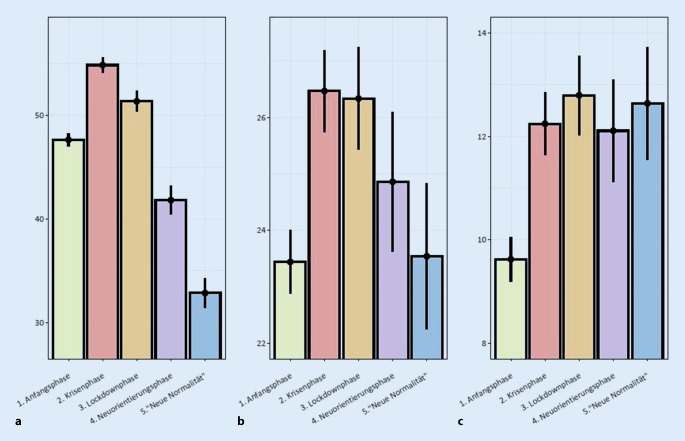
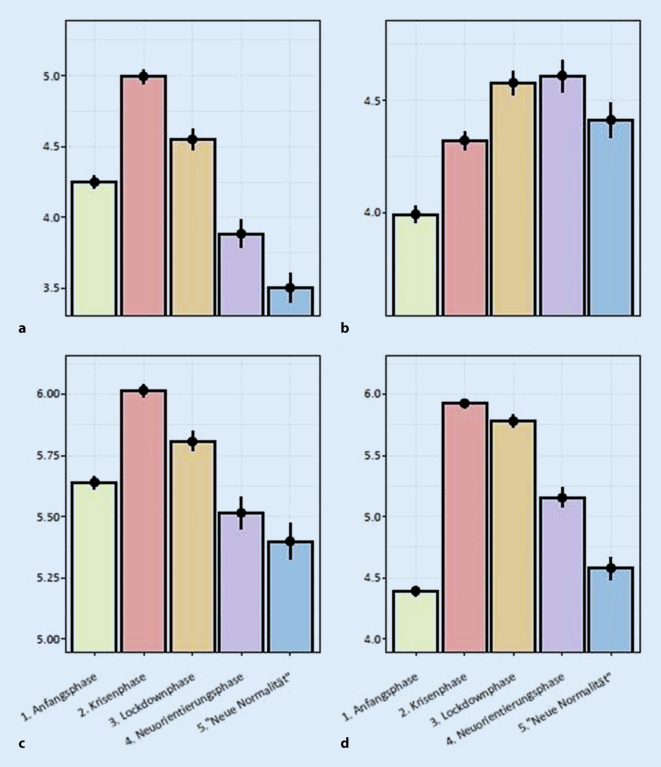
The Germany-wide online-based cross-sectional study (03/10-07/27/2020) included 22,961 people (convenience sample). Generalized anxiety (GAD-7), depression (PHQ-2), and psychological distress (DT) were collected, as well as COVID-19-related experiences and behavior patterns: COVID-19-related fear, trust in governmental actions, subjective level of information, adherent safety behavior, and personal risk assessment for infection/severe course of illness. The pandemic was retrospectively divided into five phases (initial, crisis, lockdown, reorientation, and new normality).
Compared to pre-COVID-19 reference values, GAD‑7, PHQ‑2, and DT levels were significantly elevated and persistent throughout the different phases of the pandemic. COVID-19-related fear, information level, trust, safety behavior, and the risk assessment for infection/severe course of illness showed, after initial strong increase, a strong decrease to partly below the initial value. Exceptions were constant risk assessments of having a severe course of illness or dying of it.
The increased levels of psychological burden, which have persisted throughout all phases of the pandemic, illustrate the need for sustainable support services. Declining values over the duration of the pandemic in terms of trust in governmental actions and the feeling of being well informed underline the need for more targeted education.
新冠疫情对心理健康的潜在影响在早期就已显现。对于德国而言,其影响程度,尤其是在疫情长期累积下的影响程度,尚未得到充分调查。
本研究旨在确定心理负担以及与新冠疫情相关的经历和行为模式,并展示它们在德国疫情不同阶段是如何变化的。
这项基于网络的全德横断面研究(2020年3月10日至7月27日)纳入了22961人(便利样本)。收集了广泛性焦虑(GAD - 7)、抑郁(PHQ - 2)和心理困扰(DT)情况,以及与新冠疫情相关的经历和行为模式:与新冠疫情相关的恐惧、对政府行动的信任、主观信息水平、坚持安全行为以及对感染/重症病程的个人风险评估。疫情被回顾性地分为五个阶段(初始阶段、危机阶段、封锁阶段、调整阶段和新常态阶段)。
与新冠疫情前的参考值相比,GAD - 7、PHQ - 2和DT水平在疫情的不同阶段均显著升高且持续存在。与新冠疫情相关的恐惧、信息水平、信任、安全行为以及对感染/重症病程的风险评估在最初大幅上升后,大幅下降,部分降至初始值以下。例外情况是对重症病程或死亡的持续风险评估。
在疫情的所有阶段持续存在的心理负担水平上升,表明需要可持续的支持服务。在疫情期间,对政府行动的信任和信息充分感方面的数值下降,凸显了更有针对性教育的必要性。