Seidler A L, Hunter K E, Espinoza D, Mihrshahi S, Askie L M
NHMRC Clinical Trials Centre, University of Sydney, Sydney, Australia.
NHMRC Centre of Research Excellence in the Early Prevention of Obesity in Childhood, Prevention Research Collaboration, Sydney School of Public Health, University of Sydney, Camperdown, NSW, Australia.
Trials. 2021 Jan 22;22(1):78. doi: 10.1186/s13063-020-04984-x.
For prospective meta-analyses (PMAs), eligible studies are identified, and the PMA hypotheses, selection criteria, and analysis methods are pre-specified before the results of any of the studies are known. This reduces publication bias and selective outcome reporting and provides a unique opportunity for outcome standardisation/harmonisation. We conducted a world-first PMA of four trials investigating interventions to prevent early childhood obesity. The aims of this study were to quantitatively analyse the effects of prospective planning on variations across trials, outcome harmonisation, and the power to detect intervention effects, and to derive recommendations for future PMA.
We examined intervention design, participant characteristics, and outcomes collected across the four trials included in the EPOCH PMA using their registration records, protocol publications, and variable lists. The outcomes that trials planned to collect prior to inclusion in the PMA were compared to the outcomes that trials collected after PMA inclusion. We analysed the proportion of matching outcome definitions across trials, the number of outcomes per trial, and how collaboration increased the statistical power to detect intervention effects.
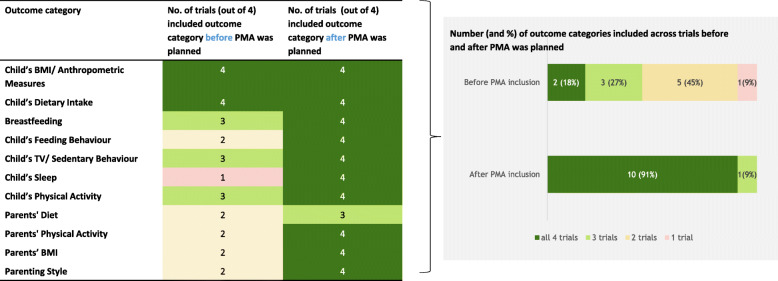
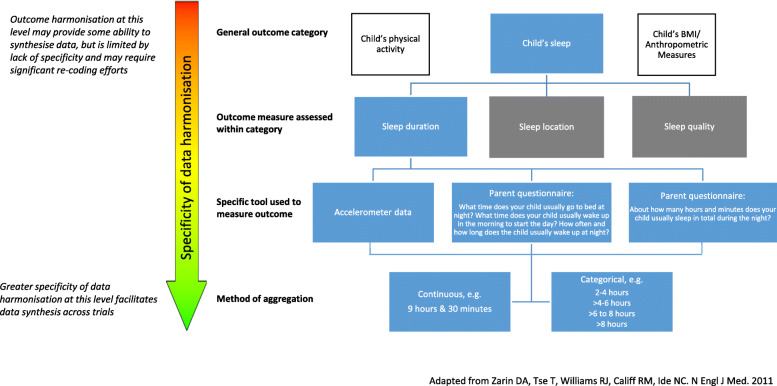
The included trials varied in intervention design and participants, this improved external validity and the ability to perform subgroup analyses for the meta-analysis. While individual trials had limited power to detect the main intervention effect (BMI z-score), synthesising data substantially increased statistical power. Prospective planning led to an increase in the number of collected outcome categories (e.g. weight, child's diet, sleep), and greater outcome harmonisation. Prior to PMA inclusion, only 18% of outcome categories were included in all trials. After PMA inclusion, this increased to 91% of outcome categories. However, while trials mostly collected the same outcome categories after PMA inclusion, some inconsistencies in how the outcomes were measured remained (such as measuring physical activity by hours of outside play versus using an activity monitor).
Prospective planning led to greater outcome harmonisation and greater power to detect intervention effects, while maintaining acceptable variation in trial designs and populations, which improved external validity. Recommendations for future PMA include more detailed harmonisation of outcome measures and careful pre-specification of analyses to avoid research waste by unnecessary over-collection of data.
对于前瞻性荟萃分析(PMA),在任何研究结果知晓之前,先确定符合条件的研究,并预先设定PMA的假设、选择标准和分析方法。这减少了发表偏倚和选择性结果报告,并为结果标准化/协调提供了独特机会。我们开展了一项世界首创的PMA,纳入四项调查预防儿童早期肥胖干预措施的试验。本研究的目的是定量分析前瞻性规划对各试验间差异、结果协调以及检测干预效果效能的影响,并为未来的PMA得出建议。
我们利用EPOCH PMA纳入的四项试验的注册记录、方案出版物和变量列表,检查了干预设计、参与者特征以及收集的结果。将试验在纳入PMA之前计划收集的结果与纳入PMA之后收集的结果进行比较。我们分析了各试验间匹配结果定义的比例、每个试验的结果数量,以及合作如何提高检测干预效果的统计效能。
纳入的试验在干预设计和参与者方面存在差异,这提高了外部效度以及进行荟萃分析亚组分析的能力。虽然单个试验检测主要干预效果(BMI z评分)的效能有限,但综合数据显著提高了统计效能。前瞻性规划导致收集的结果类别数量增加(如体重、儿童饮食、睡眠),且结果协调性更高。在纳入PMA之前,所有试验中只有18%的结果类别被纳入。纳入PMA之后,这一比例增至91%。然而,虽然试验在纳入PMA之后大多收集相同的结果类别,但在结果测量方式上仍存在一些不一致(如通过户外玩耍时间测量身体活动与使用活动监测器)。
前瞻性规划导致更高的结果协调性和更强的检测干预效果的效能,同时保持试验设计和人群中可接受的变异性,从而提高了外部效度。对未来PMA的建议包括更详细地协调结果测量方法,以及仔细预先设定分析方法,以避免因不必要的过度数据收集造成研究浪费。