Warwick Clinical Trials Unit, University of Warwick Warwick Medical School, Coventry, UK
Warwick Clinical Trials Unit, University of Warwick Warwick Medical School, Coventry, UK.
BMJ Open. 2021 Jan 22;11(1):e043564. doi: 10.1136/bmjopen-2020-043564.
Tourniquets are routinely used during total knee replacement (TKR) surgery. They could increase the risk of thromboembolic events including cerebral emboli, cognitive decline, pain and other adverse events (AEs). A randomised controlled trial to assess whether tourniquet use might safely be avoided is therefore warranted but it is unclear whether such a trial would be feasible.
In a single-site feasibility study and pilot randomised controlled trial, adults having a TKR were randomised to surgery with an inflated tourniquet versus a non-inflated tourniquet. Participants underwent brain MRI preoperatively and within 2 days postoperatively. We assessed cognition using the Mini-Mental State Examination (MMSE), Montreal Cognitive Assessment (MoCA) and Oxford Cognitive Screen (OCS) and thigh pain using a Visual Analogue Scale at baseline and days 1 and 2, and 1 week postsurgery. AEs related to surgery were recorded up to 12 months.
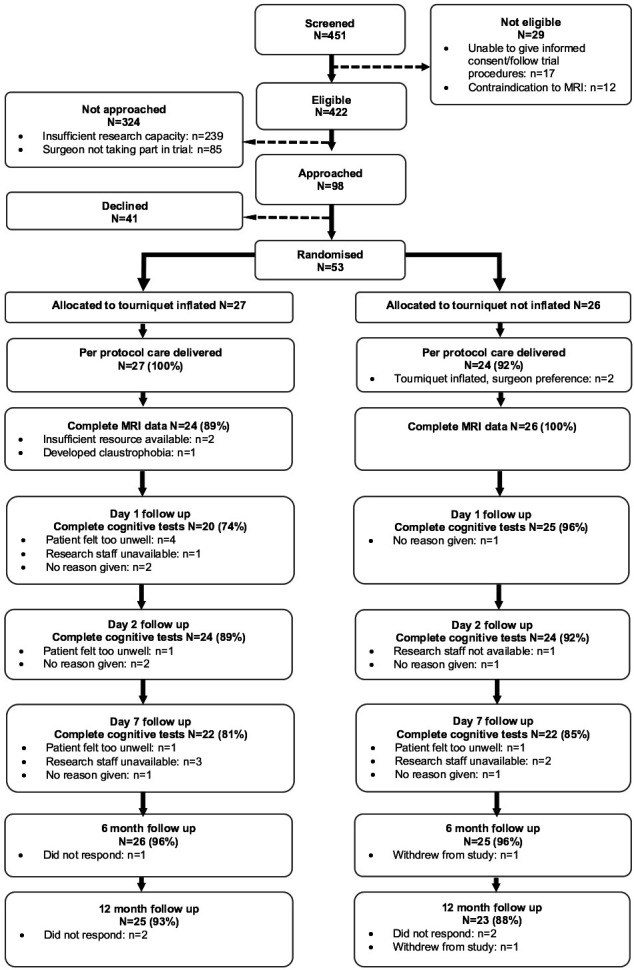
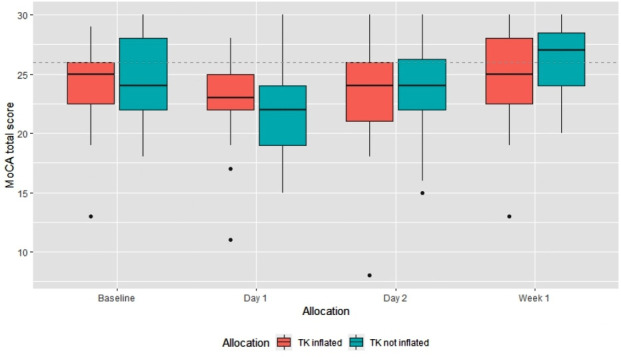
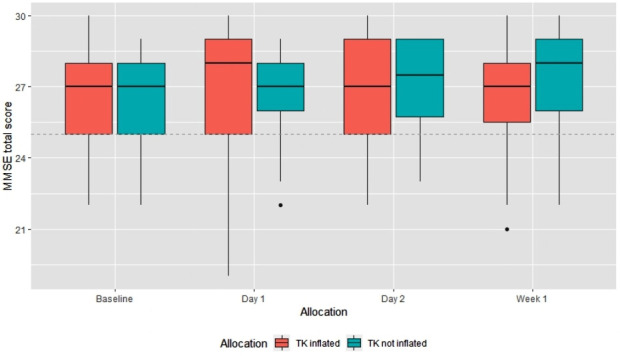
We randomised 53 participants (27 tourniquet inflated and 26 tourniquet not inflated). Fifty-one participants received care per-protocol (96%) and 48 (91%) were followed up at 12 months. One new ischaemic brain lesion was detected. Of the cognitive tests, MoCA was easy to summarise, sensitive to change with lower ceiling effects compared with OCS and MMSE. There was a trend towards more thigh pain (mean 49.6 SD 30.4 vs 36.2 SD 28 at day 1) and more AEs related to surgery (21 vs 9) in participants with an inflated tourniquet compared with those with a tourniquet not inflated.
A full trial is feasible, but using MRI as a primary outcome is unlikely to be appropriate or feasible. Suitable primary outcomes would be cognition measured using MoCA, pain and AEs, all of which warrant investigation in a large multicentre trial.
ISRCTN20873088.
在全膝关节置换术(TKR)中,常规使用止血带。它们可能会增加血栓栓塞事件的风险,包括脑栓塞、认知能力下降、疼痛和其他不良事件(AE)。因此,有必要进行一项随机对照试验来评估是否可以安全地避免使用止血带,但目前尚不清楚该试验是否可行。
在一项单中心可行性研究和初步随机对照试验中,接受 TKR 的成年人被随机分配接受充气止血带手术与非充气止血带手术。参与者在术前和术后 2 天内接受脑部 MRI 检查。我们使用简易精神状态检查(MMSE)、蒙特利尔认知评估(MoCA)和牛津认知筛查(OCS)评估认知功能,使用视觉模拟量表(VAS)在基线和术后第 1、2 天以及术后 1 周评估大腿疼痛,记录与手术相关的 AE 至 12 个月。
我们随机分配了 53 名参与者(充气止血带 27 名,非充气止血带 26 名)。51 名参与者按方案接受治疗(96%),48 名(91%)在 12 个月时接受随访。发现 1 例新发缺血性脑病变。在认知测试中,MoCA 易于总结,与 OCS 和 MMSE 相比,敏感性更高,天花板效应更低。充气止血带组的大腿疼痛程度更高(第 1 天平均为 49.6,SD 30.4;第 1 天平均为 36.2,SD 28),与未充气止血带组相比,与手术相关的 AE 更多(21 例 vs 9 例)。
全试验是可行的,但使用 MRI 作为主要结局不太合适或可行。适当的主要结局将是使用 MoCA 测量的认知功能、疼痛和 AE,所有这些都需要在大型多中心试验中进行研究。
ISRCTN20873088。