Geist Barbara Katharina, Xing Haiqun, Wang Jingnan, Shi Ximin, Zhao Haitao, Hacker Marcus, Sang Xinting, Huo Li, Li Xiang
Division of Nuclear Medicine, Department of Biomedical Imaging and Image-guided Therapy, Medical University of Vienna, Vienna, Austria.
Department of Nuclear Medicine, Chinese Academy of Medical Sciences and Peking Union Medical College Hospital, Beijing, 100730, China.
EJNMMI Phys. 2021 Jan 22;8(1):8. doi: 10.1186/s40658-021-00353-y.
The study aimed to establish a Ga-FAPI-04 kinetic model in hepatic lesions, to determine the potential role of kinetic parameters in the differentiation of hepatocellular carcinoma (HCC) from non-HCC lesions.
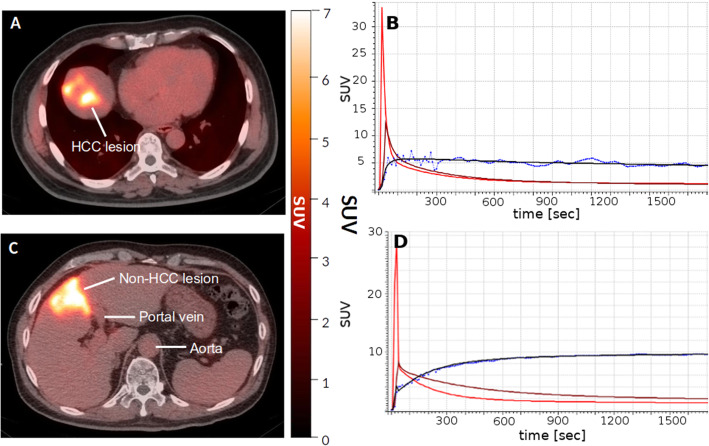
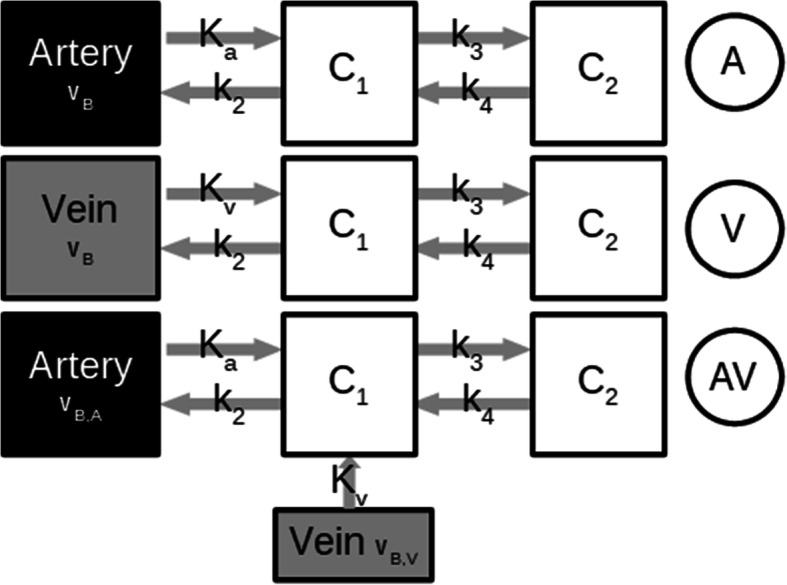
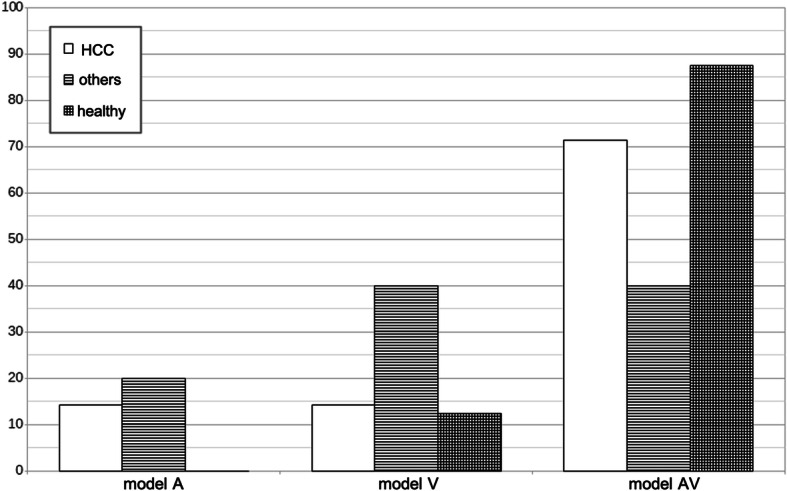
Time activity curves (TACs) were extracted from seven HCC lesions and five non-HCC lesions obtained from Ga-FAPI-04 dynamic positron emission tomography (PET) scans of eight patients. Three kinetic models were applied to the TACs, using image-derived hepatic artery and/or portal vein as input functions. The maximum standardized uptake value (SUV) was taken for the lesions, the hepatic artery, and for the portal veins-the mean SUV for all healthy regions. The optimum model was chosen after applying the Schwartz information criteria to the TACs, differences in model parameters between HCC, non-HCC lesions, and healthy tissue were evaluated with the ANOVA test.
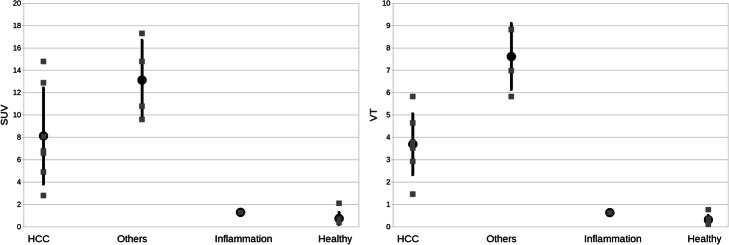
A reversible two-tissue compartment model using both the arterial as well as venous input function was most preferred and showed significant differences in the kinetic parameters V, V, and BP between HCC, non-HCC lesions, and healthy regions (p < 0.01).
Several model parameters derived from a two-tissue compartment kinetic model with two image-derived input function from vein and aorta and using SUV allow a differentiation between HCC and non-HCC lesions, obtained from dynamically performed PET scans using FAPI.
本研究旨在建立肝脏病变的镓标记的FAPI-04动力学模型,以确定动力学参数在肝细胞癌(HCC)与非HCC病变鉴别诊断中的潜在作用。
从8例患者的镓标记的FAPI-04动态正电子发射断层扫描(PET)图像中获取7个HCC病变和5个非HCC病变的时间-活性曲线(TAC)。将三种动力学模型应用于TAC,以图像导出的肝动脉和/或门静脉作为输入函数。取病变、肝动脉和门静脉的最大标准化摄取值(SUV),所有健康区域取平均SUV。将施瓦茨信息准则应用于TAC后选择最佳模型,采用方差分析评估HCC、非HCC病变和健康组织之间模型参数的差异。
同时使用动脉和静脉输入函数的可逆双组织房室模型最为合适,且HCC、非HCC病变和健康区域之间的动力学参数V、V和BP存在显著差异(p < 0.01)。
从静脉和主动脉的两个图像导出输入函数的双组织房室动力学模型得出的几个模型参数,使用SUV能够区分通过使用FAPI的动态PET扫描获得的HCC和非HCC病变。